



Witch's Apocalyptic Journey is a deckbuilding roguelite about experimenting with layered combat systems and saving a dying world. Check out our review to see what it did well, what it doesn't, and our overall impressions of the game.
Overview
What is Witch's Apocalyptic Journey?
Witch's Apocalyptic Journey is a deckbuilding roguelite set in the dying world of Aldrin. Players control Amelia, the Primordial Witch, who awakens with little memory of her past and is soon drawn into investigating a spreading corruption under the guidance of Krisna. Gameplay unfolds through repeated runs where players navigate branching routes, face enemies and bosses tied to different story paths, and gradually uncover more of the world’s mysteries. Combat is turn-based and built around highly customizable deckbuilding systems, with players assembling runs using expansion packs, companions, relics, and blessings that introduce a wide range of mechanics and synergies. A route-building system allows further control over each run’s structure, while progression between runs unlocks additional witches, cards, and customization options that expand available build variety.
Witch's Apocalyptic Journey features:
⚫︎ Turn-Based Deckbuilding Combat
⚫︎ Expansion Pack Build System
⚫︎ Route-Building for Run Control
⚫︎ Custom Card Creation System
⚫︎ Six Playable Witches
⚫︎ Relics and Blessings Modifiers
⚫︎ Branching Routes and Boss Paths
| Digital Storefronts | ||
|---|---|---|
 Steam Steam |
||
| $8.99 | ||
Witch's Apocalyptic Journey Review: A Rough But Worthwhile Journey
A Lot More Than It First Lets On

Witch's Apocalyptic Journey doesn’t waste much time before showing just how much it has crammed under the hood. What looks like a fairly straightforward deckbuilding roguelite quickly turns into something far denser, packed with expansion packs, companions, route-building mechanics, customizable cards, and a growing roster of witches to experiment with. There’s always something else to tweak, break, or build around, and runs quickly turn into that familiar loop of “okay, what happens if I try this instead?”
Set in the dying world of Aldrin, players take control of Amelia, the Primordial Witch, as she gets dragged into investigating a spreading corruption across the land. The story isn’t the main attraction here, but it does enough heavy lifting in terms of mystery and worldbuilding to keep each run from feeling like pure mechanical repetition.
All of that content is both the game’s biggest strength and its most obvious double-edged sword. Witch's Apocalyptic Journey gives you a lot of freedom in how you approach each run, but it also takes its time before letting you actually get your hands on some of its more interesting toys.
Depth Through Experimentation
The first thing that struck me about Witch's Apocalyptic Journey was just how much there is to dig into. What initially looks like a fairly straightforward deckbuilding roguelite quickly unfolds into a surprisingly dense experience packed with expansion packs, companions, relics, blessings, route-building mechanics, multiple playable witches, and even a custom card creation system. It feels like the game is equipped with an abundance of tools for players to experiment with, and figuring out how those systems interact ended up being one of the most enjoyable parts of the experience.
Combat itself remains accessible despite the sheer amount of customization on offer. Battles are entirely turn-based, giving players all the time they need to think through their options without timers or real-time pressure. The real depth comes from the expansion pack system, which acts as the backbone of most builds. Players bring a selection of packs into each run, each introducing its own mechanics, synergies, and playstyles. Some lean into status effects, others reward aggressive combo setups, and many become significantly stronger when paired with specific companions or witches. Figuring out these interactions often feels just as satisfying as actually clearing encounters.
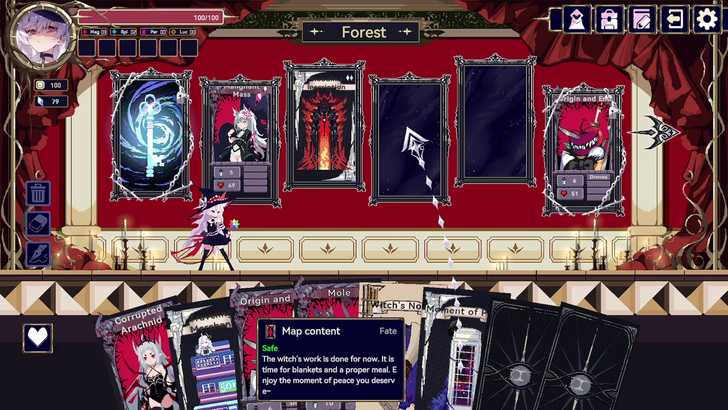
Runs are further shaped by the game's route-building system and a variety of supporting mechanics like relics and blessings that add additional modifiers along the way. Rather than following a fixed path, players use cards and frames to influence what encounters appear ahead. That opens up a surprising amount of planning before combat even begins—whether you're aiming for merchants, chasing Witch's Notes for lore, grabbing rewards, or setting yourself up for specific challenges. Combined with multiple routes and distinct final bosses, each run manages to stay varied enough that you're not just repeating the same deck over and over.
The most distinctive mechanic, however, is the custom card system. Players can design their own cards by assigning effects that trigger when drawn, played, or discarded, allowing for a high degree of personalization. There are limits in place to prevent things from spiraling completely out of control, but it still leaves plenty of room for creativity. It’s easily one of the game’s standout features and reinforces the feeling that Witch's Apocalyptic Journey treats deckbuilding more like a sandbox than a rigid puzzle.
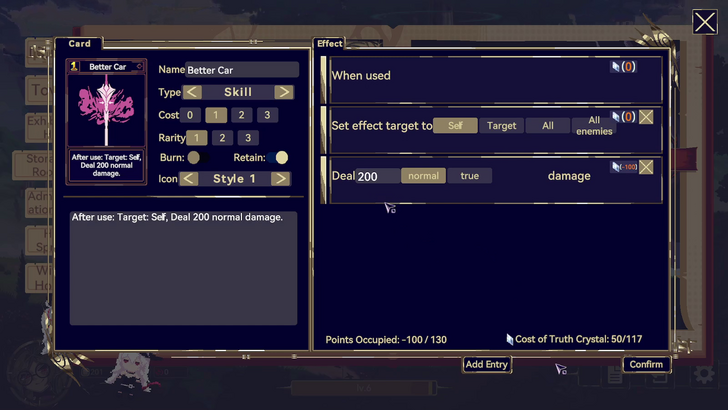
That said, the same emphasis on experimentation is also where the game's biggest friction point shows up. Nearly every major progression system is tied to Truth Crystals, a shared currency used to unlock witches, companions, expansion packs, difficulty modifiers, upgrades, and custom card options. While not especially scarce in isolation, the number of competing uses can make experimentation feel more restricted than it should be. Instead of freely testing new combinations, I often found myself weighing whether a purchase was worth slowing down progress elsewhere.
It never becomes a dealbreaker, and there’s still plenty of content available from the start. But in a game that thrives on letting players discover new strategies and combinations, tying so much of its depth behind a single progression currency occasionally works against it. Witch's Apocalyptic Journey ultimately offers a huge amount of freedom—but it sometimes takes longer than it should before you can actually access all of it.
A Story Still Coming Together
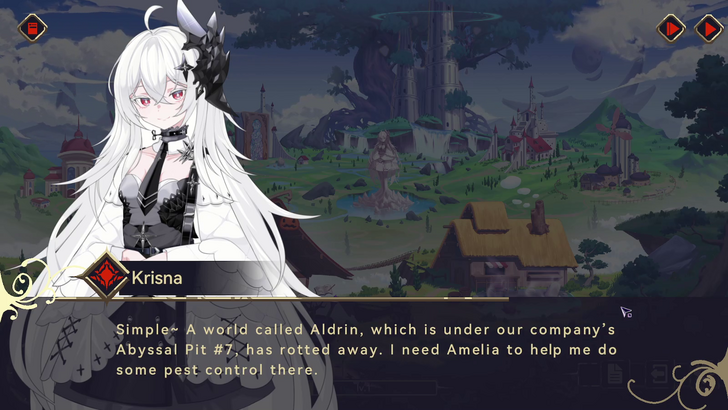
I wasn't expecting to come away from Witch's Apocalyptic Journey with much to say about its story, but the game ended up offering more narrative substance than I initially anticipated. Set in the dying world of Aldrin, players take control of Amelia after she awakens with little memory of who she is. Before she can spend too much time figuring that out, however, she's quickly roped into investigating the corruption spreading across the land by her friend Krisna, whose definition of friendship seems to involve handing out dangerous jobs at the earliest opportunity.
While the central premise is fairly straightforward, the game's worldbuilding does much of the heavy lifting. Aldrin is a world on the brink of collapse, filled with competing factions, strange creatures, and mysteries that gradually reveal themselves through Witch's Notes and the various routes available throughout the game. You can also catch glimpses of Amelia interacting with the residents back in town after runs through light, often comedic exchanges that give the characters a bit more personality outside of the main runs.
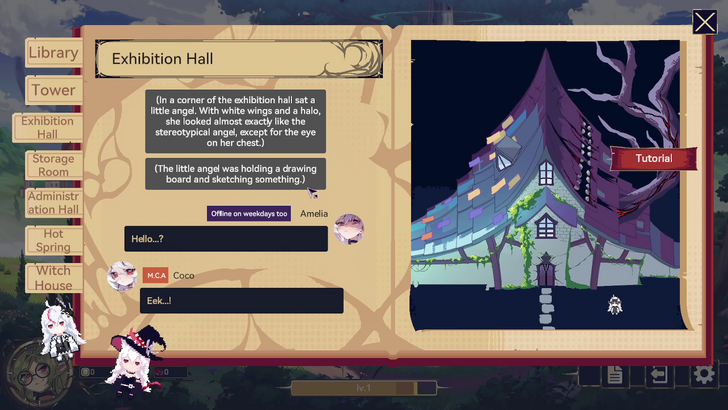
These smaller moments do a lot to make Aldrin feel more lived-in than its darker setup might suggest. Despite the setting's heavier themes, the writing regularly throws in moments of humor and levity, which helps keep things from getting too grim for its own good. The different routes also give you alternate perspectives on what’s going on across Aldrin, which is a nice excuse to go back in beyond just trying out new builds.
Unfortunately, the story currently feels somewhat incomplete due to the inaccessible Story Mode. There is enough lore and worldbuilding here to remain engaging, and several plot threads hint at larger mysteries surrounding both Amelia and the world itself. However, without access to what appears to be a more dedicated narrative experience, it often feels like players are only seeing part of the picture. What's present is still enjoyable, but it's difficult to shake the feeling that the story has more to say than it's currently able to show.
When Presentation Hits Harder Than It Misses
For all its strengths, Witch's Apocalyptic Journey can be surprisingly rough around the edges. The game’s strong presentation is occasionally interrupted by issues like text spilling outside dialogue boxes, some cramped menus, and a handful of untranslated Chinese text during my playthrough, which can sometimes hide information that’s actually useful and make certain prompts or details a bit annoying to figure out on the spot unless you go digging for a translation. None of it is game-breaking, but it’s the kind of thing that keeps popping up just enough to remind you the game still needs a bit more polish.
That said, the village hub immediately stands out in a good way. While most of the game leans on pixel art, the village menu uses detailed character illustrations that give each resident far more personality than I expected going in. It’s a small touch, but combined with the colorful UI and fantasy framing, it makes Aldrin feel a bit more like a place you’re actually passing through between runs rather than just a menu screen.
If there’s one area where Witch's Apocalyptic Journey really punches above its weight, it’s the pixel art. Character sprites are expressive, enemy designs are varied, and attacks are communicated clearly even when things get chaotic. Combat animations themselves are fairly simple—mostly relying on sprite movement rather than flashy effects—but it honestly didn’t bother me much in practice. Once fights get going, the combination of effects, screen shake, and sheer visual clutter makes everything feel surprisingly energetic anyway.
Audio is where the game really locks in its impact. Sword clashes land with a sharp metallic crack, deflections feel clean and intentional, and heavier attacks carry enough weight to make even routine fights feel meaningful. Even simple actions like finishing blows or strong hits have a satisfying punch to them thanks to how well the sound design sells each impact. It’s the kind of audio work that makes up for a lot of what the visuals keep relatively restrained.
Overall, even with the occasional UI and localization hiccups, Witch's Apocalyptic Journey leaves a stronger impression than you’d expect from a deckbuilding roguelite like this. Beneath the rough edges is a presentation that genuinely does a lot of work in making both its world and its combat feel alive.
Is Witch's Apocalyptic Journey Worth It?
Keeping the Journey Going

Witch's Apocalyptic Journey is one of those games that's easy to lose hours to without realizing it. Between its expansive deckbuilding systems, wealth of unlockable content, and impressive amount of build customization, it constantly encourages experimentation and rewards players willing to engage with its many mechanics. Every successful run feels like an opportunity to discover something new, while its layered progression systems ensure there is always something else to work toward, even if not everything is immediately within reach.
That isn't to say the journey is without its bumps. The Truth Crystal progression system can occasionally make experimentation feel more restrictive than rewarding, while UI issues, text overflow, and untranslated strings are constant reminders that the game still needs a bit more polish. The story also shares in these uneven edges, with intriguing worldbuilding and memorable characters occasionally undercut by Story Mode chapters that remain inaccessible during normal play.
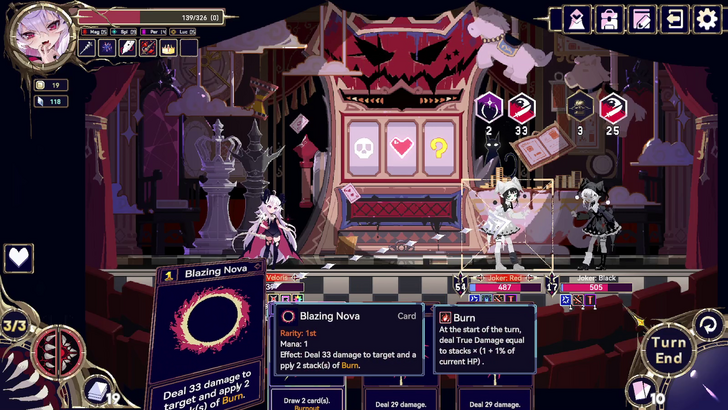
Even so, Witch's Apocalyptic Journey consistently succeeds where it matters most. Its deckbuilding systems offer a huge amount of room for experimentation, its world is packed with enough mysteries to keep you invested, and its surprisingly strong pixel art and combat audio give every run a lot more personality than you’d expect at first glance.
At the end of the day, I’d still recommend it. It’s not the smoothest experience, and it definitely has its rough edges, but if you’re into deckbuilding roguelites, there’s more than enough here to make it worth your time sinking into.
Game8 Reviews