



Wabisabi Sushi Derby is a racing and stat-training game where chefs compete to create the best running sushi in the galaxy. Read our review to see what it does well, what it doesn’t, and our overall thoughts on the game.
Overview
What is Wabisabi SushiDerby?
Wabisabi SushiDerby is a 2D single-player racing and stat-training game developed by ITAMAE STUDIO and published by Kodansha Ltd. The game is set in a reality where sushi has become the most popular food in the galaxy, and sushi chefs make a name for themselves by competing in organized sushi races.
Wabisabi SushiDerby features:
⚫︎ 38 Playable Sushi Types
⚫︎ 5 Racing Tiers
⚫︎ Unlockable Difficulty
⚫︎ 27 Races
⚫︎ Pixel Art Style
| Digital Storefronts | |
|---|---|
 Steam Steam |
 Switch Switch |
| $4.99 | |
Wabisabi SushiDerby Review | It's Huge Fun in Bite-Sized Bursts
Intergalactic Horse-Sushi Races
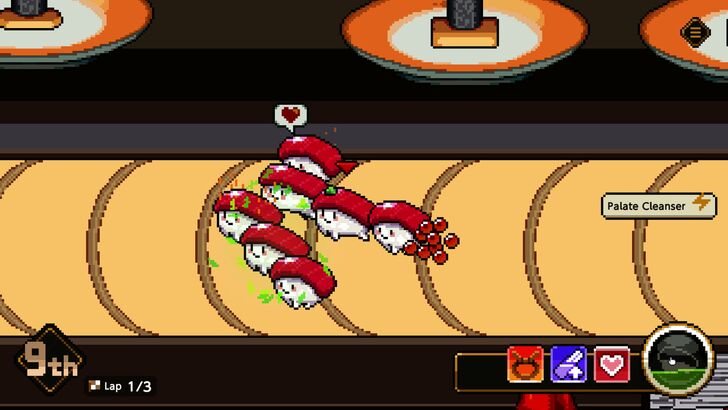
Wabisabi SushiDerby places you in a world where sushi has become an intergalactic craze. Your goal is simple: to become the best sushi chef in the world. How? By winning sushi races, of course. Yes, it’s an odd premise all around, but this game isn’t about sticking to norms and following formulas.
It’s a racing game where you don’t even get to steer. Tough sell, I know, but just a few minutes with Wabisabi SushiDerby made me realize that to judge it through the lens of a racing game would be doing it a disservice. It plays much closer to Uma Musume: Pretty Derby than Need for Speed, but horse-girls and horse-sushi don’t really match up that well either.
There really isn’t a great comp for this game, and that’s fitting for the title: "Wabi-Sabi," the concept of finding beauty in uniqueness, transience, and imperfection. So much of the game’s appeal lies in what makes it different, from its nonsensical premise and four-legged sushi to its auto-racing mechanics and light incorporation of roguelite elements.
Just Roll With It
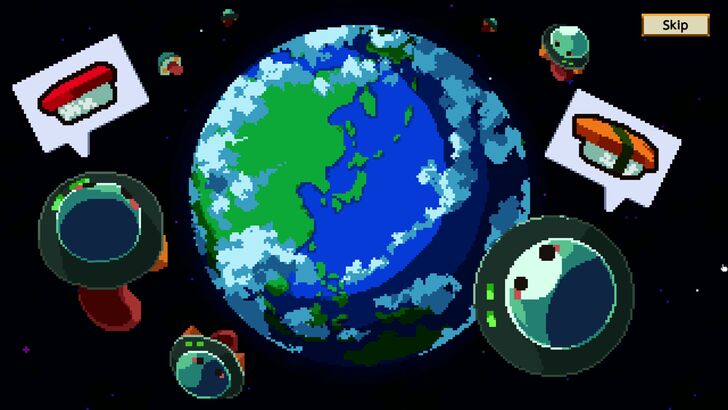
The narrative background of the game can be difficult to wrap your head around. Aliens have discovered and fallen in love with Earth sushi, and now sushi has become the most popular food in the galaxy. Now, humans around the world are taking advantage, training to become sushi chefs so they can make a fortune… racing sushi? We obviously missed a couple of steps there, but the game is aware of that and amusingly refuses to acknowledge it outright.
After providing the backstory of why the sushi scene had become so competitive, Wabisabi SushiDerby never revisits the story. You’re simply tasked with winning the “S1 Galaxy Cup,” and, honestly, the game doesn’t need more. It gives you a bit of narrative motivation, then it lets its stellar gameplay carry the experience. If anything, the lack of cutscenes was a boon, as I could lock in on the wonderfully addictive grind.
Roll, Race, Repeat
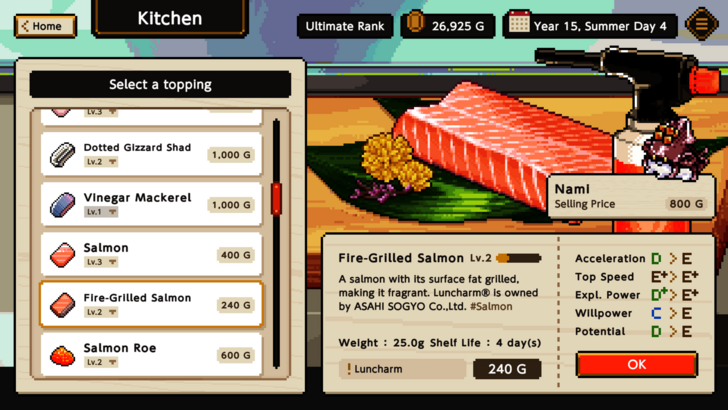
The gameplay loop is extremely short and fast-paced. First, you select a topping for your sushi, which determines its starting stats and abilities. Then, every day, you get the chance to spend money and train your roll. After that, it’s off to the races. Rinse and repeat.
You start with just three potential toppings, but the list rapidly grows as you progress, eventually maxing out at 38(!!!) toppings. What makes this truly impressive is the actual variety. There are some similarities across the lot, but they mostly play in uniquely flavorful ways.
Shrimp rolls tail-whip trailing sushi, squid ones squirt blinding ink, and wagyu beef rolls bullrush through crowds. The list goes on. Instead of just being a completionist’s checklist, the sushi unlock screen became an incredibly exciting thing to progress through. From start to finish, I was so excited to unlock and try new toppings because it kept the game feeling fresh.
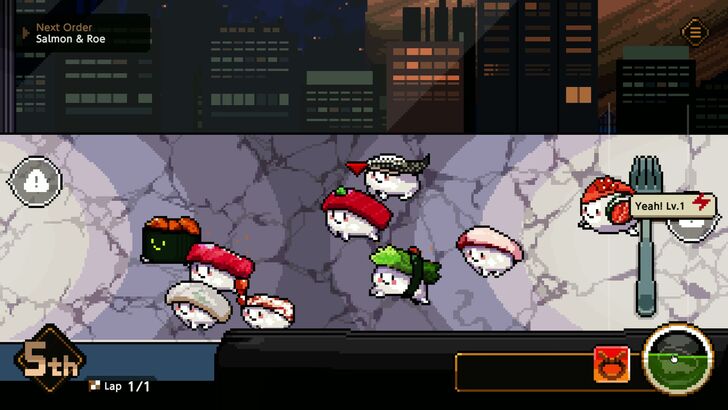
Once you have your sushi, you get to train it once before every race. This is what makes every piece of sushi you mold distinct. Through training, you can improve your sushi’s performance stats and augment its abilities. This was right up my alley as a roguelite enthusiast.
With each in-game day, I loved seeing what overpowered (or utterly ineffective) combination of abilities and stats I could put together. I usually ignored first- and last-lap buffs, but through sheer luck, I once ended up with a build that stacked them. Suddenly, I had a broken setup for single-lap races. It made every training session feel like an opportunity to discover a new strategy instead of an attempt to repeat the optimal build.
Lastly, we have the actual racing. You have little control of your sushi during races. You can’t jump, brake, or even steer manually. What you can do is activate abilities and cheer to give your racer a brief boost. By stripping away most of the control, the game forces you to hyper-focus on timing just a few clicks per race, providing a racing experience that I found uniquely challenging and surprisingly engaging.
Not Your Typical Racing Game
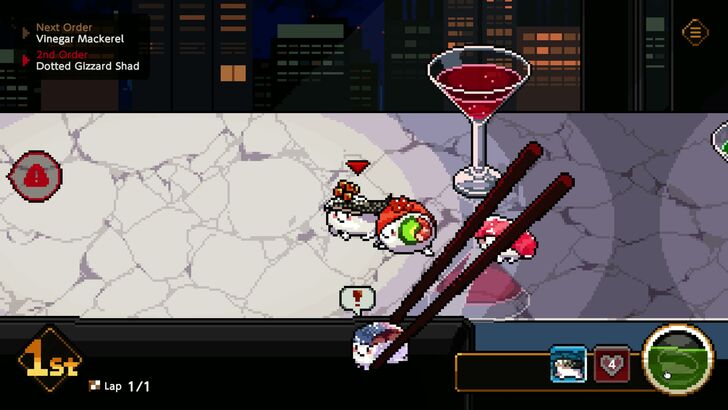
During races, the sushi will run automatically and carelessly navigate themselves through the course. As they run through the track, customers will place orders at set spots, meaning if sushi of a certain kind enters the area, a pair of chopsticks will come hovering in to take them away. If your sushi is taken, you instantly lose the race and your sushi, meaning you’ll have to create and train an entirely new one.
The player’s only job here is to click on a couple of buttons to activate abilities and cheer your sushi on, giving them an instant speed boost when evading chopsticks. With so little to do every race, I was worried that the racing portion of the game would become mind-numbing, but I was dead wrong.
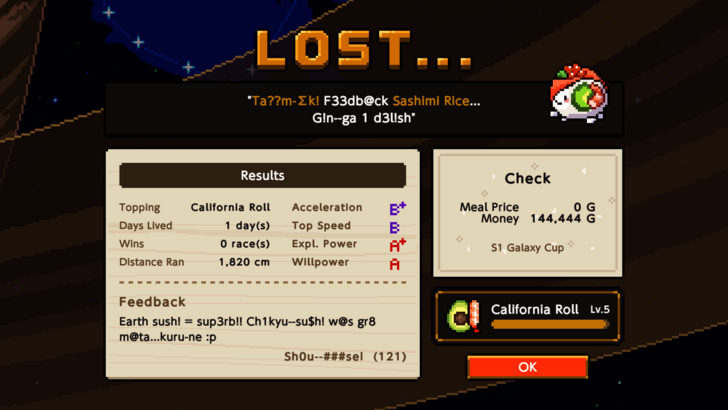
With all the intricacies of controlling a racer gone, racing here became a game all about timing. As I got to know each track, I figured out the optimal spots to boost, where orders are placed, and how obstacles affected the racers. With that, I had to track every little thing going on. A mistimed cheer could mean the difference between a decisive victory and getting unceremoniously gobbled up.
I’d be lying, though, if I said that it didn’t get mildly infuriating at times. No lead was safe, and sometimes, that was purely because of the lack of control. Sushi will try to avoid obstacles, but they’re not very good at it. One time, my California Roll was sitting on a healthy lead, but it hit a service bell, and instead of course-correcting, it bounced off and proceeded to hit it three more times before being pushed by an opponent. My sizeable lead turned into a 6th-place finish, and I had zero control or fault in it. The frustration rarely lingered because of how fast the game moves on, but expect some ragequit-worthy moments.
Worth Fine-Tuning the Recipe
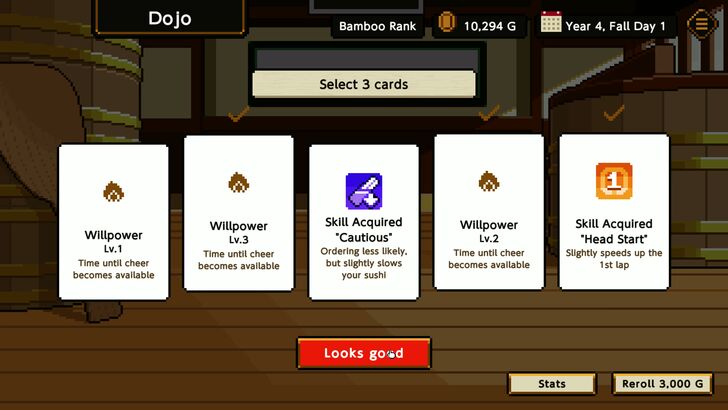
There are four main stats to keep track of when choosing and training sushi. The first two, Acceleration and Top Speed, are self-explanatory. Third, Explosive Power determines how significant a speed boost your sushi gets when you cheer. Lastly, Willpower reduces your cheer cooldown.
You can improve your sushi’s stats by having them train. Every day, you can choose from 4 random training regimens, each providing 5 possible stat upgrades or additional skills. You’ll then choose 3 to apply. If your sushi is eaten mid-race, these upgrades disappear. If your sushi survives, its stats will decrease, but you’ll get to train it again.
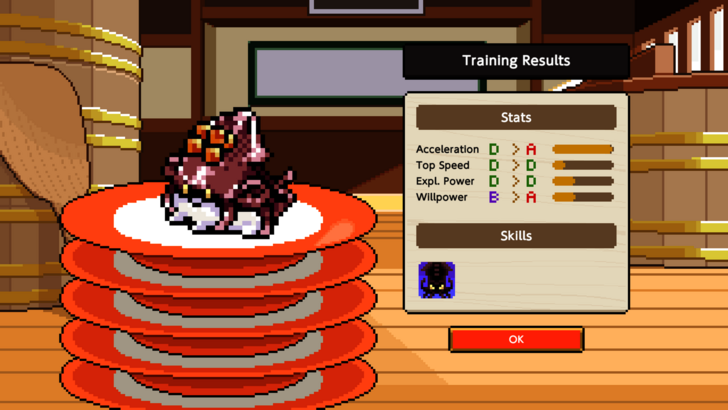
It’s a simple system that was expertly executed. Because training is slightly randomized, I was rarely handed the exact build I wanted. Instead, I had to constantly adapt to what was offered, and the impact of each decision felt very real. But because these upgrades were temporary, I felt free to experiment, fail, and find what really works.
It’s remarkable how balanced these stats feel. None of them stand out as more important than the others, and there’s a visible difference in how sushi performs, depending on which stats I choose to focus on or ignore.
This doesn’t mean that an all-around build is always ideal. Different tracks rewarded different builds. For drag races, I looked to invest heavily in top speed. For tracks with a lot of order spots, I looked for Willpower upgrades to boost often in case RNG wasn’t in my favor. I loved how the stats system added real depth to gameplay beyond just “number goes up.”
That’s One Big Menu
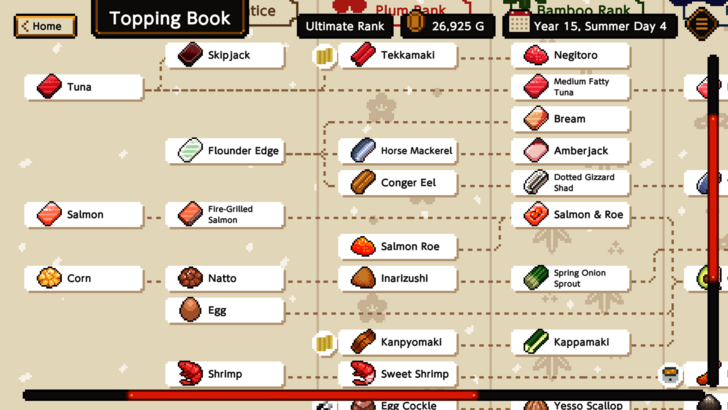
I don’t think I could rattle off 15 kinds of sushi off the top of my head, and Wabisabi SushiDerby more than doubled that. Again, the game has 38 distinct toppings to choose from, and while I definitely had my favorites, I can honestly say that they’re all worth at least trying out for a couple of races.
Using abilities is a hugely impactful part of each race, and most toppings provide a unique set. The basic sushi toppings have one or two distinct abilities, but the more complex rolls put these together in interesting ways. What’s more is that you can mix and match abilities through training, making each roll truly unique.
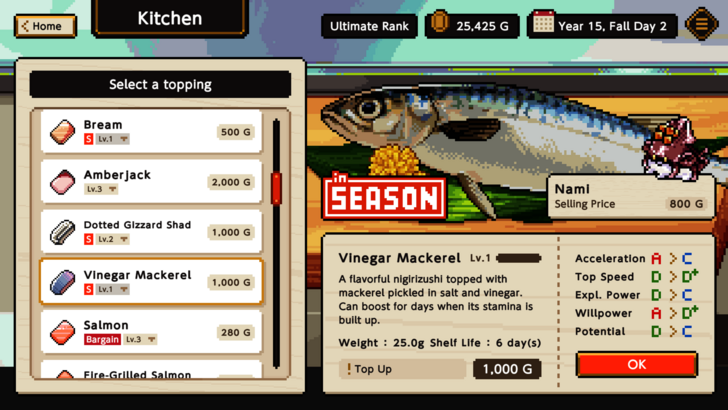
The game incentivizes you to try every topping, too, beyond just being a prerequisite for unlocking better toppings. First, certain toppings will go on sale or be in season, meaning they get a slight performance boost to nudge you into trying them out.
The real incentive lies in the optional restricted races, where you're faced with limitations like using only tuna-based sushi, vegetarian sushi, or cheap sushi. These races had me trying toppings I otherwise would have ignored, and they opened me up to new strategies. When everyone has the same abilities or stats, how can I stand out? I loved racking my brain to get through those challenges.
Because of this variety, the game never felt old in my entire near-100% achievement playthrough. Even when I was just spamming Tuna for more than an hour because I was stuck on one of the endgame challenge races, I never got sick of the loop. While I ended up having a general strategy ready, each race would still be unpredictable because of my opponents’ and my own abilities.
Beautiful to Look At, Clunky to Navigate
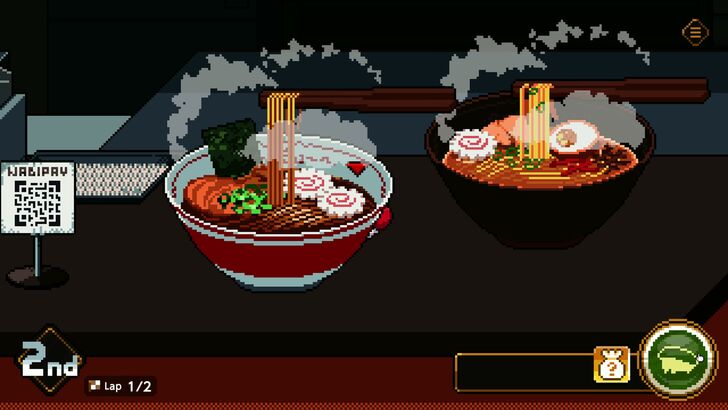
Wabisabi SushiDerby’s pixel art style is stunning. Yes, the sushi is adorable, but most everything else in this game is gorgeous. My jaw dropped when I saw the ingredient renderings in the Kitchen menu. And even during the races, if you can spare a second to admire the backdrops, you’ll find beautifully detailed illustrations and environments that feel vibrant and alive.
Itamae nailed the art, but the functional side of the visuals falls short. There are 27 races and 38 sushi toppings to choose from, and both are displayed in single-file lists that show just a handful of entries at a time. No filters. No sorting options. Scrolling through those two lists to find what I was looking for felt needlessly cumbersome. I had to eventually memorize where everything was just to make things a bit easier. I wish the interface had offered a more elegant solution.
Missed the Mark with Audio

There’s not much to say about Wabisabi SushiDerby’s soundtrack. Each racetrack is accompanied by unique music, but nothing actually impresses. None of the tracks are bad either. They’re kind of just there. It’s fun, energetic music that inoffensively gets the job done.
The same can largely be said about the game’s sound effects. They’re cute and amusing, but they’re largely non-functional. There isn’t even an audio cue for when your sushi’s about to get abducted by an oversized pair of chopsticks. Do you know how many times my sushi got devoured because I had my eyes glued to my cooldown meters? Too many times. A little audio cue would have been nice. It’s an easy feature to overlook, but I undeniably felt its absence in more than a few races.
Is Wabisabi SushiDerby Worth It?
Buy This Over Real Sushi
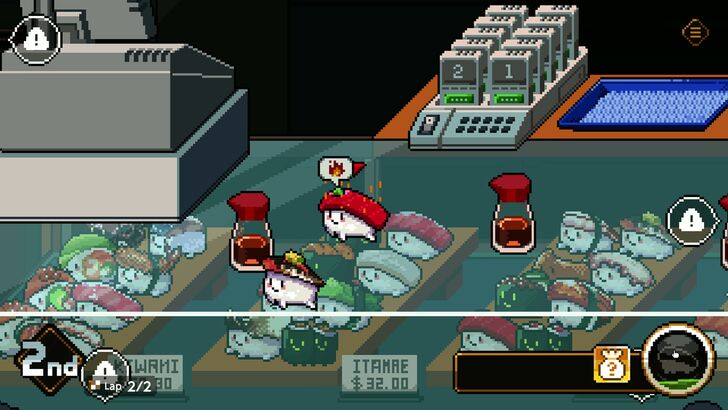
At just $4.99, Wabisabi SushiDerby is cheaper than an actual meal at a Japanese restaurant, and you’ll likely be enjoying this way after you’re done digesting your lunch. It’s easily worth the price.
It’s a 6 to 8-hour game, but the gameplay is so addictive that you shouldn’t be surprised if you end up coming back for more just for fun. You’ll also unlock the Catastophe difficulty after finishing the game once, so if you’re hankering for more sushi, there’s a worthwhile challenge to be had. Even the first race took me a few attempts to win, so it’s not unlikely for this mode to double your playtime.
FAQ
Is Wabisabi SushiDerby multiplayer?
No, Wabisabi SushiDerby is an exclusively single-player game.
What are the System Requirements to Play Wabisabi SushiDerby on Steam?
The System Requirements as listed on Steam are as follows:
| Specifications | Minimum | |
|---|---|---|
| OS | Windows 10 | |
| Processor | Intel Core i5 | |
| Memory | 2MB RAM | |
Game8 Reviews

You may also like...
 |
Umamusume: Pretty Derby |
 |
Dave the Diver |
 |
Everything is Crab |
 |
Vampire Crawlers: The Turbo Wildcard |
 |
Pokemon Champions |