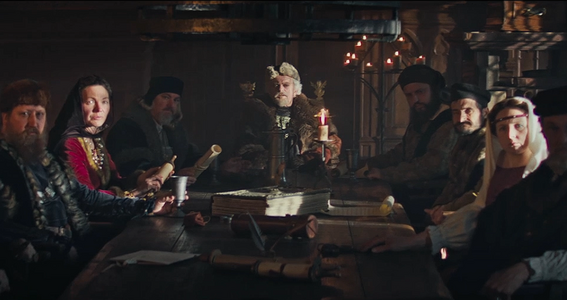




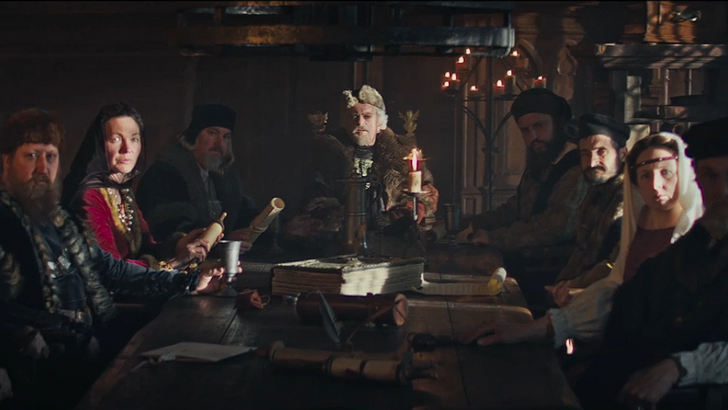
The Guild - Europa 1410 is a grand strategy game where you manage your own business in early 15th-century Europe. Read our review of its early access build to see what it did well, what it didn’t do well, and if it’s worth trying.
Everything We Know About The Guild - Europa 1410
The Guild - Europa 1410 Story
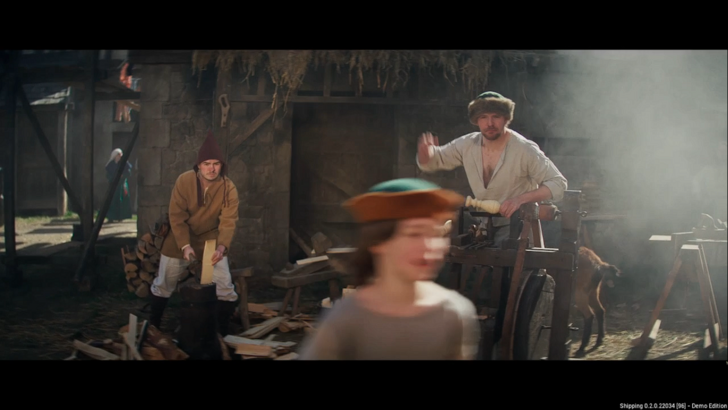
The Guild - Europa 1410 doesn’t have its own story to tell. Rather, the player gets to make every decision in their run through a 15th-century European peasant’s lifetime over the course of multiple turns. From the nature of their craft, to their spouse and heir, players can determine their lifepath as a simulated European nation hustles and bustles around them.
The Guild - Europa 1410 Gameplay
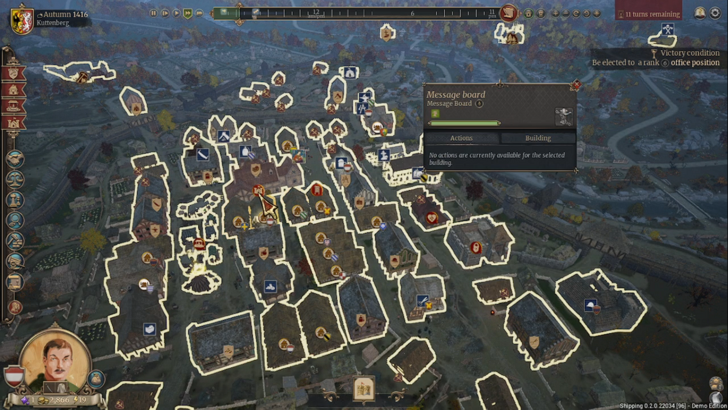
The Guild - Europa 1410’s gameplay combines grand strategy with point-and-click resource management, allowing players to play a constant game of profit margins, demand, supply, and the improvement of their craft as the days pass. As they create new items and provide services to gain coin, players can work toward their chosen goals, be it high office and lawmaking for their town, or simple, honest mercantile work.
The Guild - Europa 1410 Release Date and Time
Hitting Early Access Shelves on July 16, 2026
The Guild - Europa 1410 is slated to release exclusively for Steam’s Early Access on July 16, 2026. The game’s 1.0 release date is yet to be announced by the game’s developers, but we’ll update this article with that information as soon as it is available.
| Digital Storefronts | |||||||
|---|---|---|---|---|---|---|---|
 Steam Steam |
|||||||
| Wishlist Only |
The Guild - Europa 1410 Review [Demo]: Not So Grand, But No Less Great, Strategy
Sitting Around's Never Been This Fun
I will forever be thankful for the technology given to us by the modern era, but sometimes, amidst the hustle and bustle of modern capitalism, one feels the need to "return to monkey", as it were. Of course, one would still want the level of control and freedom a modern citizen is afforded, something the yesteryears simply did not have for many. What’s a disenchanted peon of the elite to do?
Enter The Guild - Europa 1410, a grand strategy game that’s not so grand, but no less great. Set in the first few decades of 15th-century Europe, The Guild—which is what I’ll be referring to this game as henceforth—gives you all the tools you need to flourish as a tradesperson mastering their craft.
Truth be told, it’s a lot of sitting around and waiting. It’s anything but unrewarding, though, and you’re granted a very fine brush to paint the image you want of 15th-century life. Everything from simple craftsmanship to politics and espionage is at your dirt-crusted fingertips with this game, so let’s get to what this demo has in store.
Tricking Out Your Trade in 15th-Century Europe
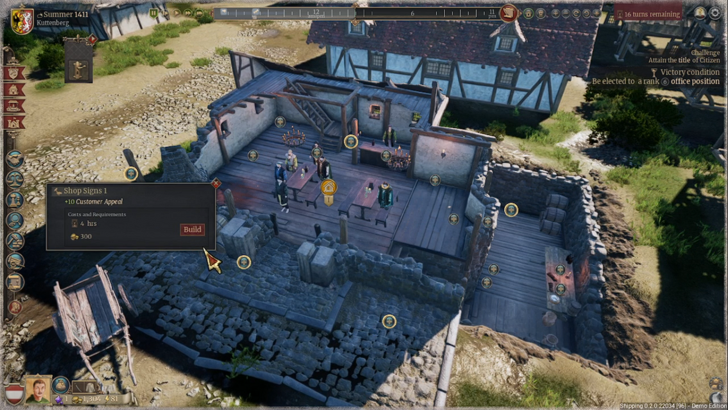
The Guild is a life-sim mixed with the depth of a grand strategy game and the day-to-day operations of a shop simulator. What shop that ends up being is the first choice you’ll have to make when you start a new game. For the demo, you’re given the choice between being a Smithy, an Alchemist, or an Innkeeper. It doesn’t sound like a lot of choices, but it’s actually quite generous once we get to the gameplay, since each of the three is a multiple-hour run in and of itself.
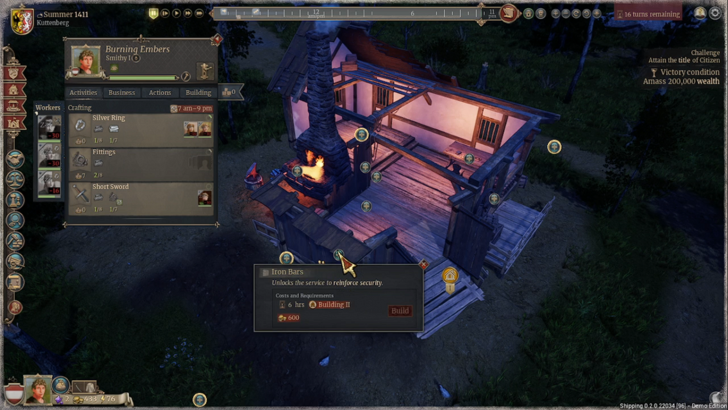
I first went with being a Smithy, because nothing says 15th-century like the clanging of metal and the heat of the forge, at least in my book. With the tutorial for controls done, I got a good look at my ramshackle store, my only apprentice, and the firelit hole I called a forge. Humble beginnings, as far as shops go, but that’s enough for me to get cracking.
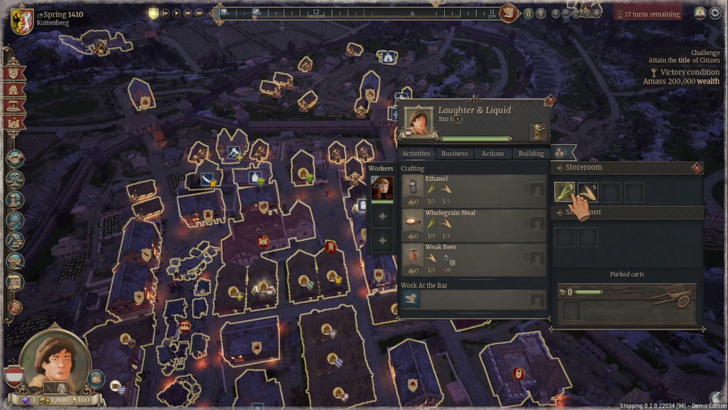
From here, the story is yours to tell, and I mean that in the most literal sense. See, The Guild isn’t just about the constant push and pull of supply and demand, nor is it just about the management of your production through careful assignment of your available workers. No, it’s also about living in this era, and what all that entails.
Deceptive Depth with Satisfying Payouts
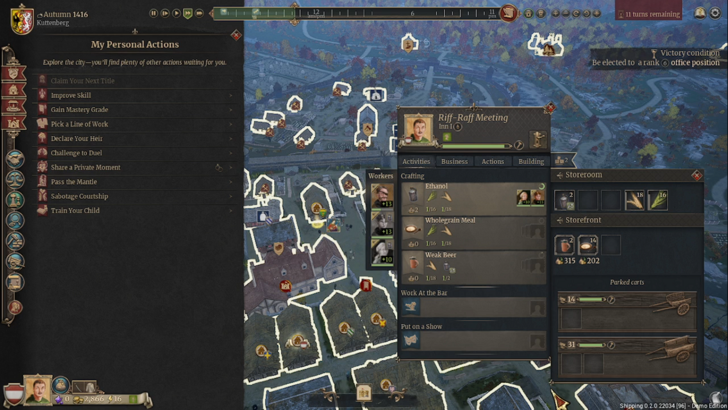
The Guild has a deceptive depth to its gameplay that’s revealed to you in layers. Confusing layers, which we’ll get to later, but the genius of it is that it unfolds as if you were a young adult learning how the world works for the first time. It starts off as a simple, closed-off task—say, managing a quaint smithy at the outskirts of town—then it becomes more complex as the world reveals itself to you through your goals.
Going to the market to buy materials reveals the possibility of your carts being waylaid to and fro, which, in turn, reveals the game’s dynamic law system that may make an action legal one turn, and illegal the next. This, then, reveals the nature of "turns" in this game, and how they’re 24-hour blocks of time that dictate many more systems at play, such as your business’s operational hours, what services are available to you, peak business hours, and the like.
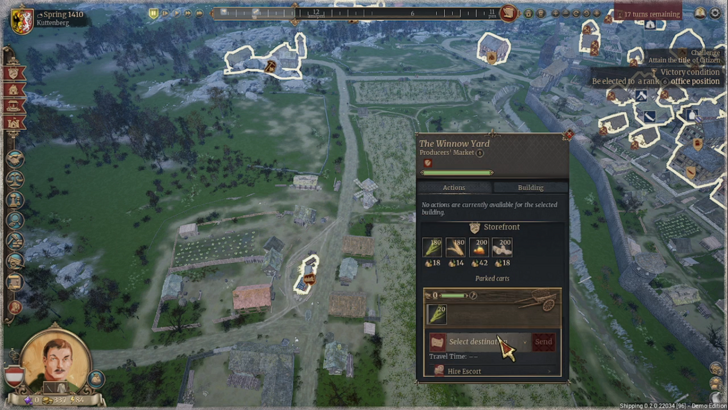
There are many, many, MANY more things we could go off of here, and that’s just from the simple act of buying some iron to make an undoubtedly poor dagger. There’s your personal energy for specific actions that bestow bonuses, worker loyalty and performance, accident chance, sanitation, worker productivity, salaries, skill learning, promotions, trade licenses…well, you get the idea.
Zooming out a little bit, you’ll soon find that there’s more to this game than just running your store and producing goods. You can socialize and curry favor from strangers, court a spouse and be wed within the next turn, gain an heir, and establish your legacy. Heck, even run for office, if you’re so inclined. That’s the beauty of The Guild in a very densely packed nutshell: choice.
I started out as a humble Smithy who paid for escorts out of pocket with every delivery to deal with thugs trying to steal my merchandise. To end this constant pain, I curried enough favor through church donations to be voted into the lowest political office possible. From there, I bought a spyglass for my home, gathered evidence of crimes, and sold evidence on the side as a spymaster of sorts in addition to having my smithing business expand to a bigger store.
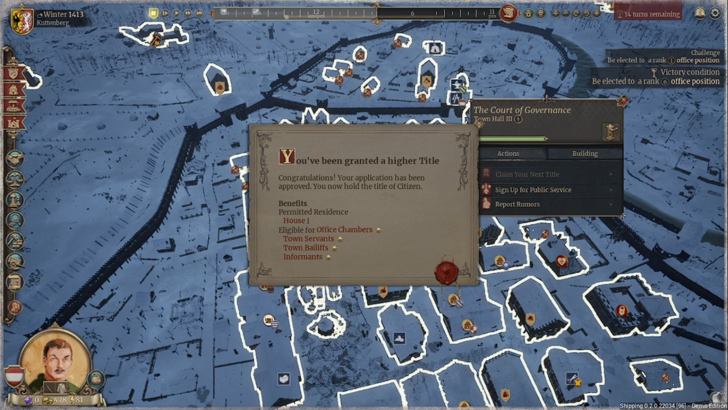
Never could I have ever expected that outcome for me, and I severely underestimated how much I could achieve in this game. The Guild’s depth is deceptive, but rewarding, and all the sitting and waiting is likely to reward you with a good life in the long run. More than the simple goal of making more money––though that is an option—you can take some wacky routes to the life you want in a Baldur’s Gate 3 kind of way, through incremental changes in opinion and status.
Keep in mind, this is just a demo. I couldn’t even play in other counties yet, let alone professions outside the three this demo gives you. No second stores, no secondary professions, and you’re limited to 17 turns only, regardless of how well you do. And yet, I got away with so much already, and remain thirsty for more.
Confusing to Start, But Gets Easier the More You Play
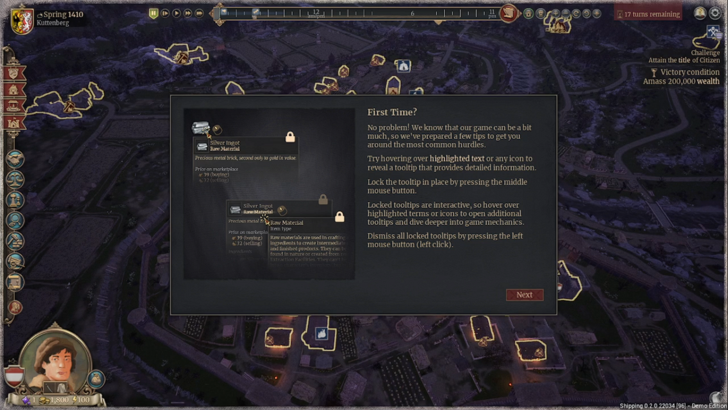
Unfortunately for The Guild, though, depth is a double-edged sword that few can wield unscathed. For all the choices you are given and the reverberating consequences they carry, there are about 10 unanswered questions the average player will have as the day-to-day of their playthrough apathetically continues.
The Guild has a tutorial problem. As I said earlier, the game reveals itself in layers, only mentioning specific mechanics in tutorial pop-ups as players mouse over them or as turns pass. Now, this works well with many games because these mechanics don’t matter before they’re talked about. In The Guild, however, many things are at play long before you get to know them, and the consequences of not knowing when you should’ve is likely to end your medieval life in the historically correct way: early.
That’s not to say that The Guild lacks tooltips or a means to teach the player. No, they just need a more comprehensive breakdown of the game’s mechanics; the daily goings-on that may not be the most important thing at the start, but should be attended to lest it fester into a game-ending consequence.
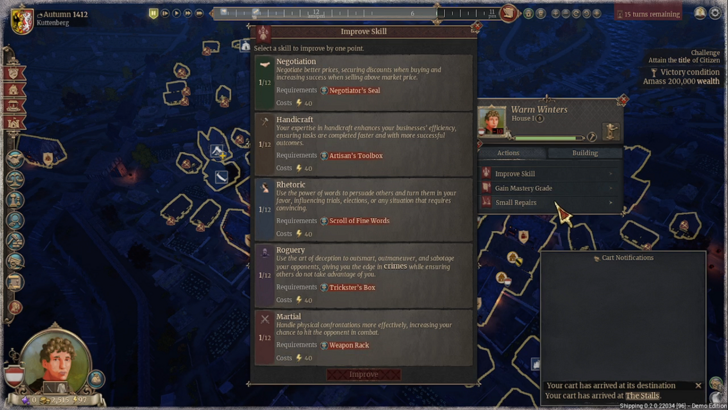
This nearly happened to me during my first Smithy run. I overinvested in Silver Rings, buying and selling these at a premium, thinking that I’m more likely to gain favor from nobles and upper-class men since it said it could. I also built a great many swords to equip my apprentices to no effect, since there wasn’t a means I could find for their martial skill to help with my business, even if only to escort my carts.
A skill issue? Perhaps, but that’s something a game like this needs to prepare for because not every person who loves strategy is a savant with spreadsheets. A little handholding is a concession games of this genre must make, patronizing as it may be to some. Strategy is only enjoyable if you’re equipped with the knowledge to win, or the means to get it. Otherwise, you’re just bumbling about in chaos, hoping to end up where you need to be.
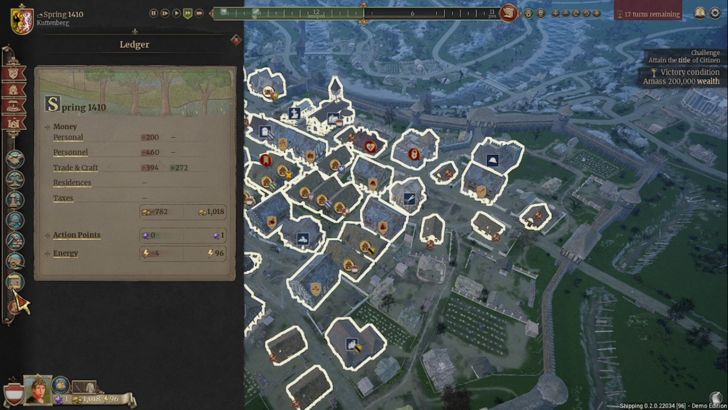
It does get easier as you play, that’s just how learning goes. I just think the devs could smooth over that learning experience some. I don’t think a lost run is necessary to learn the hard lessons, not when each run takes hours. A few curated scenarios and an extra 10 minutes of tutorial or so, and this game could give Europa Universalis V a run for its ducats.
Comparably Pared-Down Version of its Kin
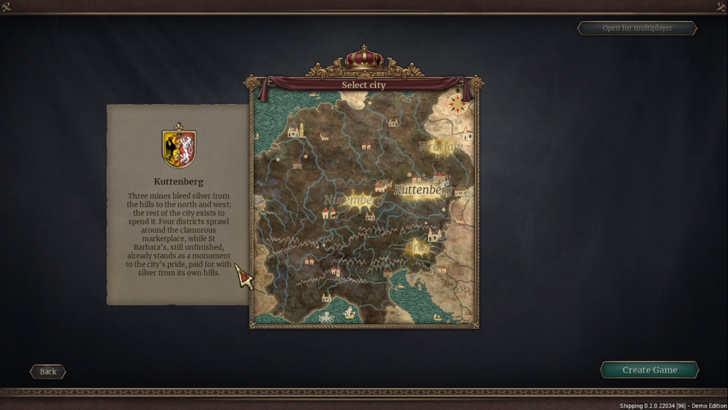
That last bit’s wishful thinking, of course. Hyperbolic, even, because The Guild is actually quite light compared to its brethren. Now, I said it has incredible depth and great payouts, and those are both correct, but those comparisons are against simple shop simulators and business sims.
In the stage of grand strategy and management, this game has accomplished only two things: it fixed multiple points of failure and made this a playable game, while also making it far less exploitable.
See, in the community of people who enjoy grand strategy sims, The Guild is a small fry. Despite its depth of choice and density, it’s also quite hands-on, and as a consequence, much smaller in scale. Without any means to automate production, and a one-to-two-step cycle of using carts for logistics, this makes The Guild far more stable, with much fewer steps for players to get creative with.
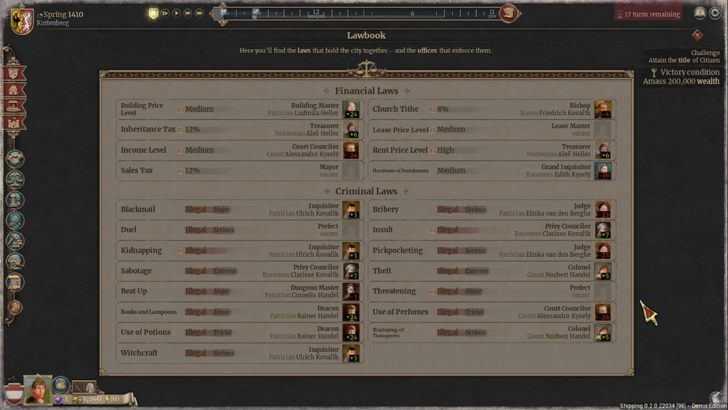
It’s a matter of ease-of-use over sandbox enjoyment. The highest echelon of players might soon find themselves bored, while the newer or more casual players can actually feel like they're achieving something. Of course, that second idea is brought low by the game’s insufficient tutorial, so it’s a daisy-chain of difficulties for The Guild at the moment. I believe that’s not something a few updates before EA can fix, though.
Absolutely Packed for a Demo
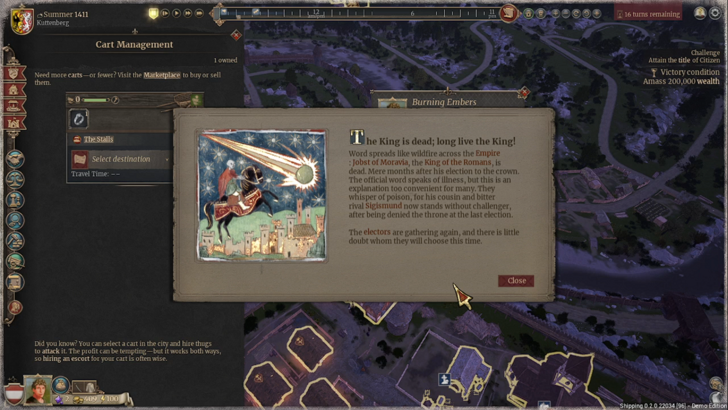
So, yeah, those are the finishing touches for The Guild - Europa 1410’s demo. It’s a great proof of concept for what it’s trying to achieve, but there are a few notable warps in the billet the devs need to hammer out before it comes out to Early Access this July.
A better tutorial, for one, and more complexity to make up for its lightness, for another. That second improvement will likely come with the new professions, counties, and expansion of shoply duties as new professions unlock during a run, so no need to worry about that too much. I don’t expect this game to be the deepest strategy game ever, as it has enough depth for what it wants to be; we just need to trust it has something else up its sleeve.
This demo in itself is positively packed with content, so give it a try before the game comes out and see what I’ve been ranting about for yourselves. It’s not so grand, sure, but it’s definitely great.
Game8 Reviews