



Staffer Retro: A Supernatural Mystery Quest is a detective adventure game where players follow Verita to investigate mysteries and uncover the dark truths lurking beneath. Read our review, covering the story, gameplay, and if it's worth buying.
Overview
What is Staffer Retro: A Supernatural Mystery Quest?
Staffer Retro: A Supernatural Mystery Quest is a standalone story sequel in Team Tetrapod's Staffer series. Set in a fictional version of Sicily where supernatural abilities and Mana-infused artifacts called Staff co-exist with everyday life, the game tasks players with gathering documents, cross-referencing testimonies, and reasoning through contradictions to uncover the truth behind a string of interconnected mysteries.
Staffer Retro: A Supernatural Mystery Quest features:
⚫︎ Re:Story system to complete surface-level mystery
⚫︎ Retro system for resolving deeper mysteries
⚫︎ 40+ unique document types holding various clues
⚫︎ Characters are fully-voiced in Japanese
⚫︎ Spine-animated character art and cutscenes
⚫︎ Branching narratives and endings
⚫︎ Six Acts with 20+ hours of playtime
| Digital Storefronts | |||||
|---|---|---|---|---|---|
 Steam Steam |
 Switch Switch |
||||
| $24.99 | |||||
Staffer Retro: A Supernatural Mystery Quest Review | Indebted Sequel That Minimizes Its Magnifying Glass
A Story Bigger Than the Heroine Herself

Good narratives in mystery games are a balancing act few games pull off well. The goal is to make players feel like they cracked the case themselves, piecing together contradictions, truths, and clues toward a satisfying conclusion. But to have a great mystery, it needs to make you feel like a detective, actively untangling truths rather than just handing you the answers on a silver platter. It's a tough bar of entry to reach when titles like Hotel Dusk, Trace Memory, Zero Escape, and Your Turn to Die already exist.
Still, Staffer Retro: A Supernatural Mystery Quest attempts to pull off that exact same magic trick. It demands that you scour all documents and cross-reference testimonies, leaving no stone unturned. But while it starts with a genuinely sharp hook, it doesn't quite manage to keep its balance. What begins as a dynamic, rewarding detective adventure eventually gets weighed down by its own scope, letting its lore and narrative ambitions push its best investigative features into the backseat.
Despite those later stumbles, there is something instantly compelling about the game's setup. Staffer Retro is at its best when it trusts players to do the digging themselves but is at its weakest otherwise. That line between a story that wants to grow bigger and a mystery system that thrives on the finer details is what defines the entire experience.
World Full of Staff and Pheno-Mana

The story follows Verita, an ordinary girl living above her family’s secondhand shop in a fictional town in Sicily. Almost from the opening moments, she finds herself buried under her missing father's debt to a ruthless loan shark named Vassanio.
Much like a classic noir detective forced into a situation they never wanted, Verita's aloof exterior is tested immediately as she gets dragged into Staff hunting and investigations. What starts as a slice-of-life conversation between Verita and her schoolmate spirals into a string of supernatural conspiracies.

It's a smart way of structuring the flow of the narrative. Grounding the opening in an ordinary time before yanking it away gives the upcoming stakes real weight, and it does well at building genuine shock factor. The shift lands its initial punch, showing players that Verita is just a kid that’s overwhelmed, but there’s just no time to sit on these thoughts, since she has mysteries to solve and a debt to pay.
That said, the momentum works in the story's favor. This is reflected through Verita’s skill set in gameplay, where she gets better with her deductions and guesswork over time. Sadly, the story doesn’t use this much later on, as it favors narration over actual detective work. The downside of the game’s narrative is when this balanced momentum gets shaky, and where exposition goes up, gameplay goes down.
Solving, Collecting, and Revisiting
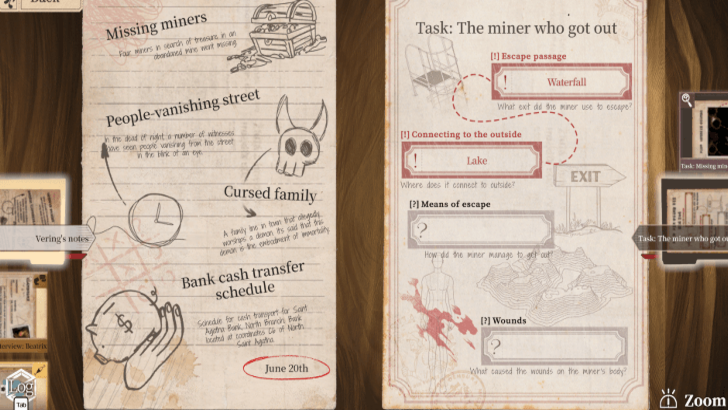
Though Staffer Retro presents itself in a visual novel format, the investigative loop isn’t fully passive. Progress relies on interviewing witnesses, collecting documents, and manually cross-checking evidence until a contradiction or correct combination of clues clicks into place.
For those newer to the genre, it’s kept the solving layer more accessible. The game features a dedicated hint button to help highlight which documents or testimonies currently need to be matched.
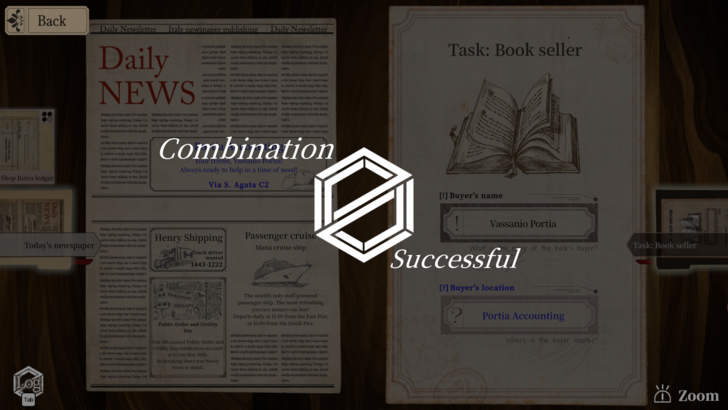
The highlight of the game’s loop is the series' signature two-layer deduction mechanic, which serves as the ultimate payoff for your attention to detail. Most cases first resolve through the surface-level Re:Story
system, providing a clean, official explanation of events. Afterward, the game then eventually initiates you to use the Retro
system to actively dismantle that conclusion, using hidden contradictions to expose the full truth.
An early example occurs in Act 1. The moment the pieces realign to uncover the real culprit and trigger is incredibly satisfying, transforming my view of the mystery visual novel into an engaging puzzle to finish.
However, the investigative framework occasionally lags due to two main things. Pacing slows at times, as Staffer Retro’s deduction is point-and-click by design. The experience also suffers from some writing inconsistencies. This is seen through Verita's sister, Vero, when she provides support in guiding to the solution. Unfortunately, these awkward lines from her and other recorded interviews add a not-so-welcome layer of challenge in deciphering the clues in the long run.
Pacing That Stutters
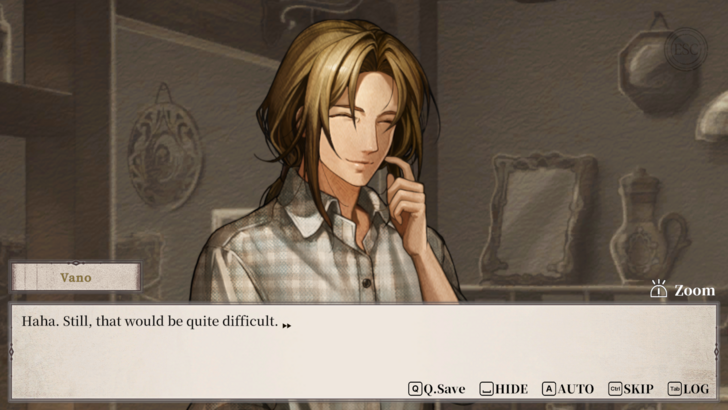
While the premise gets off to a strong start, that same momentum doesn't always hold. There were scenes that felt excessive in terms of flavor text or reactions, especially when Verita, Vering, or sometimes both, would loudly scream throughout. With how frequently this reaction is used, it results in many scenes depicting dire moments having less impact and sometimes even breaking immersion.
As you progress, the acts lean more into worldbuilding and lore around Mana and the Staff artifacts. Later acts are spent on these and characters’ stories, lessening moments for independent cross-investigations and lowering the scale in difficulty when actively dealing with clues. Those details are handled with care, but it comes at the direct cost of the detective work that made the earlier mysteries fun.
Additionally, some of the twists or character appearances in later chapters feel spoonfed well in advance rather than genuinely surprising. One particular act that felt rushed was Verita’s family confrontation, as they simply laid everything out for all parties in under an hour.
With the heightened exposure of narrative coming into play, more is actually said than left unsaid. Players hoping for an even mystery-solving experience all the way through to the credits may find themselves mostly just following the flow of the story towards the later half instead.
A Cast Worth Getting Attached To

The cast is what ultimately kept me invested in Staffer Retro from start to finish. Verita gets her underdog status early: she’s renowned as the school’s loner with zero life goals and tied to a business in debt. It is through the Staff cases she finally gets a spark, not just because she has bills to pay but because she’s finally found something she’s actually interested in.
She refuses to let her co-detective Vering handle everything alone despite having every reason to just walk away. It's the kind of quiet but newly gained, stubborn resilience that makes you want to see her win, even when the story continues to stack the odds and her own mind against her.

Her relationship with Vering is where a lot of that emotional weight actually gets built. What starts as a purely transactional arrangement with Verita working off her father's debt for a cut of Vering's Staff sales slowly shifts into something closer to friendly trust.
You see it in the small moments: Vering wanting to pay off Verita's debt herself or the way the two start bantering casually, a stark contrast to the skeptical view they had of each other in the beginning. Neither of them says it outright, but the story lets their actions do the talking.

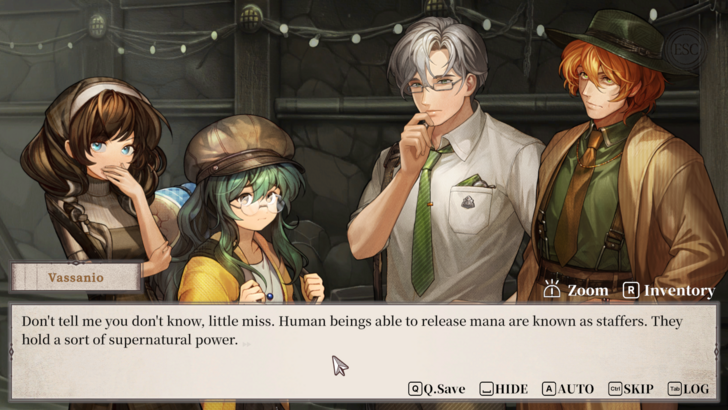
The rest of the cast pulls its own weight, and a big part of that comes down to the performances. The fully voiced Japanese cast elevates scenes that could've fallen flat, particularly during the game's bigger reveals, where the shift in tone relies on a vocal delivery to land. One instance was when the polite Vassanio switched to condescension. As he revealed that Verita’s father owed a large sum to him, this broke the heroine’s aloof exterior into a voice of desperation all in one earth-shattering moment. Add in the game's partiality to comedy between its darker beats, and the characters get room to have more contrast in their personalities. It's this combination that turns what could've been just a normal supernatural whodunit into something with more spark and genuine heart.
Pretty Presentation, Subpar Soundtrack

Visually, Staffer Retro is a major positive for the series, with Spine-animated characters and a soft, sepia-toned filter and art style that gives it its own identity among detective-adventure games. The big highlight here is the Spine-animated character work, as it brings a level of fluidity to conversations that static VN sprites just can't match. The small shifts in posture and expression help make characters look like they're reacting in real time.
The audio side is where it has its ups and downs. On its own, the voice work is strong, and it does a lot of heavy lifting during key emotional beats, as mentioned earlier. The background sound, though, doesn't get the same level of care. It cycles through a fairly limited pool of tracks that gets reused across six different acts. By the midpoint of a 20-to-30-hour runtime, that repetition blends even further into the background than it should.
It's not a dealbreaker, but it is rather a missed opportunity. A game this confident in its visual identity, I believe, deserved a score with the same amount of personality. Its absence is one of the more noticeable gaps between what Staffer Retro gets right and what it leaves behind.
Rewards Active Investigation and Attention
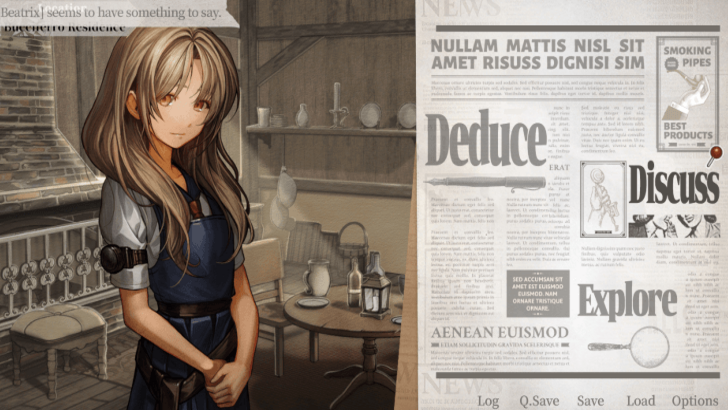
The Re:Story system is Staffer Retro's clearest strength, and it's most effective up until the middle of the story. Being handed a case that's already technically closed, then forced to tear it back open by reviewing testimonies for contradictions, makes every payoff feel earned rather than handed to you. Each act tries to combine a genuinely clever mystery with real emotional stakes, and it's a good example of the system working exactly as intended.
Act 1 is where this was nicely executed to lure players in. Tracking down a delivery route using nothing but an unassuming sculpture had me genuinely puzzled in that moment. Despite that short-lived confusion, I was eased into the mechanics available. The game teaches you that one line of reasoning is a part of the mystery as well, allowing you to revisit any missed clues or contradictions to unlock its core truth.

Part of the game’s gimmick is first showing a half-truth while having a prompt available to conclude the current act. Doing so can either shorten the act’s plot or end the game there. It's mechanics like this that show there’s information being intentionally hidden, rewarding us players who scoured through all the notes and details.
That momentum carries into the next act as well, where the stakes shift from financial debt to a missing father. Beatrix, Verita’s schoolmate from the prologue, reappears, and this time we’re addressing a personal problem she confided in Verita back then. The game introduces Bryan, a man motivated by his organization's mission to help their investigation of missing miners and a fabled Staff treasure.
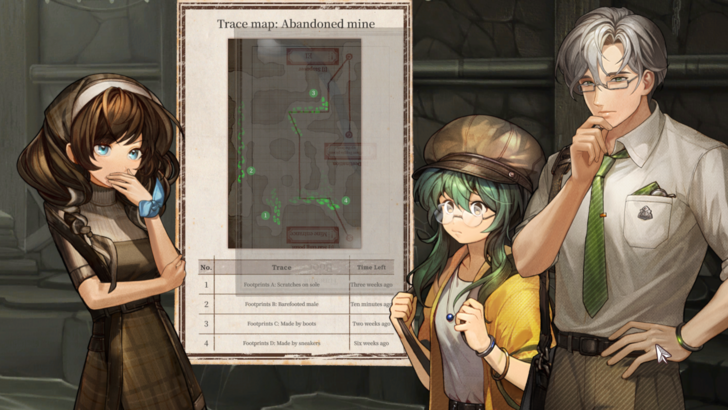
Apart from the usual duo’s timeline and reasoning to solve clues, Bryan adds his own skills in the form of tracking footsteps. Juggling Bryan's perspective alongside Verita and Vering's own leads adds a neat layer of puzzle-solving that keeps the deduction interesting even as the cast keeps growing.
While all these are not the most groundbreaking puzzle-solving mechanics you'll find in the genre, the subtle built-in hints mean you're rarely stuck for too long. In doing so, the game still does its job in trying to give that I figured it out
feeling.
Is Staffer Retro: A Supernatural Mystery Quest Worth It?
Worth the Debt, Interest and All

If you're a returning fan of the first game or someone who just enjoys playing mystery-driven adventures, Staffer Retro: A Supernatural Mystery Quest is a worthy purchase. You're getting a genuinely likable cast, 20-plus hours of content, and a fun deduction structure, all wrapped neatly in a visually enjoyable package. The game does well as a standalone story, with only light mention and references to its predecessor.
However, if you're coming in purely for the mystery-solving, temper your expectations. The deduction system does take a backseat in the later half to make way for the narrative and lore to muscle in. Puzzle lovers looking for a consistent detective experience from start to finish may want to wait for a sale rather than buying at full price.
Still, the strength of the world, the voiced cast, and the handful of genuinely great deductions along the way are enough to carry it. Though the shift in pacing for the late game did throw me off, I still felt invested enough to continue the story. For those looking into a fresh supernatural mystery priced reasonably at $24.99, this is a sound buy.
FAQ
Is Staffer Retro: A Supernatural Mystery Quest a Direct Sequel to the First Game?
No. Staffer Retro is a standalone story sequel, following a new protagonist, Verita, and a self-contained mystery. Familiarity with the first Staffer game isn't required to follow the story, though returning fans may pick up on connections to the series' lore around the Bureau, Mana, and Staff artifacts.
How Long Does Staffer Retro Take to Complete?
A full playthrough covering the main story runs roughly 20 to 30 hours for all six acts.
Does Staffer Retro Have Multiple Endings?
Yes. The game is reported to feature 11 possible endings via the official game description.
Is Staffer Retro Fully Voiced?
Yes, the main story features over 20 characters voiced by a cast of 17 or more Japanese voice actors. However, there is no English dub, though the game includes English text.
Game8 Reviews