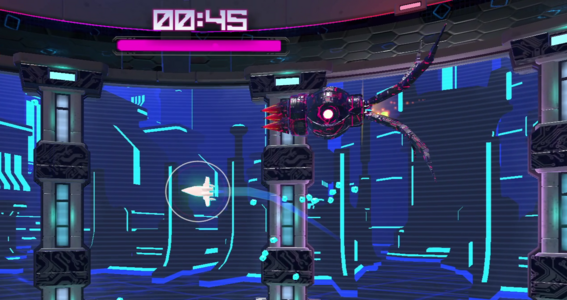




OUTBLAST is a twin-stick bullet hell shooter where players must shoot constructs infected by the viral intelligence and make a final stand to defend the planet’s core. Read our review to see what it did well, what it didn’t, and if it’s worth buying.
Overview
What is OUTBLAST?
OUTBLAST is a twin-stick bullet hell shooter where players must fight through five districts and bosses to defend the planetary core of Perseon-6 from an onslaught of corrupted constructs. Pick up power-ups and use your bombs and boost moves to gain the upper hand.
OUTBLAST features:
⚫︎ Classic twin-shooter bullet hell gameplay
⚫︎ 360-degree level design
⚫︎ 5 unique levels and boss fights
⚫︎ Competitive global leaderboards
⚫︎ VR compatibility
| Digital Storefronts | ||
|---|---|---|
 Steam Steam |
||
| $8.99 | ||
OUTBLAST Review: Classic Bullet Hell’s Unambitious Grandchild
Balancing “Easy Enough” and Challenging
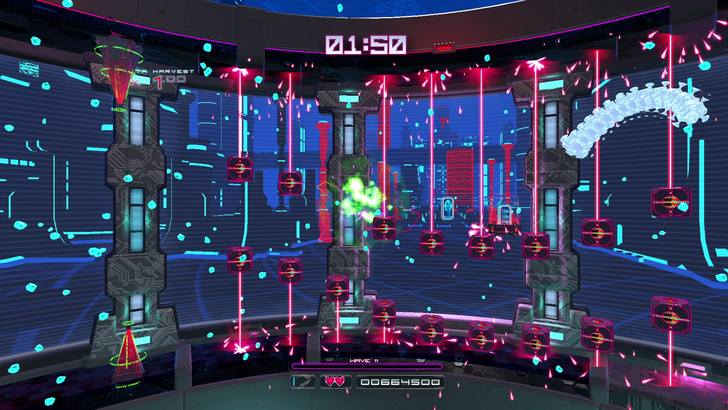
Making a bullet hell rewarding and welcoming can be tricky: it has to put up a proper challenge and balance its brutality to appeal to newcomers. Games in the genre would endlessly wrestle with this spectrum to fix the genre’s hiccups, like the Gradius syndrome: power-ups become so pivotal to clearing levels that losing them softlocks the player. Some, like the Donpachi series, gave you a lethal starting arsenal to offset the impact of power-ups; others threw away power-ups entirely and centered around a core mechanic, like the excellent 2001’s Ikaruga. OUTBLAST, a pseudo-sequel to Gradius that clearly shows a lot of reverence for the genre’s forebearers, somehow runs into the opposite problem.
OUTBLAST sits at a very awkward position on this spectrum. It’s a traditional bullet-hell shooter that attempts to hold on to the classic tropes that made the genre inaccessible for years, while also trying to make it simpler for newcomers. There are power-ups and some interesting special moves in the game, yes, but they fail to add flavor and impact to the gameplay compared to, say, Touhou’s character-exclusive power progression, that their inclusion feels more… obligatory.
Despite its fun boss battles, OUTBLAST is dragged down by generic level and enemy design, and an overall lack of identity. It shows some promise, but OUTBLAST ultimately fails to learn from the past decades of innovation from its genre’s predecessors.
A Story That Reads More Like a Mission Directive
It came as no surprise to me that OUTBLAST didn’t seem remotely interested in presenting its story. As soon as you boot up the Arcade Mode, you’re immediately chucked into the tutorial stage. No cutscenes. No voiced dialogue. Just your ship and an objective to shoot everything that moves.
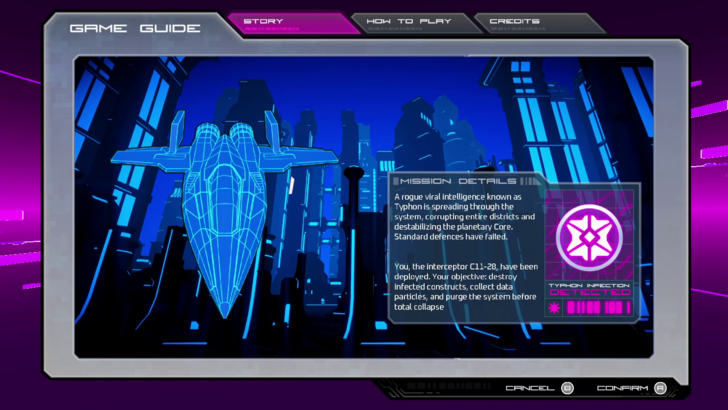
Instead, they tucked all the lore and narrative away as flavor text in the Guide menu and digital storefront. Aboard a craft called the interceptor C11-28, you were deployed to stop the onslaught of constructs corrupted by the rogue viral intelligence, Typhon, and save the planet’s Core and its civilization. It’s yet another iteration of the classic Skynet/AI uprising apocalypse plot, but with less time travel hijinks.
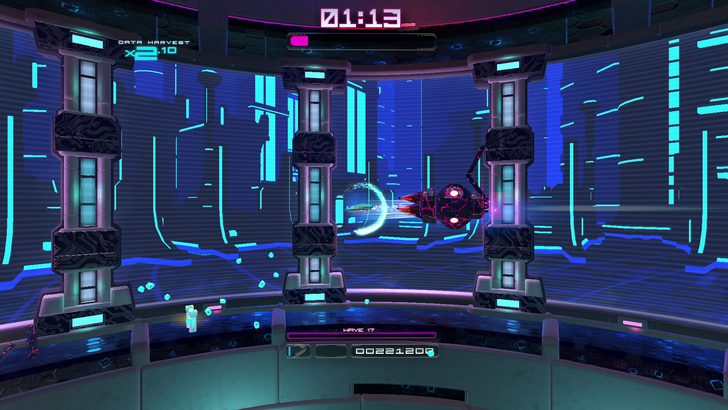
While it’s nice that it fleshed out the world and events that led to your skirmish, the game fails to reveal anything new or interesting since it presents crucial information so plainly. From the get-go, corrupted machines have infiltrated this neon, futuristic city, and security turrets have been taken over by a virus. You’re saving the world.
And while the lack of representation of this narrative through cutscenes or dialogue doesn’t hurt the gameplay (after all, classic bullet hells did follow this formula), it also doesn’t add any weight to it either. It’s the same arcade experience, with or without it.
Lackluster Playstyle Options Slow Level Progression
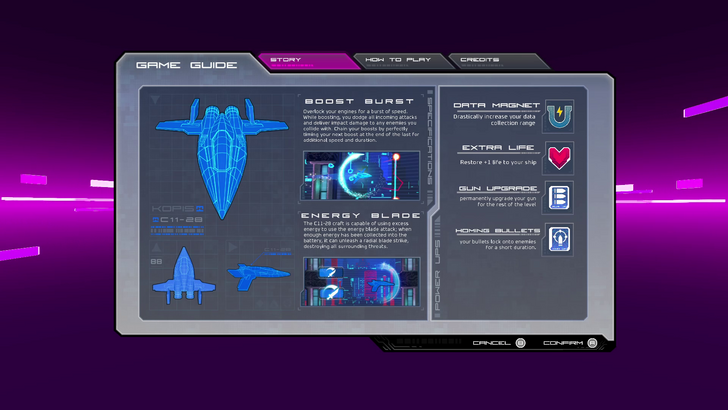
OUTBLAST plays like any standard shoot-’em-up: you navigate your ship, shoot enemies, and pick up power-ups that spawn in the stage. This pretty basic but tightly-made set-up is complemented by the bomb attack, which will detonate a blast around a short radius, and the boost, which has a small QTE mechanic where you can dash and ram opponents and obstacles.
Using this arsenal, you’re thrown into enemy waves to destroy every one of them before time runs out or your lives do. This is a departure from the genre trope where taking down enemies acts more like a score booster rather than a hard requirement, so missing a few mobs wouldn’t end your playthrough. Here, missing one would spell the end for your runs.
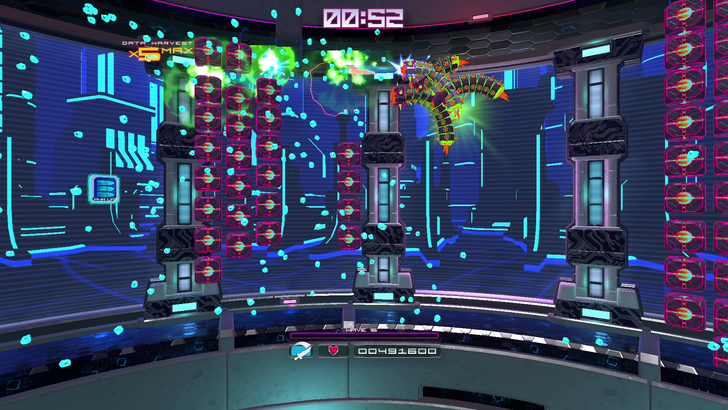
So at this point, games would normally give you things like a multispread projectile or bomb power-up to clear out the enemies on your screen. The problem is that there isn’t one.
In this game, you’re stuck with single-target-focused projectile power-ups (and the occasional invulnerability). While a boost in damage could make the fights go a bit faster, the game fails to give crowd control options while demanding you to shoot everything down, turning later skirmishes from an expression of skill into mud fights that last longer than they should have. You would think that because you’ll fail if you miss an enemy before the timer ends, they’d compensate by giving you ways to clear groups more efficiently.
This is even more baffling when you look at the stage design. In OUTBLAST, levels all take place in a cylinder, and your ship can loop around it in 360 degrees like a globe. It’s a cool idea, on paper, until you see how enemies can circle the stage as you do. I can’t even count the number of times when I’ve missed one enemy and was forced to circle the long stage to hunt it down. Sure, they give you a compass to locate them, but it’s never enough when I couldn’t even determine which direction they’re moving around the stage.
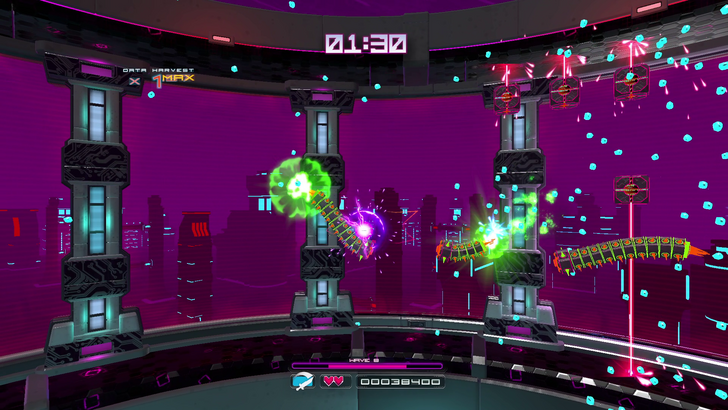
This long goose chase of intercepting and tailing enemies slowed the gameplay to a crawl and even cost me runs when the clock struck zero. This problem only got worse as I progressed, as the enemies got stronger and bulkier, while the quality of my bullets and moves barely improved.
Whereas other bullet hells would try to choose between focusing on upgrades or a gimmick-y mechanic, OUTBLAST tried to juggle both and failed to make either rewarding to master. It’s frustrating, especially considering how you can see that there’s a good game buried underneath the slow progression once you get to the fun boss fights.
The Emergent Joy of Versatility in Boss Battles
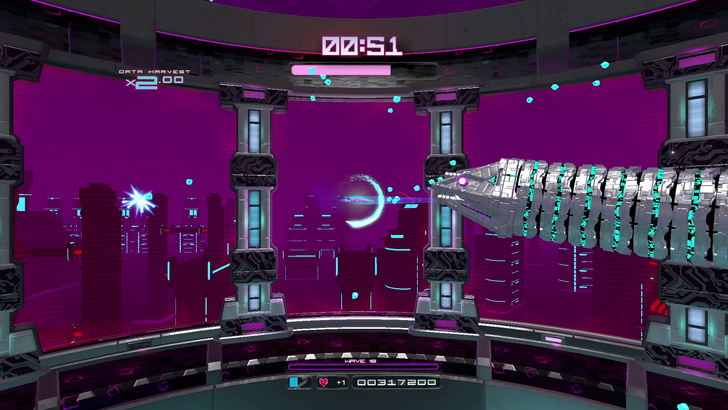
Fighting a boss in OUTBLAST feels like the reward you get after trudging through the same, unholy levels and enemies. Because I wasn’t required to take down X amount of mobs on the screen, my single-target-focused power-ups and moves actually matter in the outcome of these battles. These were easily my favorite parts of the whole experience since they actually prompted creativity and strategy with the game’s mechanics .
For example, the first Hydra boss will circle the stage for a set amount and leave mines before it recedes into the background of the stage. You can either tail it from behind so you can take out the mines immediately, or race it from the front to fire and get closer to a range where your bomb can hit it. Choosing either would test different aspects of your skill: the former would have you dodging projectiles, and the latter would have you timing your boost mechanic.
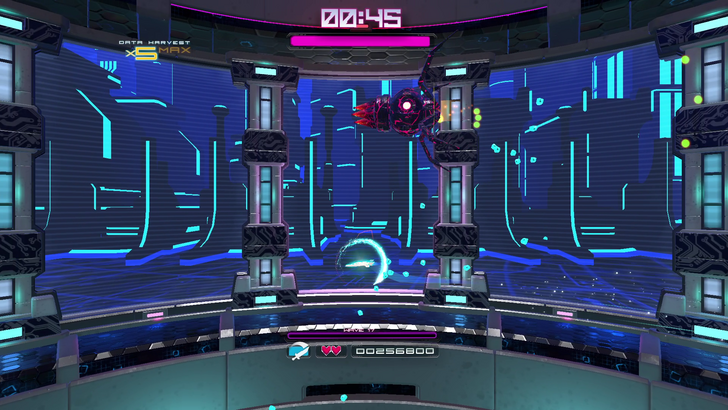
This is a good showcase of OUTBLAST’s potential to capitalize on emergent gameplay: the game shines when you’re able to use the same set of tools and dream up a hundred ways (exaggeration) to win fights. And as a bonus, boss fights don’t even need crowd control most of the time, so it’s exempt from one of the game’s problematic areas. After all, by the time you’ve reached the last District of the game, you likely would have respawned and gone through a thousand iterations of runs, studying boss patterns and experimenting to find the fastest ways to take them down.
And I think that’s what the rest of the game is missing: experimentation.
Yes, levels need to be punishing, but they should also give you options to explore a bigger, more viable toolcase. Your pea-shooter shouldn’t just turn into a faster pea-shooter after risking your life to get a power-up; that’s just underwhelming–sad, even. Imagine if your boost could tear through enemy rows or your bomb could detonate chain explosions, rather than barely hit two enemies near you? They’d be more useful in demolishing enemy waves and actually fun to master.
The tools make or break this experience. And I grieve over the fun game OUTBLAST could’ve been if they’d just put the same amount of love they poured into boss fights into them.
Nice Visuals Getting in the Way of Gameplay
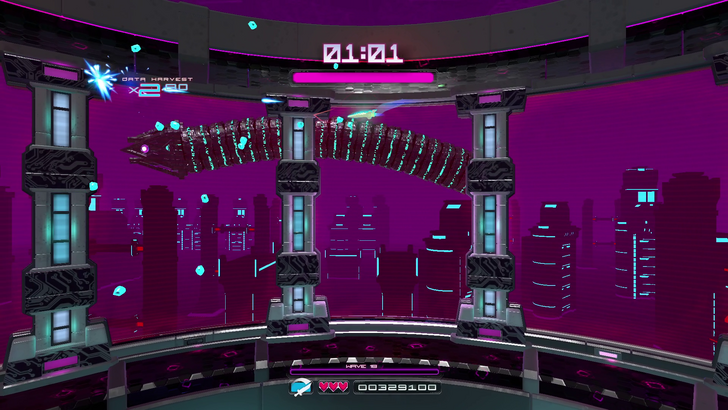
The game carries a 2010s synthwave aesthetic that fits really well with a retro-style shoot-’em-up. The art style inherently oozes 90s charm despite coming out two decades after its time, which echoes OUTBLAST’s undertaking as an homage to classic bullet hell shooters, while trying to strike out as its own thing.
For one, they did well in integrating it into everything: the UI, the special effects, the color palette, and the 3D models. The visuals aren’t as high fidelity or masterfully crafted compared to the best indie offerings in the market. What it does achieve, though, is a good visual identity: everything feels cohesive and works together to build the game’s neon dystopic atmosphere.
In short, the visuals are good. But what’s stopping me from fully praising it is its lack of one ingredient that can make or break games in this genre: visual hierarchy. Bullet hells can quickly get messy (beautifully, I’d argue), so the gameplay elements must stand out from each other and the background.
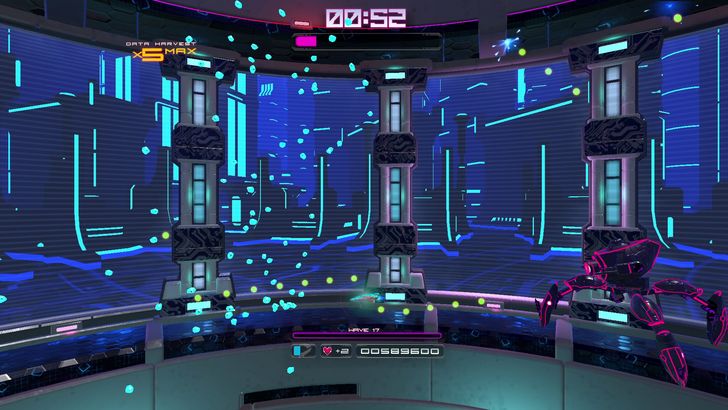
Projectiles, for example, have to be the brightest things on-screen so they’re easier to spot. In OUTBLAST, the projectiles are as bright as the neon-lit city backdrop, so they often blend in and are hard to spot. Adding on to that, both projectiles and backgrounds have variations that even share the same palette profile of bright neon blue, red, and green. As a result, the saturation levels of these backgrounds and projectiles are so strong that they’re all equally competing for your attention.
It’s really frustrating to end a run when you collide with an easily avoidable projectile or obstacle. As you may recall, the "shoot-’em-all" gameplay had you circling the levels fast to chase enemies. Because of how these projectiles blended in the background, I sometimes found myself hitting a stray bullet that was just suspended in space, long after I had already taken out the turrets in the level.
This needlessly adds a layer of tedium when navigating stages, thus holding the gameplay back further and feeding into the already sluggish level progression.
Bland, Repetitive Music and Functional Audio Design
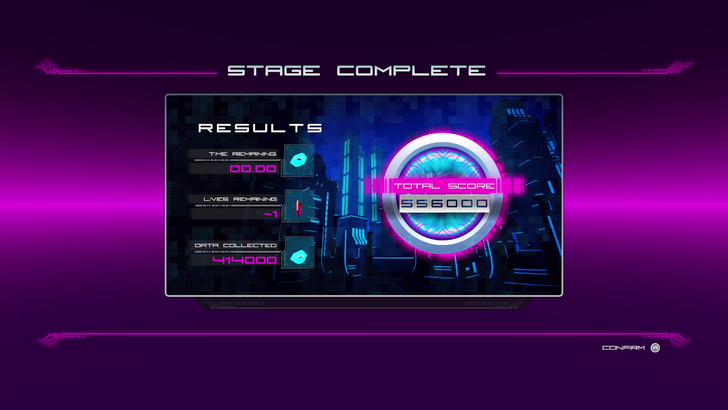
Unlike OUTBLAST’s visuals, the audio manages to carry the gameplay mechanically and compensate for the former’s shortcomings by providing some much-needed hit feedback.
Every projectile, both from enemies and the player, instantly pops as soon as they’re fired, when they’re traveling through the air, or when they hit enemies or obstacles. There’s a clear hierarchy and variation in the sound effects, balanced to help players parse through what’s happening on-screen. In short, it doesn’t leave you guessing when you’ve shot an enemy down or when it starts attacking, which is important considering how the gameplay can often turn the screen into a diarrhea of projectiles.
On the other hand, unlike the game’s visuals, which stood out for having a good artistic identity, I’m more reluctant to give its audio the same treatment. While its sound design does fit with the retro futuristic style, it’s guilty of sounding generic, especially the SFX. The lasers, the explosions, down to the pick-up jingle, all sound very generic.
Is OUTBLAST Worth It?
No. There Are Better Options.
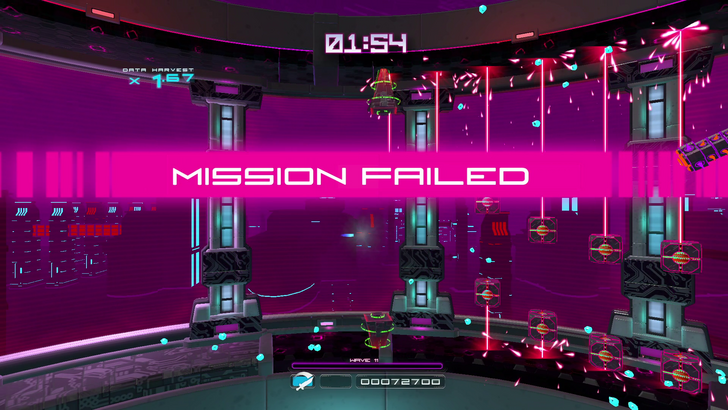
OUTBLAST has potential, though it’s hard to recommend the game right now, especially for its price range at $8.99. Levels can feel slow, and the gameplay lacks the same depth as its bullet hell contemporaries. I would personally wait for content updates to add more gameplay variety and polish to the level progression.
FAQ
Can you play this game without a VR rig?
Yes. You can play this game with a controller or a mouse-and-keyboard setup. The developers do encourage the former for the best experience.
Is there a PvP competitive mode?
There is no dedicated “competitive” mode, but the Arcade Mode and Stage Select have global leaderboards for the highest scores accumulated. Both modes are single-player, as of writing.
What are the System Requirements to Play OUTBLAST on Steam?
The System Requirements, as listed on Steam, are as follows:
| Specifications | Minimum | |
|---|---|---|
| OS | Windows 7, 8, 10, 11 | |
| Processor | 2.3 GHz Dual Core | |
| Graphics | Intel HD 4000 | |
| Storage | 2GB | |
| VR Support | SteamVR compatible headsets including Meta Quest, Valve Index, and HTC Vive | |
Game8 Reviews

You may also like...
 |
BALL x PIT |
 |
Homura Hime |
 |
Deep Rock Galactic: Survivor Review | Rock Solid! |
 |
Saros Review | Eclipses All In Its Wake |
 |
Stella Sora Review | Bullet Heaven, Girl Heaven, Wallet Hell |