



| MOUSE: P.I. For Hire | |||
|---|---|---|---|
| Release Date | Gameplay & Story | Pre-Order & DLC | Review |
Overview
What is MOUSE: P.I. For Hire?
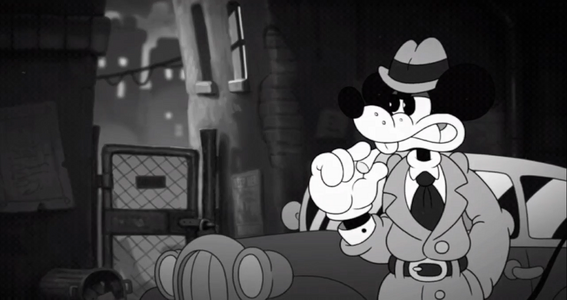
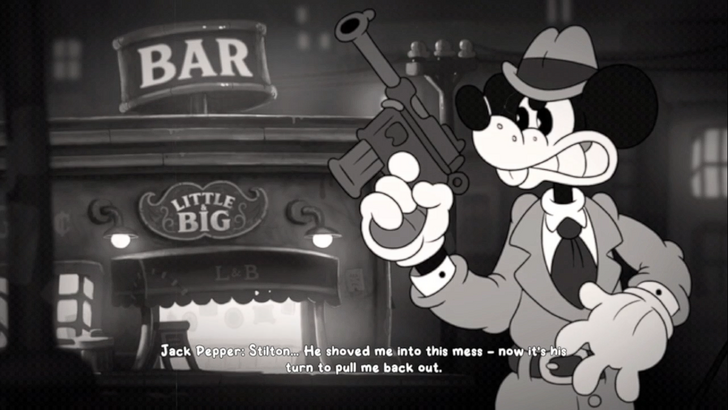
MOUSE: P.I. For Hire is a first-person shooter made in the rubber-hose animation style reminiscent of early Mickey Mouse cartoons. Designed with cartoon physics and classic noir stories in mind, MOUSE: P.I. For Hire puts players in the tiny shoes of a private detective as they follow various leads across Mouseburg. With endless goons and mysteries abound, it will be up to their wit, deduction, and trusty Micer pistol to set Mouseburg straight, one solved case at a time.
MOUSE: P.I. For Hire features:
⚫︎ 2D on 3D graphics in the style of early cartoons
⚫︎ 12 unlockable weapons, including guns, explosives, and melee
⚫︎ Fully voiced dialogues
⚫︎ Weapon and traversal upgrades
| Digital Storefronts | ||||||||
|---|---|---|---|---|---|---|---|---|
 Steam Steam |
||||||||
| $29.99 | ||||||||
 PS PS |
 Xbox Xbox |
 Switch 2 Switch 2 |
||||||
| $29.99 | ||||||||
 Switch Switch |
||||||||
| Coming Soon | ||||||||
MOUSE: P.I. For Hire Review: Gold Standard of the Golden Age
The Best Thing Since Bendy and Cuphead
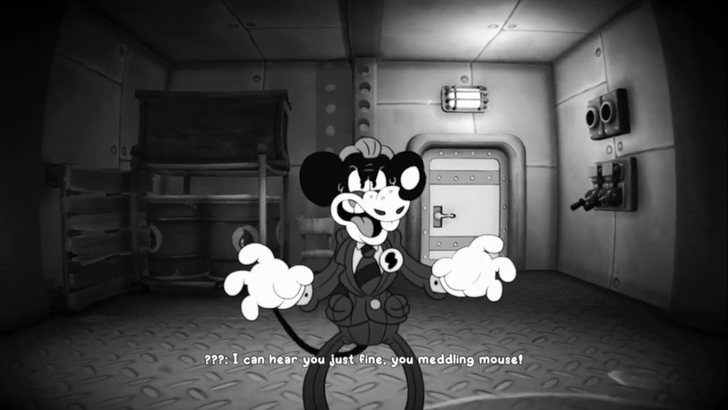
Cuphead and Bendy and the Ink Machine were both standout games in 2017 for taking the rubber-hose animation style in two completely different directions and excelling on both fronts. For a time, everyone was talking about the golden age of animation like it were yesterday.
Well, it’s 2026 now, and not many have captured the same magic since then. Don’t get me wrong, many have tried. Even Cuphead and Bendy have both released more of their own stuff since, but it’s just not the same. It’s not as novel anymore, if not completely off-base.
That is, of course, until MOUSE: P.I. For Hire (MOUSE) came along. It, too, takes the style to a new direction and excels in its execution, completing the rubber hose hat-trick, and proving that the style wasn’t just a fad of the time. Keeping in mind minor hiccups like pacing, it’s a darn good game even if it didn’t like it does now.
Those are just the preliminary details, of course. There’s much to discuss about MOUSE: P.I. For Hire, and the corkboard stands empty. Let’s start pinning, then, detective.
Unravelling Mouseburg’s Corruption, One Case at A Time

Kicking things off with MOUSE’s story, the game is set in the fictional city of Mouseburg. Though not a direct analogue of any real-life city, Mouseburg takes visual and narrative cues from major noir settings like New York, Chicago, and San Francisco, blending all three into the perfect stage for the game’s city-spanning narrative.
Every noir story needs a no-nonsense protagonist, of course, and in the case of MOUSE, it puts you in the tiny gumshoes of a local P.I. named Jack Pepper as he investigates the unintentional disappearance of a local magician. What he finds is a rabbit hole—or should I say mouse hole—of corruption and crime that goes much deeper than anyone could’ve expected.
I must say, what an inspired idea it is to make an LA noir in an art style that’s historically contemporary with the genre. Cuphead went completely fantastical, and BATAM chose to highlight the animation industry in particular, so a cartoon noir story is exactly the perfect era piece to ground this game.
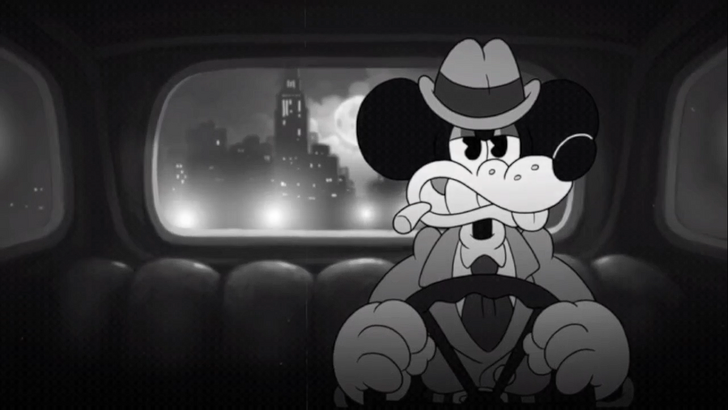
And ground the game, it did, because the story is among its better aspects. I won’t spoil anything here because noir stories are all about mystery and pieces falling into place when they should, but trust me when I say that the characterizations for the noir archetypes are perfect, the story beats are straight out of James Ellroy’s works, and the wacky cartoon violence is what ties it all together.
The game has everything a noir title could ever ask for. Take Jack Pepper, for example. Ex-soldier, ex-cop, and now a private eye just looking to make ends meet while having as grey a morality as the film he’s on; now that’s a noir detective!
What about the cases he takes? What are those about? Well, we’ve got cop corruption, racism against immigrants, assassination attempts on officials, mysterious disappearances, and arson, just to name a few. It’s a wild ride from start to finish with grit to spare, and the game would not be the same if all you could do was shoot at random mice.
The Right Tool and Mouse for the Job
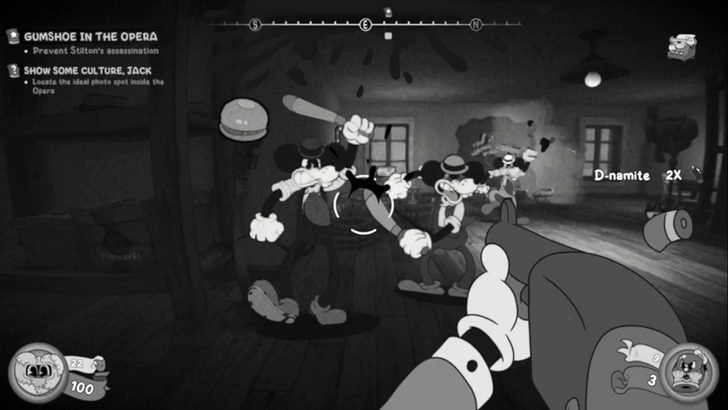
On the topic of shooting random mice, in addition to being a classic noir story, MOUSE is also a first-person shooter. That means there’s more than enough of that violence to go around, and most of it’s dished out by you.
Playing a lot like modern DOOM, MOUSE lets you control Jack Pepper and his expanding arsenal of classic, mouse-themed weaponry as he gets into firefights against nameless goons, cappos, robots, and every type of mouse in between.
Each weapon has its own unique type of primary fire—from the Micer’s simple bullets to the Devarnisher’s acid globs—as well as an upgradeable secondary fire. Ammunition, health, armor, and power-ups are also found aplenty throughout each of the game’s linear stages, creating a loop of dynamic combat and exploration that something like DOOM: Eternal popularized, though to a noticeably less combo-reliant extent.
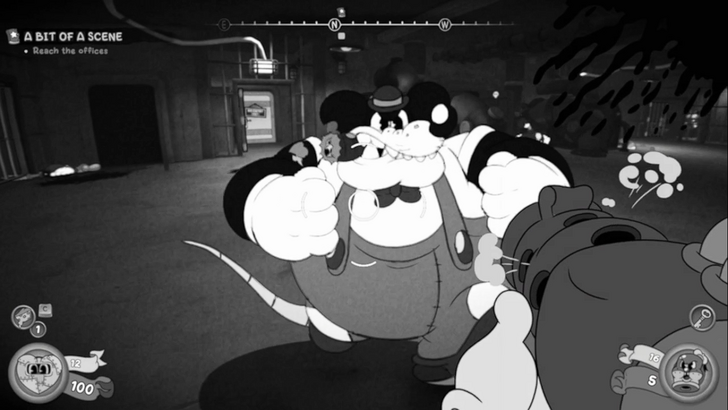
On the surface, MOUSE really does just seem like your run-of-the-mill stylized shooter similar to the likes of Forgive Me Father or Warhammer: 40,000: Boltgun, and it kinda is. The shooting isn’t particularly special, and the enemies are more limited by their cartoonization rather than empowered by it, unlike in Cuphead.
Enemies are rather stiff, save for the bosses, so the gunplay really isn’t that dynamic. That’s not why I rate the gameplay so highly, however. If gunplay were all it had, perhaps MOUSE would’ve been less commendable. It’s a good thing it’s got a ton of other things going for it, too.
More Than Just Squash n’ Stretch Shooting
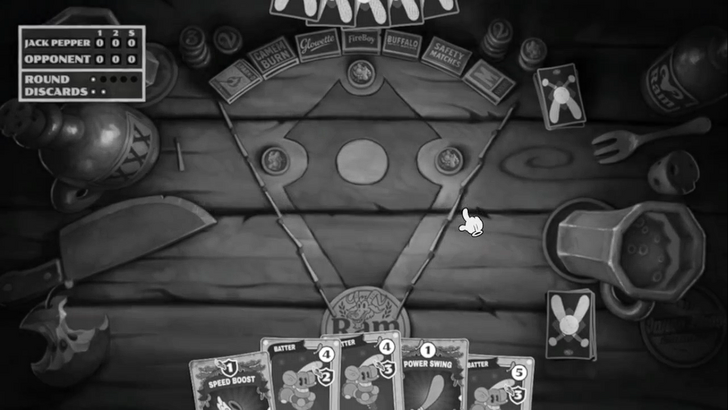
MOUSE has a plethora of other things to do apart from the shooting, and the baseball card game is just one of them. Between alley shootouts and the seedy dialogue in barely-lit rooms with barely-intelligible accents, you can kick up your feet and play a game of baseball cards, which is its own game within the game, rules and all.
I won’t go too deep on the innings and outs of the baseball card game because it’s too much to go through here, just know that it’s light on strategy, but easy to pick up, and increasingly addictive the more you play it. There’s even a grand prize waiting for you if you win enough games, so there’s every reason to partake.
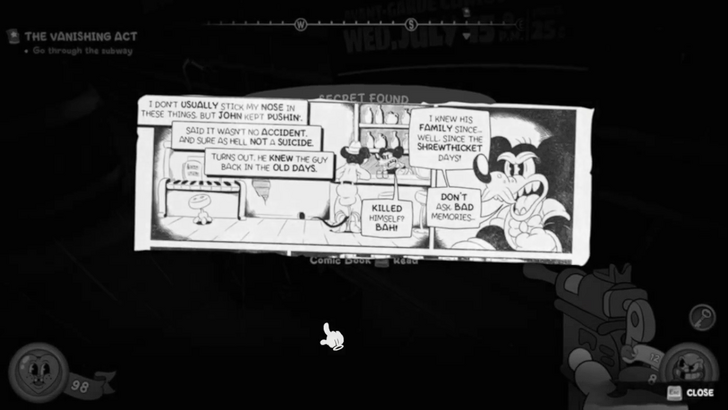
To help fuel this addictive endeavor, you can instead go exploring. Check through levels for nooks and crannies where powerful new baseball cards could be lurking. Newspaper clippings, figurines, and comic books number among the other things you can find, making this as much a collectathon as it is a shooter.
The levels themselves are engaging in ways that aren’t combat-related, too, holding many mini-games of their own, like the tailpicking (lockpicking) mini-game, as well as level-wide platforming and jumping puzzles to break up the shooting gallery segments.
Making FPS Boss Fights Fun Again
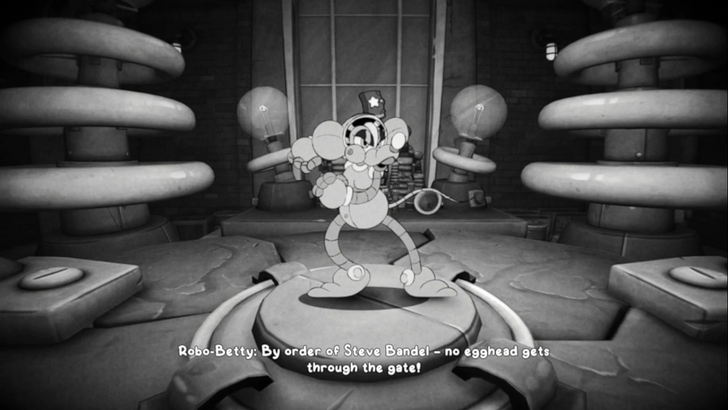
That’s not to say that all the combat is monotonous, though, because some of it’s genuinely great. I speak of the boss fights, which bookend every major section of the campaign with creative encounters. The first one is just a simple bullet-sponge, as is often the design for FPS games, but the ones that follow are all creative in their own way.
My favorite is one of the game’s mid-bosses, who shows up in three separate parts of the level. They show up as a mini-boss for the first two instances, having simple attack patterns and less health, but they combine with the third one in the last encounter for the level to create a chaotic dance of bullets, button pushes, and robotic magician’s assistants (don’t ask).
These boss fights are my favorite part of the game’s combat by far, as they pose a much bigger and more creative threat than the often point-and-click-only goons that go for you for the majority of the game. That said, this upside is a symptom of the game’s only major flaw: pacing.
Not Enough Frames to Save the Pacing
If there was one bad thing I could say about MOUSE, it’s that its pacing is quite slow. Scratch that, it’s very slow, much slower than it ought to be. I get the idea; noir stories are usually slow-burning dramas with plenty of dialogue, so that’s to be expected. I’m just curious as to how that causes my arsenal to still be one gun big two hours into the campaign.
I’d have expected a secondary gun at least a couple of levels in, but I’ve reached the third already with only a pistol in hand, and some hope that maybe a shotgun or something will show up soon.
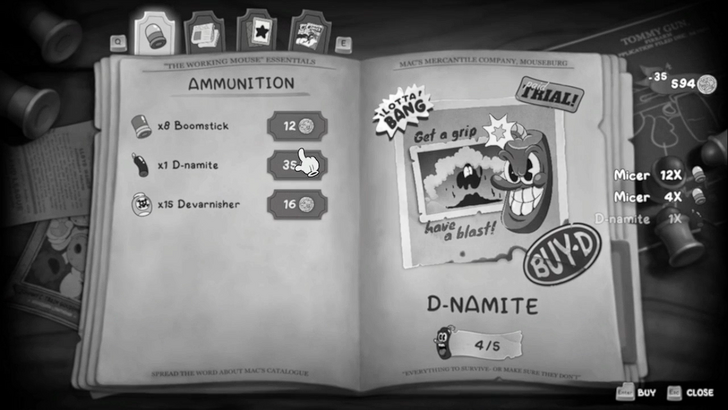
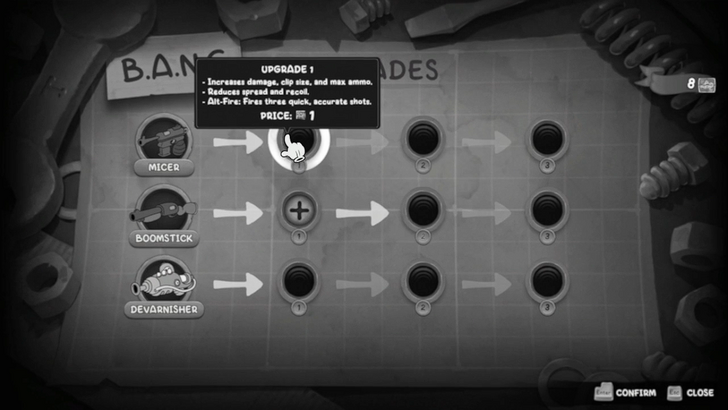
It eventually did, focusing on that "eventually", then it’d be another hot minute before the third one showed up, and so forth. That’s nothing compared to the upgrade system, though, because that’s three boss fights deep, and you’ll be flying vanilla until then.
I understand some pacing had to be sacrificed to keep the game’s noir flair respectful to the genre, but I think bumping up the unlocks a tad wouldn’t have jeopardized that in the slightest.
Big Band Jazz and Golden Age Animation
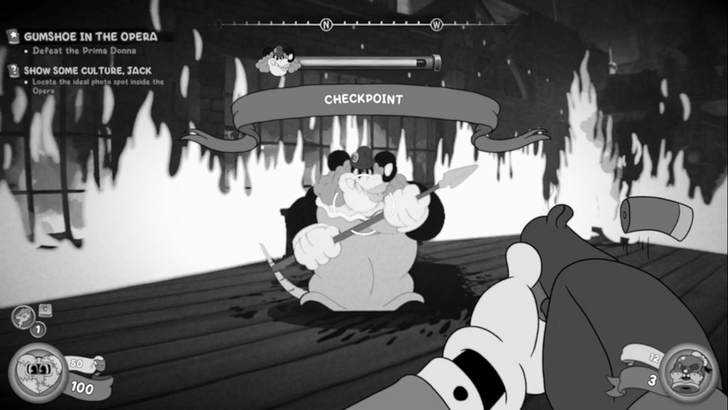
Moving on back to good tidings again, it’s time we discussed MOUSE’s visuals and audio, because frankly, it’s the first thing you notice about the game. Before you even play, you have the option to make the game look and sound as ancient as you want, with various settings for filters and audio qualities for maximum immersion.
And immersion, you shall have, because even in the most modern of both settings, you have a lot of great sights to see and sounds to hear from this game. Big band jazz songs flow freely from the background as you show those goons who’s boss. The blaring trumpets and soulful brass give the otherwise simple level combat a much more energetic feel, cancelling out that con handily. The moment I saw Caravan Palace in the credits, I knew there was no doubt about the game’s audio quality.
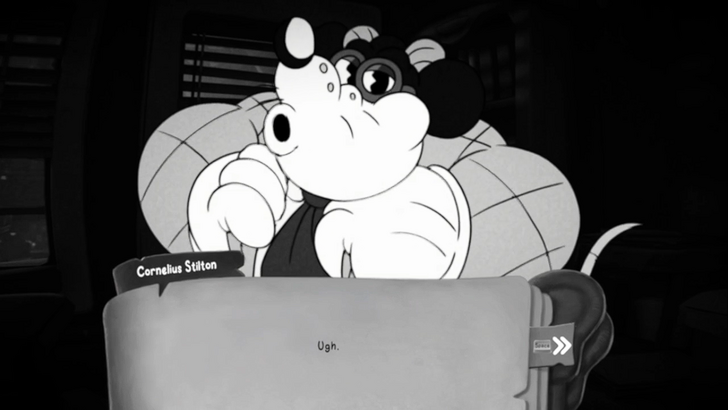
Continuing my commentary on its audio, MOUSE has full voice acting chops to show off alongside its band music, and it’s not by some nobody either. Troy Baker brings Jack Pepper’s rough pipes to life with his amazing performance, and everyone else in the cast delivers just as well. The game didn’t need voice acting to be good, but I sure am glad they went for it anyway.
And the visuals—oh, the visuals. This game looks amazing. It’s stylized to heck, from the smallest details like the health bar being alive and animated to the giant 3D set pieces you fight enemies on, this game has that look on lock.
And it’s not just another variant of Cuphead either. Utilizing 2D sprites for enemies and 3D sprites for literally everything else, MOUSE has a feel that marries past and present beautifully, making the whole thing look like a cartoon come alive in the most literal sense.
The Best Use of This Style In a While
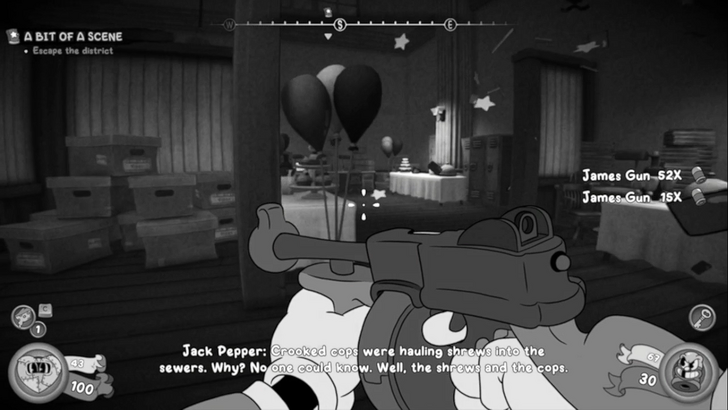
That’s pretty much everything I want to say about MOUSE. It’s a labor of love, as most games that use this style tend to be. It’s a harder method from a harder time that’s otherwise all but forgotten, and I think using it on purpose deserves praise, especially if you knock it out of the park with its execution.
The game has some issues with basic combat being monotonous and unlock pacing being far too slow, but the game’s story, visual design, and audio all make up for it, and then some. It’s an experience that almost anyone can appreciate, and I think there’s value to MOUSE far beyond the squash n’ stretch of its characters.
It’s not the first of its kind, but it’s among the best, and with it being the third to shine, the resurgence of the rubber-hose revival continues with this hat-trick.
Is MOUSE: P.I. For Hire Worth It?
Very Much Worth the Cheddar
MOUSE: P. I. For Hire is an absolute steal, and that’s not just because it costs a measly $29.99. The game has had hundreds, if not thousands, of hours of hand-drawn animation, professional voice acting, and live music performances injected into it, and every minute of it shows.
It looks great, plays well enough, sounds amazing, and has the intrigue to run James Ellroy for his money, all while looking like a Saturday Morning cartoon in the 1930s. That’s a whole lot of effort for not a whole lot of money. If not to play the game, but to enjoy the style, the story, or the music, buy MOUSE: P.I. For Hire, now!
FAQ
How Do I Unlock Alt-Fire for my Weapons in MOUSE: P.I. For Hire?
Players can unlock weapon alt-fire modes using the B.A.N.G., available in Tammy’s Workshop after defeating the Watchamacallit-003 boss fight. Each Alt-Fire mode must be unlocked for each weapon separately.
Can I Upgrade Weapons in MOUSE: P.I. For Hire?
Yes. Players can upgrade their weapons on the B.A.N.G. in Tammy’s Workshop once it is unlocked. Upgrades can be purchased using blueprints, which can be found hidden within levels while on a case. Each upgrade can increase various weapon stats, or even unlock new firing modes.
Game8 Reviews