



| Light and Night | |||
|---|---|---|---|
| Release Date | Gameplay & Story | Pre-Order & DLC | Review |
Overview
What is Light and Night?
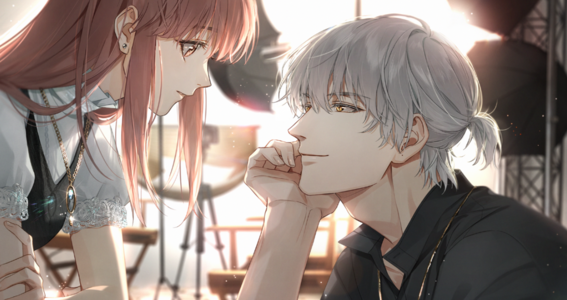
Light and Night follows a young fashion designer whose goal is to create a name for herself in the fashion industry by establishing her own brand. Unbeknownst to her, her presence will set in motion a series of events that will expose an entirely new world complete with supernatural beings, warring clans, and a conflict that threatens the safety and balance of the human world. She soon comes across five mysterious and highly accomplished men whose fates are entwined with hers.
It blends narrative-driven gameplay with card battles and mini games. Players will take on the role of a female protagonist (name customizable) whose story becomes deeply intertwined with the lives of five male love interests. They will be able to experience different storylines and even branching routes through the game’s visual novel format.
Outside of the main storyline, players can get to know their desired love interests by playing their individual stories and routes. They can also grow closer to the five love interests by interacting with them directly through mini games and the companionship/affection system.
For more gameplay details, read everything we know about Light and Night’s gameplay and story.
Light and Night features:
⚫︎ Five Love Interests
⚫︎ A Deep, Intriguing Story
⚫︎ Blend of Modern and Supernatural Elements
⚫︎ Heart-Fluttering Bouts of Romance
| Digital Storefronts | |||
|---|---|---|---|
 Google Play Google Play |
 App Store App Store |
||
| Free-to-play | |||
Light and Night Review: An Oddly Translated Delight
Another Big Contender in the Otome World
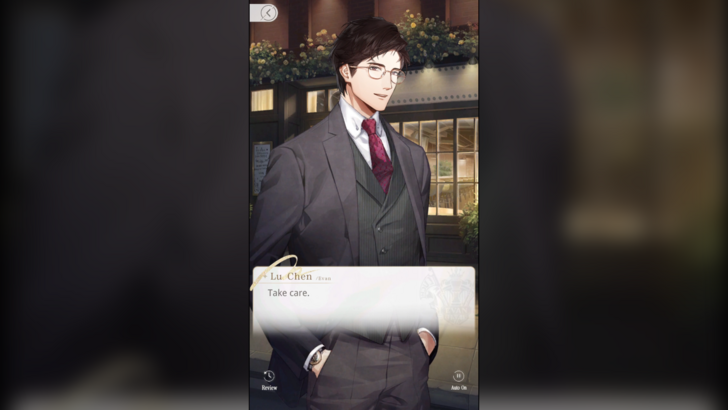
2026 is definitely the year of otome games and female-oriented games. The genre, which has always been popular in Japan, has finally broken through the global sphere in recent years. With the widespread popularity of games like Mystic Messenger, Obey Me!, the Ikemen series, Twisted Wonderland, and most recently the top-grossing title, Love and Deepspace, more and more otoge and joseimuke (Japanese for "aimed at women") titles, both by bigger companies and indie developers, have flourished in the industry. From new upcoming titles to older titles on the Switch localized into English, they’re all making their mark on the global sphere, and it’s not stopping.
One of those games riding on the global trend is Light and Night. Now, don’t come for me—I know Light and Night is immensely popular in China as part of the famed Chinese "otome game Big 6", with five years of service under its belt and a massive audience to boot. And finally, finally, it’s here with an English localization (Light and Night also has servers in Taiwan and South Korea) in SEA.
I’ve known of Light and Night for quite a while, but I’ve never had the time to dive into it nor the patience to go through a game I couldn’t natively understand. I’ve become a resident of Guangqi City for several days now, and here’s a quick review on what to see and expect with it.
Humble Beginnings at Guangqi City
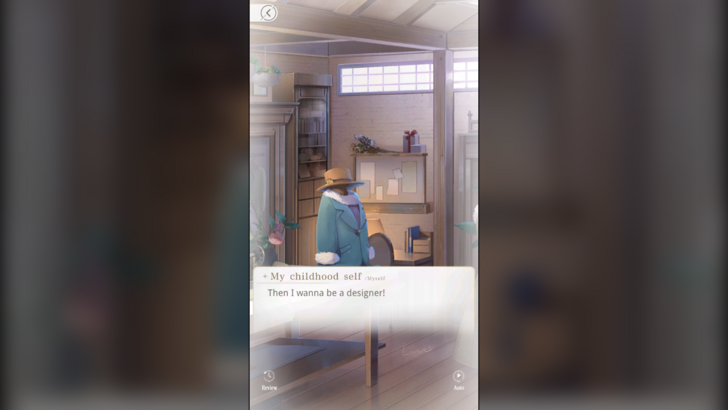
You play as the main heroine (henceforth referred to as MC), an aspiring designer in the heart of Guangqi City. After the conclusion of the competition in the opening and having your talents recognized, you are recruited into Warson, a big-shot design company. Along the way, you get tangled up with each of the five love interests (or LIs, for short) and find out more about the world around you.
The plot in the beginning plays out like a lot of standard K or J-dramas or romcom anime—MC loses the competition she’s been working hard on, and on top of that, is stalked by some hostile-looking men—until she is saved from some hostile people by a dashing young man in a cafe ala K-drama. The next morning, your cold-hearted and sharp-tongued boss seems to have taken a liking to you, the new employee, and you somehow keep running into one of the world’s hottest (in face and popularity, yes) racers in the world. Not that it’s bad—this narrative is tried and tested to work to appeal to many, and with men that attractive, I wouldn’t complain at all. It’s the stuff of dreams.
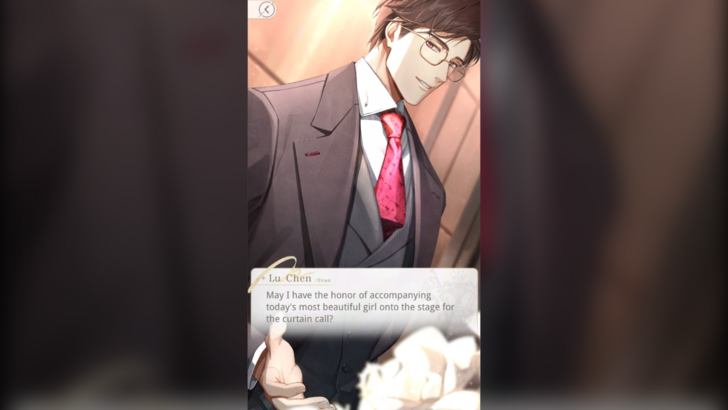
Depending on your choices in certain sub-chapters, you also end up with either the Light ending or the Night ending (surprise, huh?) at the end of each main chapter. I played two accounts simultaneously to see the differences since I was really curious about that even at CBT—but as expected, it doesn’t directly affect anything in the long run. Each ending just features a different LI with different dialogue and direction. For instance, one chapter ending features Qi Sili "helping" you out by barking orders, while the other has Lu Chen instead, who, by virtue of being the nicest man (presumably) among the initial three, actually takes up the job you were left with.
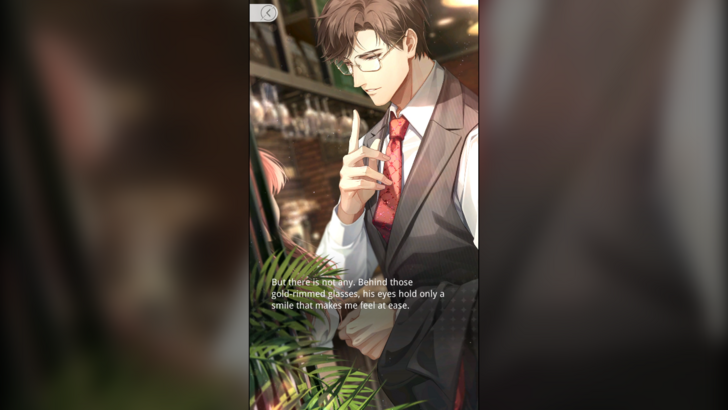
But that doesn’t mean the story itself is superficial and just sells hot men for the sake of it. Further chapters reveal that there’s more to Guangqi City, the LIs, and the MC herself than meets the eye. Head honcho designer Qi Sili (Sariel) is sharp, critical…and appears to know how to talk to lizards; Lu Chen (Evan) appears like the perfect rich husband-to-be on the outside, but there’s something eerie about his perfection and his family; and Xiao Yi (Osborn) seems to be more than just a top R1 (this universe’s version of F1) racer. Really mysterious stuff.
By Chapter 3, things start taking a turn towards these darker themes, of fantasy and the paranormal. The first two chapters were so remarkably normal for the most part that you wouldn’t think there was anything going on behind the scenes (apart from a few suspicious instances, but I digress). After it settles you into the rhythm of Guangqi City and your position as an up-and-coming Warson fashion designer, it breaks your "spell" of a normal life with incidents that, quite literally, put you in danger.
I wouldn’t want to spoil anything, as a game’s story is best experienced through one’s own hands, but it deserves applause for being rather well-written (at its core) and a joy to read. Mostly. And I say mostly because the story feels and looks great, but the English localization? Ack, the woes of being lost in translation.
Awkward Localization
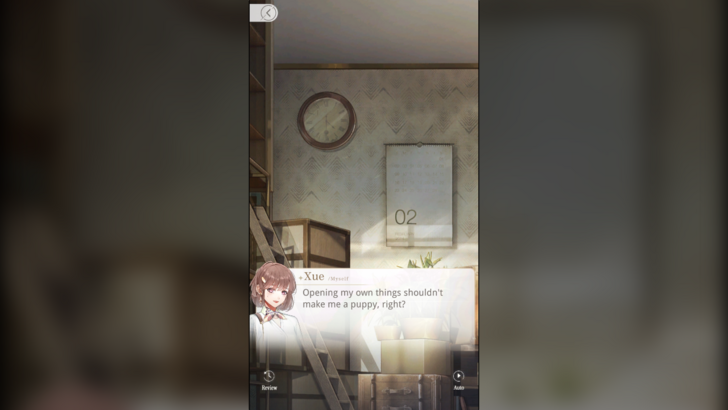
There are several instances where written sentences just don’t feel right or don’t feel like they were translated properly. I can’t speak for the Chinese dub, and I don’t know if they’re actually localized well, but as an English speaker, some sentences are just phrased awkwardly. Of course, there’s always a little bit of nuance lost in translation in any translated game, but if the English sentence doesn’t even look right, then how is it supposed to properly give the same feeling?
For example, the line above; "Opening my own things shouldn’t make me a puppy, right?" MC here is opening a cookie tin from her childhood that she and her childhood friend Xia Mingxing hid away. Written across the top is "DO NOT OPEN! Opener = puppy!!!" It’s grammatically correct, right? But it’s definitely a sentence that was perhaps translated too literally. Is it because puppies are too inquisitive? Or something along those lines? After a bit more research, I was unable to find the meaning of why it was called puppy, and instead stumbled upon a separate translation done by fans for the CN server—which mentioned absolutely nothing about being a puppy and was more threatening, something along the lines of swallowing a thousand needles for breaking the promise. And that’s…only one example of how weird the translation can be.
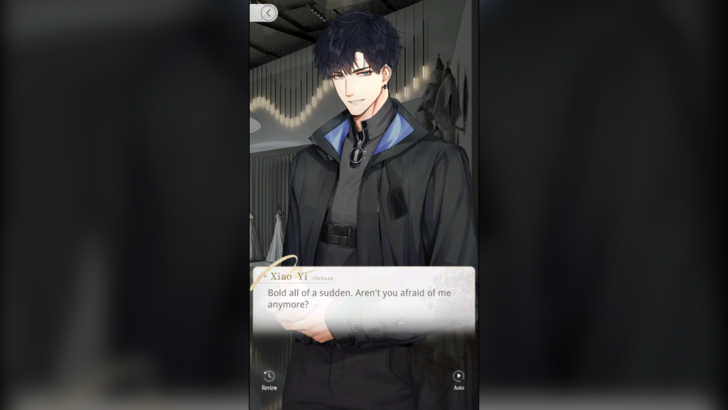
Unfortunately, the deeper you go into the story, the more the localization worsens. Sentences are oddly written and don’t seem to capture the deeper meaning. Again, one of Light and Night’s main appeals and why it’s so popular in CN is that it’s written well, and the story becomes more intriguing and a delight to read the more you go in—unfortunately, I’m not feeling the entirety of it with these translations. It’s not terrible to the point of completely missing the core of it all, but it’s lackluster for sure.
This extends to UI translations too. One of the earlier confirmation popups read "Understanding" instead of just "Confirm" or "Understood", the latter of which is a bit strange as a UI choice anyway. There are also a few wrong labels, such as in the mobile phone when wanting to video call one of the LIs. Zha Lisu and Xia Mingxing’s portraits are incorrectly labeled with "Unlocked" despite not being clickable.
Mainly a Visual Novel with A Dash of Combat
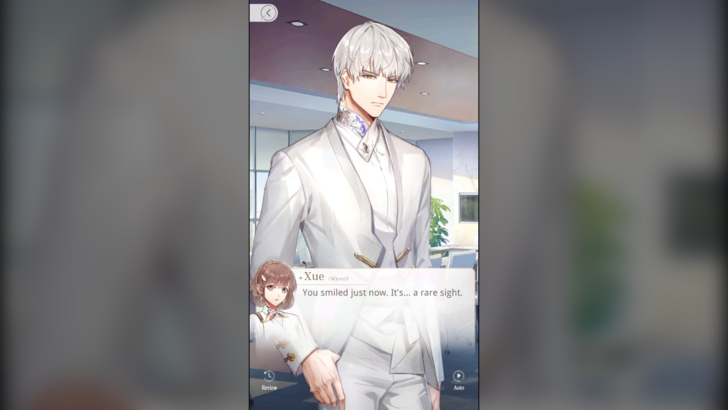
Light and Night, much like its contemporaries like Love and Deepspace, Tears of Themis, Lovebrush Chronicles, Mr. Love: Queen’s Choice (RIP) and many other modern otome games, makes storytelling central in its gameplay. Most otome games fall under the visual novel category with some gameplay elements, and Light and Night is no different.
Its main story is the driving force of the game and of advancement. Because of that, a lot of its core mechanics, like where to gather materials for Bonds (what they call the collectible cards or Memories (if you’re coming from Love and Deepspace), character stat upgrades, and even parts of the in-game shop are locked behind main story progression.
It’s definitely not a game where you can just breeze through things easy-peasy. One chapter can have 20+ sub-chapters or nodes to go through, several of them combat-related, or a rhythm mini-game for "creating" design pieces. You’re unable to progress through the story without upgrading your Bonds, and you will definitely need to farm a plethora of resources to get your battle team up to speed, so the game makes sure you’re not just trying to skip through everything. Hell, even the game itself constantly puts out a notification to "take it slow".
This becomes more apparent in the later chapters of the game, where you would start needing Bonds at level 45 and above—these aren’t just suggestions; they’re pretty much requirements. You can get away with being underleveled by one or two notches, taking control of the battle (auto-battle can be…pretty dumb) and using the correct Bond Attributes (like their elemental affinities), but more often than not, you will need to reach the level requirement to pass through. My second account is stuck at Chapter 6 because I can’t get my Bonds to higher levels without being completely broke in Aurora Coin. Playing the long game is key.
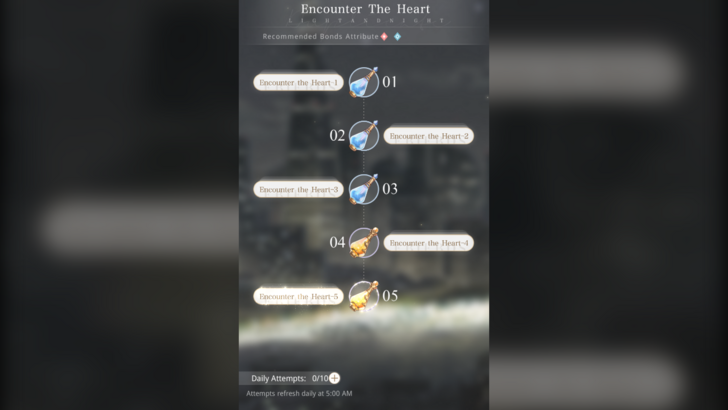
What’s more is that getting these resources to level up is not entirely easy and requires several days to do properly. The dedicated nodes for EXP materials, Imprint (Special Skill) materials, Reflection (alternate art and stat boost upgrade) materials, and even Aurora Coin (in-game currency) have a daily limit of 10 attempts per day unless you pay with Polaris (main paid currency) to replenish them. Grandma’s Shop, the mode to get Ascension materials, offers opportunities to get the aforementioned materials unlimitedly, but at a drastically lower rate that it’s probably not worth spending all your energy on unless you have some to spare.
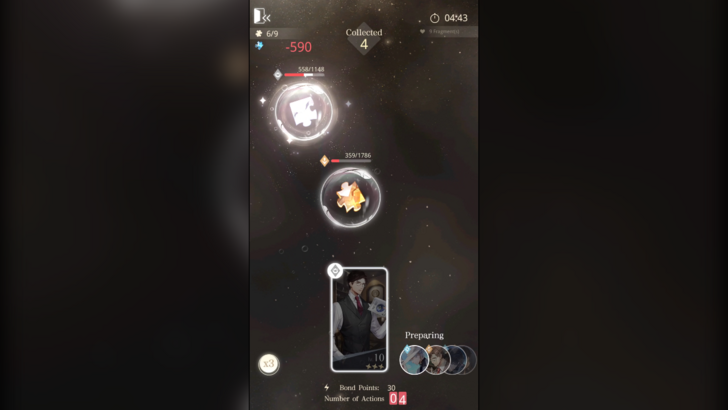
The combat itself is simple and turn-based, most similar to the 2D games mentioned above, like Tears of Themis and Lovebrush Chronicles. You have a squad of five Bonds that attack these bubbled Fragments, which you chip HP away at. They aren’t hostile, but you will only have a set number of rounds and a limited number of turns to defeat them. Hence, the importance of leveling up your Bonds as these combat nodes get more difficult to defeat the deeper you go.
For the romantic players who want that sprinkling of cute date scenes with your chosen LI, of course, Light and Night has got you covered there as well. Outside of the main story, there is the Fateful Encounter mode, which has the free unlockable Encounters (accessed after completing certain chapters in the main story), or the Memory chapters, which require you to possess the corresponding 6-Star or 5-Star Bond and level it up to 20 or 30.
Encounters play out like a usual otome game route, with branching choices and different endings. You’re free to replay them at any point without having to redo from the start, which is great for completionists (and for those curious about how the other choices play out). Memories, on the other hand, are more linear—one storyline with three to four side detours before playing out exactly the same in the end. You can either interact with them, like patting their head; listen to an ASMR-like clip of them talking; or go straight to the storyline that also shows the corresponding Bond’s Reflection or cover art.
Pleasing, Aesthetic Audiovisual Presentation
Putting aside the incredibly attractive men for a bit, the game looks really pretty even beyond the LI’s visuals. You, the MC, look just as stunning as the men that surround you, and so do the NPCs, in a more casual and normal but charming way. I’m really liking An An’s design, so it’s a joy seeing her on screen whenever. The backgrounds are decent as well, detailed enough to serve their purpose and to paint the scenario effectively.
The UI, although it may feel like it's all over the place, is pleasing to the eyes. Nothing too flashy that it burns the retinas or awkward color palettes that blind you, and instead you’re greeted with soft, elegant colors like white and gold, navy blue, and the like.
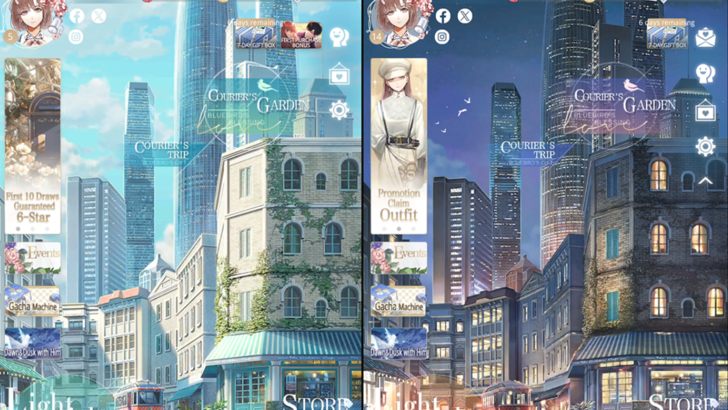
One little detail I appreciate is the commitment to the light and night motif right at the home screen—the background changes depending on…well, if it’s morning or night. From a bright teal and sky blue at noon to a muted orange-purple at night, it’s gorgeous. It’s a feature found in other games like Love and Deepspace and Lovebrush Chronicles as well, but there’s just something about it being in the game called Light and Night that makes it perfect.
Although, as with its contemporaries, it does end up reusing quite a bit of background assets. The entrance of the grand Lu estate looks exactly the same as Gao Xuan’s cafe from Xia Mingxing’s mini-event story. Just a bit of a nitpick, but it’s a minor issue and one that is frequently found across multiple otome games anyway. I just find it amusing.
The audio also is quite lovely. A lot of classical-themed piano pieces are in sweet, lighthearted scenes, with the right mix of stronger, heavier beats made with hints of violins and electronic music in more tense situations, and they all play perfectly to whatever is going on screen. My favorite track has to be the one that plays in the main story chapter menu, but each of them so far has been great to listen to.
And of course, the main story is fully voiced (except the main character, of course, as with any otome) from the LIs to the NPCs, which is always a nice touch. Although, as much as full voice acting is great in any game, perhaps you may want to stick to the original Chinese dub for this game.
Some of the English Voices Feel Flat
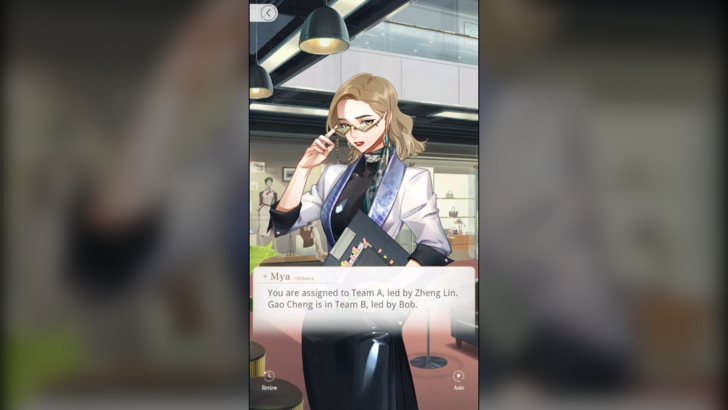
The English voice acting could use some work. Some of the NPCs' lines, and even the LIs' lines, fall flat in their delivery as if they were amateurish students playing a part for a grade. Some of them don’t feel natural and sometimes cringey, which kind of breaks the immersion of it all. Personally, I find myself already warming up to Xiao Yi’s English voice, and Lu Chen’s oddly nice British accent is great, but Qi Sili has this nuance that just feels…weak, which is strange for a guy who supposedly has an air of being arrogant and who knows he’s on the top of everything and everyone. Zha Lisu doesn’t hit the right way either, but Xia Mingxing is pretty decent.
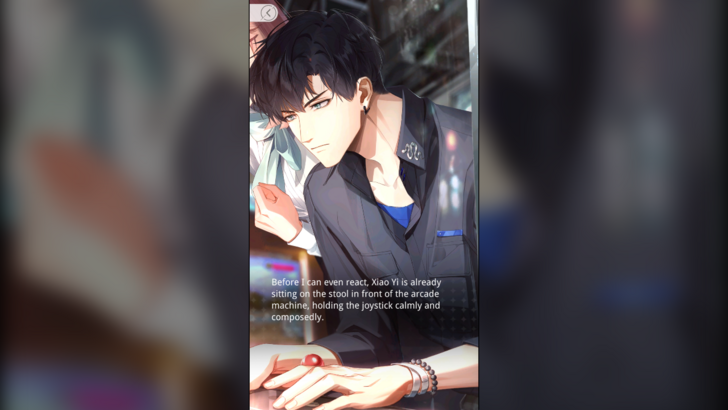
In another vein, sometimes the English lines don’t match what the text says, or one or the other is missing. There’s this one instance where Xiao Yi calls you Miss Navigator, but the text reads him saying Miss Lost instead. Right after that, he completely misses out on saying the other half of his line on the dialogue box, which is quite a bummer.
Monetization Feels Expensive
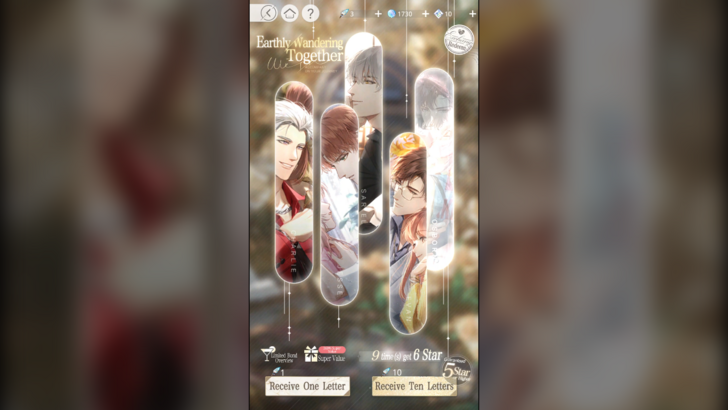
Another thing I’m pretty bummed about in Light and Night is its monetization. Much like my gripe with Stella Sora before, a pull is quite expensive. At least Light and Night didn’t pull the rug from under us and change up their economy last minute, but I do have to admit—it’s more expensive than what most players would be used to in other otome games.
A pull, or a Letter, is 300 Ursa Minor (premium currency strictly for pulling). F2P players will, at the very least, not including non-renewable resources like First Time Clear rewards after clearing chapters, collect 100 Ursa Minor from completing dailies (50) and buying the daily 50 Ursa Minor from the Academic Journey tab.
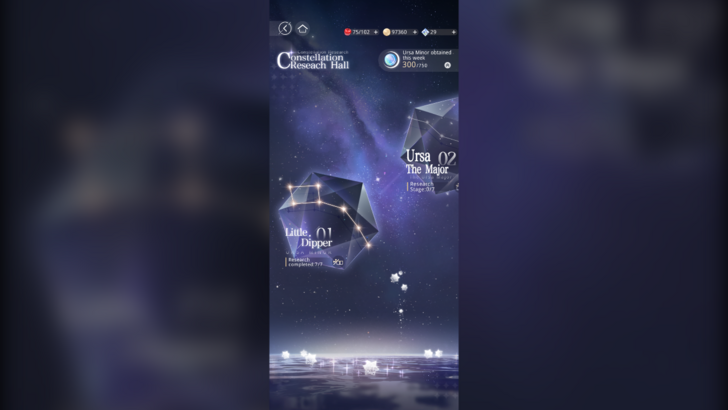
Upon playing further into the game, there is, indeed, a game mode called Constellation Research that allows you to farm up to a maximum of 800 Ursa Minor (provided that you have cleared the main story up until at least Chapter 6) per week. Add to that the 700 (daily renewable 100 as mentioned before), and you have 1500 Ursa Minor weekly. In a span of a month, you can then scrounge up enough for at least 20 pulls with the barest daily effort, which is, in hindsight, not too bad. You can further up the ante to a minimum of 35 pulls by purchasing a Monthly Pass that gives 150 Ursa Minor a day.
6-Star Bonds have a 2% rate, 5-Stars have 10%. Standard stuff, as far as I know. Nothing wrong with the rates, but the main pull currency is just…expensive and definitely not the friendliest to F2Ps (free-to-play), so saving and focusing on only one LI is the best option for those not willing to swipe that card. Hard pity of getting a 6-Star Bond caps at 70, but there is absolutely no 50/50 guaranteed pity here, similar to Arknights: Endfield. You can lose multiple times to the wrong 6-Star, and judging from the first-ever limited-time banner for this server, Ocean Whispers in Moonlight for Qi Sili, these events are pretty short with only a week to spare. Not too sure yet about multiple LI banners (multis, for short), but perhaps they’re a bit more generous with two weeks, maybe.
However, there’s a bit of a silver lining in the form of the spark system—every pull, no matter if it's a single or a 10-pull, will net you a Heartfelt Letter, which can then be used to purchase 6-Stars and 5-Stars outright from the Bonds shop. 6-Stars cost 180, while 5-Stars cost 80. And based on my observations, these Heartfelt Letters, even from pulling on a limited-time banner, will not expire. So technically, you can save up for future banners as well across multiple events. Tough luck though, if you’re specifically aiming for that really nice Bond from the present banner, but it is what it is.
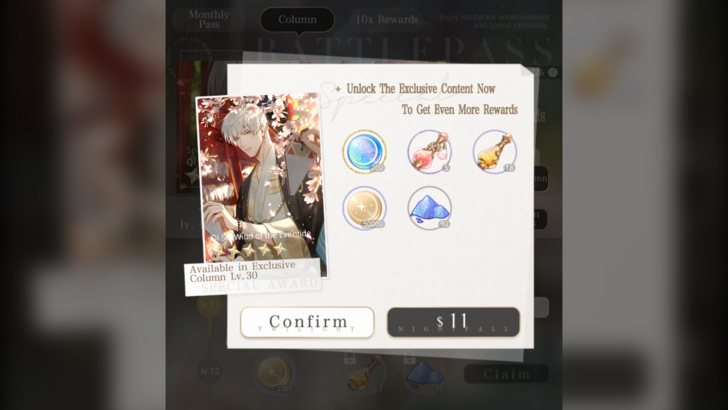
On another note, they do really like advertising their packs whenever they can. For example, every time you collect your rewards from the Column (the game’s Battle Pass, Promise, whatever you want to call it), it just keeps pelting you with the pop-up to buy the upgraded version for more rewards.
What doubly sucks is that there’s no Claim All button, so you have to go through that pop-up multiple times if you’re claiming several of them. It’s way too aggressive and is more of a turn-off than what it's worth.
Is Light and Night Worth It?
Worth It…If You Can Forgive The Localization
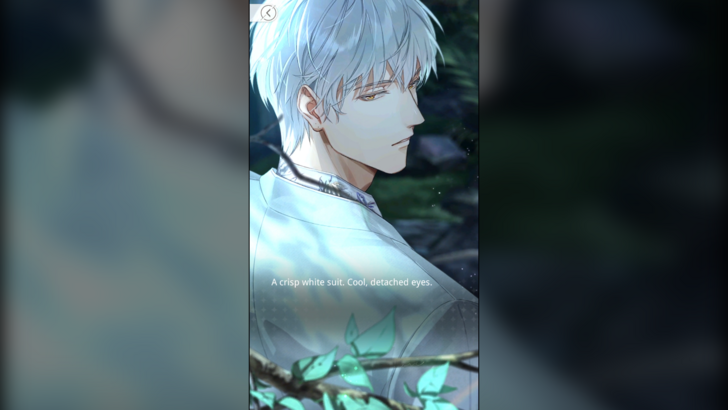
The Light and Night SEA server definitely needs a hefty chunk of polish, especially in localization. However, if you can overlook its lackluster translations, its foundations are more than enough to keep you around—attractive men, an intriguing story with supernatural abilities and beings, decently good audiovisuals, and the splash of romance with said attractive men.
Be forewarned though—even with some other types of gameplay in there, it’s still essentially a visual novel. If you’re just here to gawk at the handsome LIs, then you’re very much free to do so, but the storyline is where it’s all at for full appreciation.
With that being said, I believe I’ll be here in Guangqi City for a much longer time than I anticipated. The grind never stops until I get Qi Sili to finally crack that sharp exterior.
| Digital Storefronts | |||
|---|---|---|---|
| Google Play |
App Store |
||
| Free-to-play | |||
FAQ
Where to download Light and Night?
Light and Night can be played on iOS and Android through the App Store and the Google Play Store. Alternatively, the game’s APK can be downloaded straight from the official Light and Night SEA website.
Game8 Reviews