



Kernelbay is a cozy idle fishing game where players earn money, unlock upgrades, and gradually explore different islands, each with its own ambience and soundtrack. Read our review to see what it did well, what it didn't, and if it's worth buying.
Overview
What is Kernelbay?
Kernelbay is a cozy idle fishing game where players slowly make their way through six different islands, each with its own ambience and aquatic wildlife. Gameplay is minimal, with players tasked with improving their fisher through skill point allocations and gear upgrades. The game is meant to run in the background, consuming minimal resources so players can do other tasks alongside it.
Kernelbay features:
⚫︎ Resource-friendly
⚫︎ Minimalistic Artstyle
⚫︎ Simple Gameplay and Systems
⚫︎ 72 Fish to Unlock
⚫︎ 6 Islands with Dedicated Wallpapers
⚫︎ 12 Curated Songs
| Digital Storefronts | ||
|---|---|---|
 Steam Steam |
||
| $3.99 | ||
Kernelbay Review: Solid Vibes
Idle and Fishing Go Hand in Hand

Fishing in games has always been one of those things people either completely ignore or sink hours into. There’s just something relaxing about sitting near a body of water, throwing out a line, and letting time pass while waiting to see what bites.
Kernelbay leans heavily into that idea, though it sits closer to a laid-back desktop companion idle game than a traditional fishing experience. Most of the gameplay happens passively in the background rather than through active control, letting players leave it running while they do other things.
From there, Kernelbay builds its progression around that same passive loop through licenses, Pearls, and skill upgrades. Some systems work better than others, but together they shape how progression unfolds while the game quietly runs in the background.
Booting it up and seeing it immediately sit over my desktop was probably the clearest first impression—just me and a fisher already out there doing their thing, catching fish for no real reason. Then again, who really needs one to throw a line offshore and hook some bass?
Stay a While and Listen
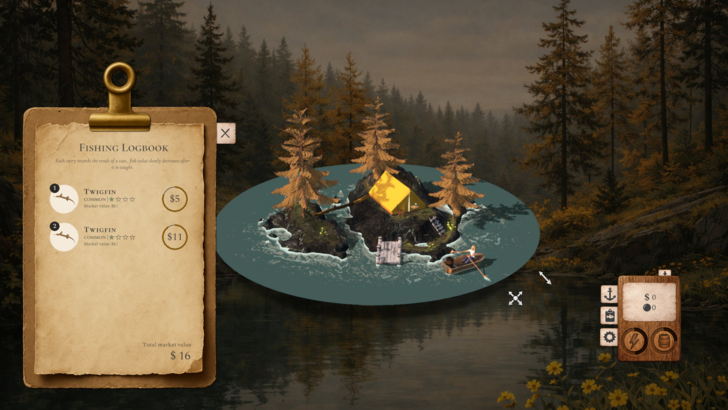
Kernelbay doesn’t really have a story tied to it, to be frank. Players jump straight into the inaction, with their fisher already out on the water, pulling in catches for the session. Instead, the game shines through its quaint, minimalistic environments and a soundtrack that changes depending on the island you settle on. The islands feel like dioramas, each with some kind of shelter, bits of natural fauna, and a dock.
What makes the game truly immersive is the sound. Each island carries its own ambience and soundtrack. For example, the first island, Wendin, feels alive with birds and crickets chirping, accompanied by a soft, emotional guitar solo.
Without a story to lean on, the game never really feels like something is missing. It also means there’s less competing for your attention while it’s running in the background, which fits the way Kernelbay is designed to sit alongside whatever else you’re doing. If anything, the lack of one helps reinforce the kind of experience Kernelbay is going for. There’s no pressure to stay locked in, follow dialogue, or constantly check what happens next. Instead, it creates a calmer rhythm where players can simply exist alongside the game rather than feel committed to it.
A License to Eel
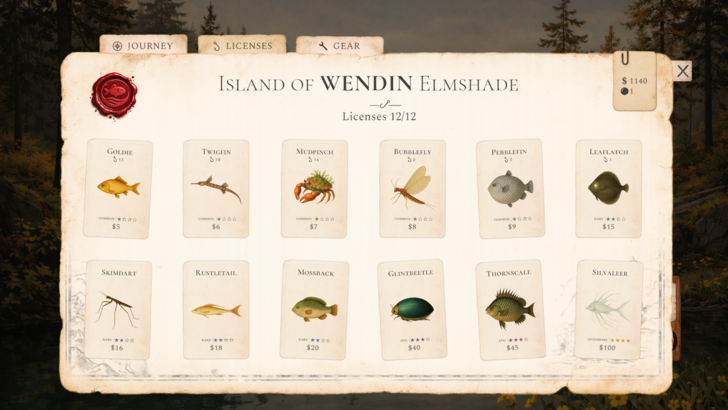
This is the kind of game where you set it and forget it. Booting it up is quick, and your fisher does their job ad nauseam whether you check in or not. Most of the interaction comes from using the money earned through fishing to increase your profit gains, through systems like fishing licenses, Pearls, and skill points that scale upward in cost as you progress. Fishing licenses in particular unlock new fish species across each island, replacing the usual fishing loop of random catches from a shared pool with a structured progression system where each of the 12 licenses per island corresponds to a specific fish type, ranging from Common to Legendary.
That’s when it becomes clear the system isn’t really about fishing anymore. In most fishing systems, especially in MMOs, the appeal comes from unpredictability: you cast a line and never fully know what’s coming up from a shared pool of fish. Kernelbay strips that away entirely by turning discovery into a fixed unlock path instead. Combined with the lack of any flavor text or context for each fish, it feels less like catching anything and more like ticking entries off a database.
At that point, progression stops being about what you might catch next and instead becomes a matter of working through a predefined list as efficiently as possible. The randomness that usually gives fishing systems their small moments of surprise just isn’t part of the equation here.
Charted Waters and Cultured Pearls
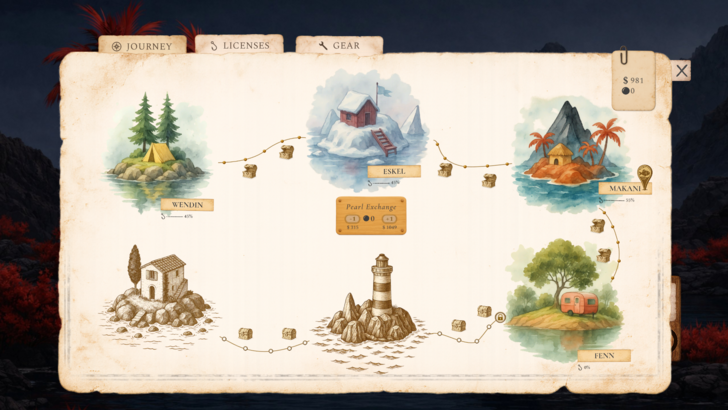
Next up are Pearls, which are primarily used to unlock nodes that lead to other islands on the Journey tab, the in-game map. These also get more expensive as you buy more. There are six maps in total, each requiring players to progress through five nodes. Every second node grants rewards ranging from money and Pearls to gear upgrades.
I found myself enjoying the process of buying nodes, mostly because gear upgrades actually show up on your deployed fisher. Since the stat boosts themselves are hard to notice early on, I ended up looking forward to the visual changes more than the numbers attached to them.
What I liked more about the Pearl system was how it naturally let me decide when I was done with an island. I could keep investing into licenses and skill points to make more money where I already was, or start saving Pearls to move somewhere new and pick up rewards on the way there. The choices themselves aren’t especially deep, but they do a good job of letting progression unfold at your own pace instead of constantly pushing you forward.
Almost Pro Bass
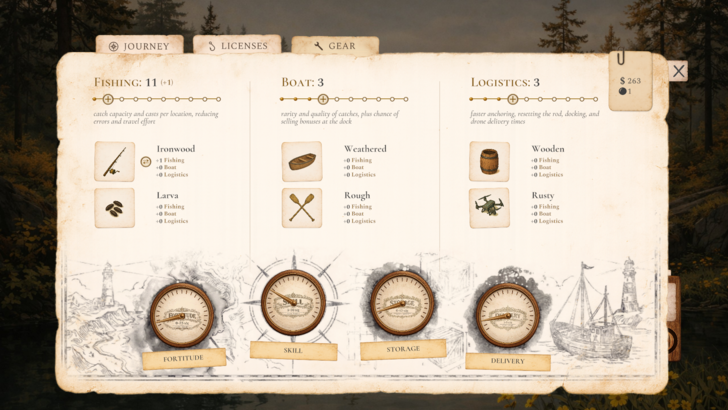
Finally, there are skill points that improve different aspects of your fisher’s capabilities. Fishing speeds up catch rate and reduces energy consumption, Boat improves the rarity and quality of fish, and Logistics speeds up movement and drone delivery time. Each stat can be leveled up to 50, with additional boosts coming from the gear upgrades mentioned earlier.
This is where Kernelbay starts to struggle a bit, because while the system clearly explains what each stat is meant to affect, those effects are rarely noticeable in moment-to-moment play. You’ll see numbers go up and read descriptions like "reduces errors" or "faster anchoring," but in practice it’s hard to tell when those changes are actually happening, especially in an idle setup where you’re not actively controlling the fisher. Even small endgame boosts—like +7 Fishing, +6 Boat, and +5 Logistics from gear—end up feeling abstract rather than impactful.
Because of that, there’s a bit of a disconnect between what the system says it’s doing and what you actually notice while playing. In an idle game especially, that gap stands out more. Most of your sense of progress comes from watching numbers tick up rather than seeing anything change moment to moment, which becomes even more noticeable in Kernelbay since the game is always sitting there on your desktop in plain view. So even though the skill system is technically working, it doesn’t always feel like it’s doing much in practice, which makes it harder to care about upgrading it beyond the numbers themselves.
Travel Light, Hope for More
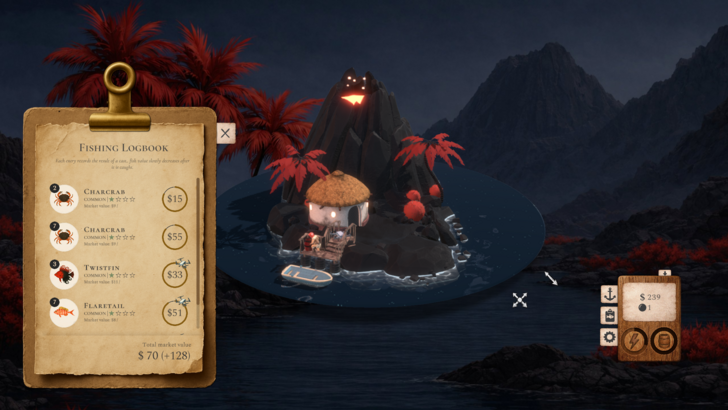
Going off into the more technical side of things, Kernelbay is a very lightweight piece of software. From my observations, the game ran at around 250MB of RAM, which is smaller than a single Google Chrome tab. It does help that it’s capped at 30fps with minimal graphics options and a total of 12 songs spread across six maps, but there are a few additions that would be nice to see.
Its nature as an idle game means it thrives on being left running on your PC. Just set it and forget it, simple as that—but it could use a bit more utility to justify keeping it open. A timer, for example, could go a long way. It could serve productivity purposes, remind players to take breaks, or even just prompt you to check back in at the dock to see if you can afford the next bundle of Pearls to unlock a node or island.
It doesn’t ask for attention, which is exactly the point. It works best if what you want is something lightweight running in the background while you do other things. At the same time, that low-resource approach also feels like the reason some parts of the game come across as so minimal. Between the restrained animations, limited visual feedback, and subtle progression systems, Kernelbay sometimes feels like it’s holding itself back in order to stay as lightweight as possible. I get why it’s designed that way, but it does leave the game feeling a little too restrained at times.
Is Kernelbay Worth It?
Keeping it Reel—It's a Good Idle Game

Kernelbay is exactly what it sets out to be: a cozy idle fishing game. It doesn’t take up too much space, and it doesn’t get in the way of anything else you’re doing. With no real story to follow, most of its appeal comes from its graphics, soundtrack, and the dopamine hit of unlocking a new island to vibe on—most of which it delivers well.
While upgrades may leave something to be desired, the game doesn’t really rely on them for enjoyment. I like seeing bigger numbers, so part of me does wish the system had a bit more polish, even if it isn’t strictly necessary for the experience it’s going for.
If you’re looking for a game you can leave running and check in on from time to time without it slowing down your PC, Kernelbay won’t disappoint. It’s no deeper than a pond, but it isn’t trying to be more than that. Instead, it aims to provide comfort and relaxation from a quiet corner of your desktop. And that, I think, is worth it.
FAQ
Will leaving Kernelbay open cause my PC to lag?
No. As mentioned above, Kernelbay uses minimal resources, allowing it to run alongside other applications without issue.
Game8 Reviews