


| inKONBINI: One Store. Many Stories | |||
|---|---|---|---|
| Release Date | Gameplay & Story | Pre-Order & DLC | Review |
Overview
What is inKONBINI: One Store. Many Stories?
inKONBINI: One Store. Many Stories is a cozy, slice-of-life simulation game where players take on the role of college student Makoto Hayakawa, working for a week in her aunt Hina’s convenience store, Honki Ponki. In those six days, she learns more about the stories of the people who come to visit and, along the way, helps them out with their predicaments…and finds her own goal too.
For more gameplay details, read everything we know about inKONBINI: One Store. Many Stories’s gameplay and story.
inKONBINI: One Store. Many Stories features:
⚫︎ An Early 1990s Japan Vibe
⚫︎ Cozy Store Management
⚫︎ Slow, Relaxing Gameplay
⚫︎ A Wonderful Cast To Get To Know
| Digital Storefronts | ||
|---|---|---|
 Steam Steam |
||
| $19.99 | ||
 Playstation Playstation |
 Xbox Xbox |
 Switch Switch |
| $24.99 | ||
inKONBINI: One Store. Many Stories Review: The Chillest Konbini on Eart
A Brief Time of Respite
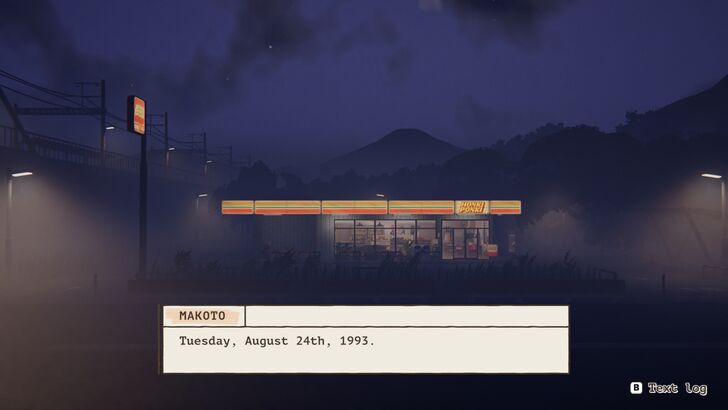
inKONBINI: One Store. Many Stories (henceforth referred to as simply Inkonbini) is a game I was heavily looking forward to ever since its announcement. Retro Japan, colorful, soft visuals, and going around a konbini—it sounded absolutely delightful from the get-go.
I was lucky enough to try out its demo as well when it was available, and upon its completion, it only fueled more of my excitement for more. In a world where everything blazes past too fast, too quick, that tiny bit of konbini fun was a good, short respite.
And here we are, months later, now launched in its warm, heartfelt glory. Honestly, my time with Honki Ponki and its patrons was incredibly short and not as captivating as I was expecting it to be, but it’s memorable enough and served its purpose well: to remind people that sometimes, you just have to take life slow and not rush into everything, that despite what life throws at you…life goes on.
A Week At Honki Ponki
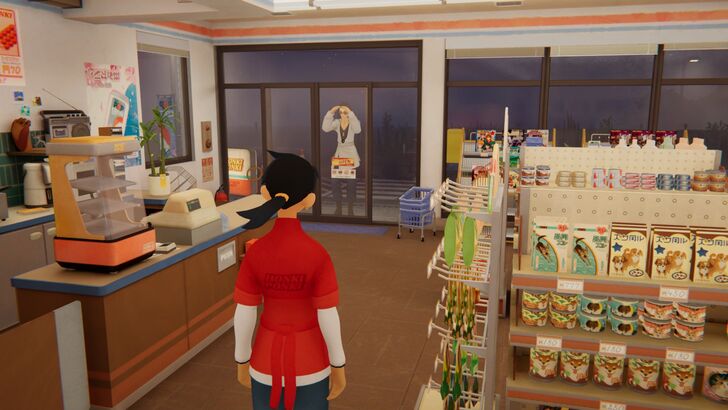
You play as Makoto Hayakawa, a young college student from early 1990s Japan, back in her countryside home for the summer. Vacation’s about to end, and your idea of a last hurrah before you return to the city is to help out at your Aunt Hina’s convenience store branch named Honki Ponki for a week (although technically six days) after she needs your help. You take the night shifts from Monday to Saturday, catering to the whims and requests of the chillest customers on the face of the Earth. It must come with the rural aesthetic.
As you go through the motions of the night shift part-timer life, you also get to know the stories of four interesting characters—Chief, your aunt’s old friend; Satoshi, the twelve-year-old with an eye for business; Naomi, the newspaper reporter on a trip; and the Mystery Man, who doesn’t speak and only answers yes or no questions (weird, I know, but bear with me). Each of them is going through their own problems, and they seem to find themselves comfortable in Makoto’s presence, allowing them to spill their life stories.
And of course, as the main character, Makoto serves as their voice of reason, given choices as to what to say to lift their spirits up. While there are several choices, they’re all kind of the same in scope—it was always something positive. In this peaceful pocket of peace, tucked away in the countryside, there is no space for massive drama or negative emotions. Just a konbini employee and her heartfelt, heart-to-heart conversations with her patrons.
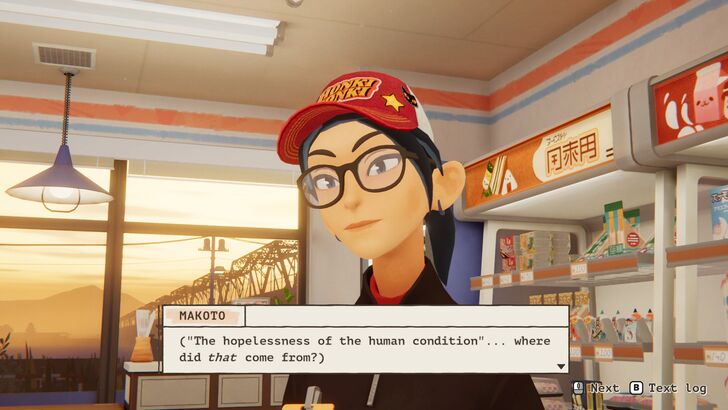
The game also has the "Many Stories" tagline, which, in hindsight, is true. However, it wasn’t as "many" as I thought it would be, but it’s not an inherently bad thing. Aside from the stories of your four rotating customers, you also dabble in the stories of the day shift workers, your Aunt Hina, and other townfolk from context clues and random anecdotes tucked away in the store.
The "many" other stories require a bit more digging on your end to be truly found. I was surely caught off-guard for a bit when I found an extra bit of lore at the end of the playthrough, where you dedicate a bit of time every day at a certain corner of the backroom. The conclusion of it wasn’t anything groundbreaking, but it did get a little laugh and proud smile out of me and a deeper understanding of another character that I never got to see face-to-face. Observation is key here, as it’s those little details that count in the long run.
A Narrative Adventure With Simulation Elements
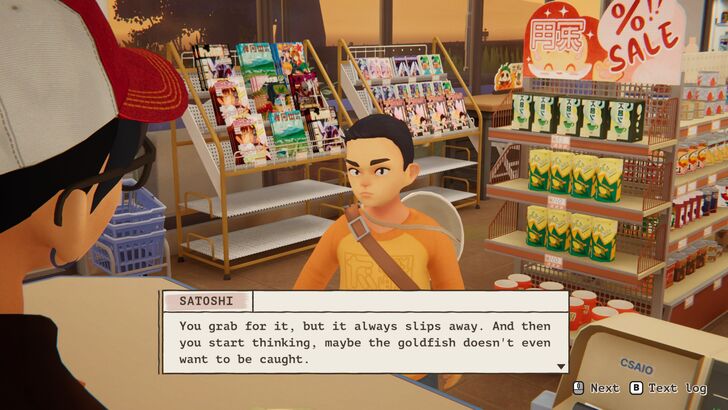
Let me say this straight out—you might think a convenience store game equals resource management, right? Well, in this case, it’s not. Inkonbini, despite what its visuals and colorful shelves of products with quirky packaging would imply, is not your run-of-the-mill business simulator, nor can it be actually considered one.
Inkonbini is a narrative-driven, slice-of-life "adventure" game where your entire playthrough revolves around the three areas of the konbini—the back room, the shop proper, and the outside. There are elements of simulation games like stocking shelves, counting change in the cash register, and ordering delivery through the phone, but they’re more there to just pass the time and to fulfill what are essentially fetch quests for the customers. If they’re looking for something specific, you help out, then engage in some conversation, then check them out at the counter. Rinse and repeat.
During downtime in between customers, you’re also free to rearrange the shelves, look around and find all interactable items in the konbini (which is an entertaining pastime especially if you’re into snooping around), or, if you’re in a bit of a rush, you can sit around like a duck in the in-store toilet to pass the time. The freedom is yours.
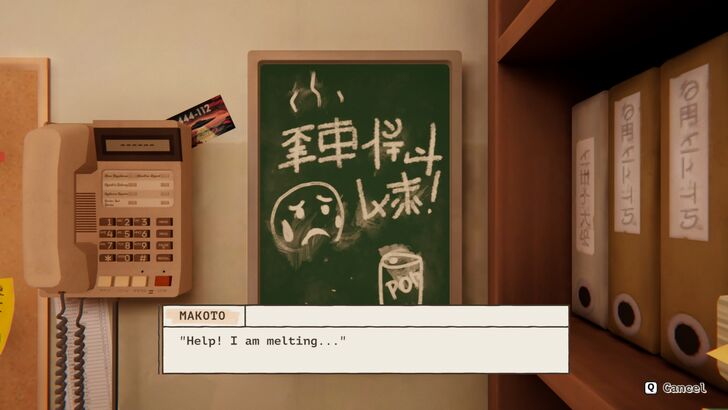
True to its cozy name, there is absolutely no form of stress-inducing activity in this game. There are no penalties for not restocking and no penalties for not managing to find the item the customer was looking for. There’s no real managing of stock here, just the managing of emotions and helping out these weary patrons of yours with their confused minds.
In fact, you can pretty much get away with not restocking the shelves or making sure everything is in its proper place, and I actually recommend that you don’t, for it makes for interesting reactions from the customers. For example, not putting the misplaced Kanji Toast Bread from the beverage fridge to the baked goods section or realigning the Pokky boxes to show the box fronts makes Chief laugh at them in amusement. Budding twelve-year-old businessman Satoshi also comments on the placement of natto on the high shelf and recommends that they be put lower because he can’t reach it. A lot of mundane, cute things that just make you smile.
The Illusion Of Choice
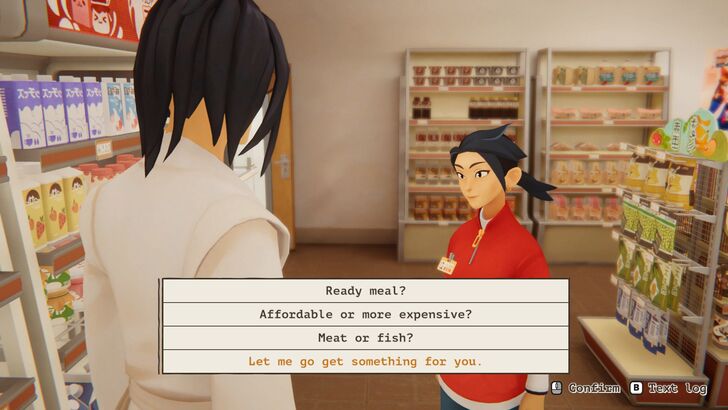
Although with that being said, there are quite literally no real consequences for your actions; this seems to extend to what Makoto says to the customers and to the overall upkeep of the store. Some of your choices along the way may matter, that’s for sure, but for most…it doesn’t seem so.
For instance, Chief shares that he has been eating the same type of instant noodles, Shirakdo, for over a decade and is constantly compelled to get it every time he’s at the konbini. On my first save file, I forgot to restock those noodles on the shelf, which prompted him instead to ask for my recommendation for something else—something new, he said. I sent him off with a shiny new bowl of Ramen Express Luxe, which he promised he’d try out.
Curiously (and as a chronic save scummer, I’m sorry), I tried it out on another save file to see what would happen if I actually did manage to put Shirakdo on the shelf. Lo and behold, he took it without asking for an opinion of what to eat. I was pretty surprised by it all that your choices actually do lead to something else—until the third day or so, that is.
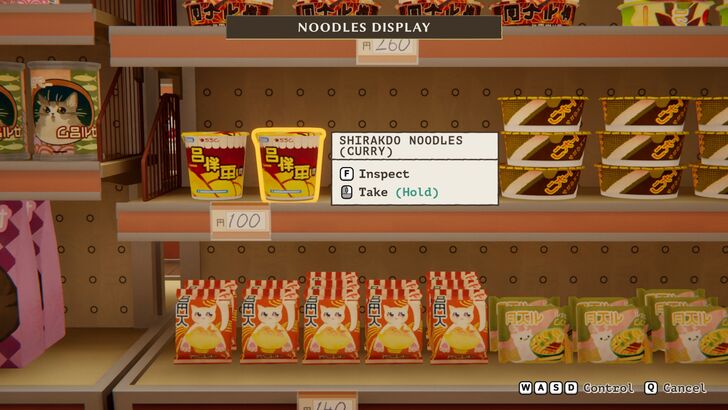
Even without your direct help, he manages to steer himself towards the simple change of choosing a different type of noodle, out of his comfort zone. It was a little bit disappointing in a way, knowing that he’ll arrive at the same point even without Makoto. Good for the character, but as a player…what was the point then if everything is scripted?
Of course, I’ve only completed the game once at this point, but seeing the minimal change in it all does dampen my spirits a little. It makes you wonder if your choices actually do matter aside from the minimal change in dialogue or process.
The Youngster With The Walking Speed Of An Old Man
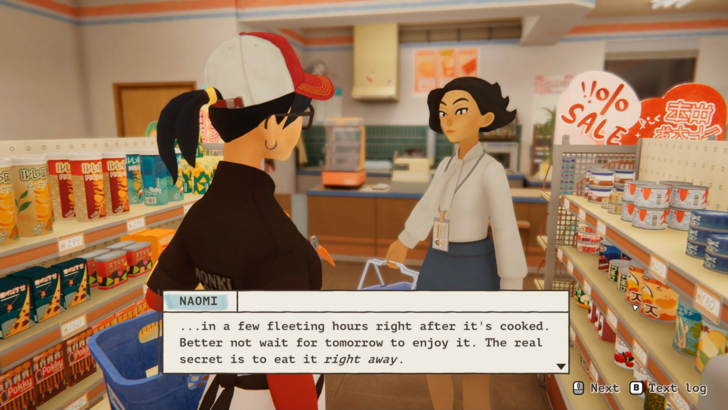
I get it; I totally understand it’s a cozy, slow-paced game. The entire game is slow-paced, allowing you to really get into the feel of relaxation and to really nail in that calm, no-need-to-rush theme of the whole thing. But Makoto is a part-time convenience store worker, a young adult, most likely in her early 20s—why is she not walking a bit faster even when she’s not carrying anything?
This was particularly hilarious when there was a fire-related accident that happened later on in the game, and you were tasked to get a fire extinguisher. Granted, it’s nearby with how small the store actually is, but with the flickering flame staring at you from the screen, I was half-expecting her to at least sprint. But no. Our lovely part-timer has no sense of urgency and continues to walk to the tool by the door with the pace of a snail. It's funny in hindsight but still can be tedious.
Stunning Audiovisual Presentation
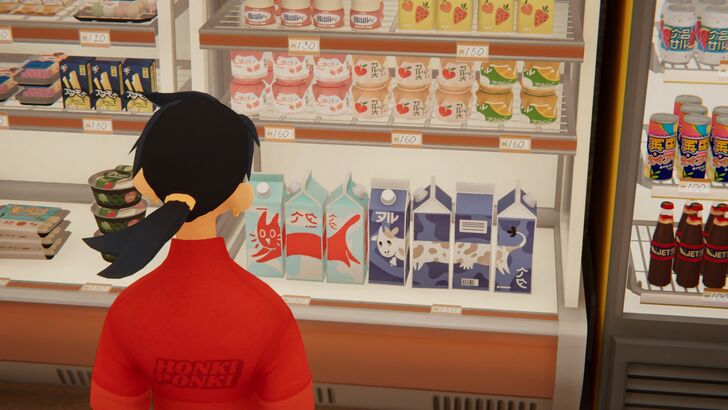
Although the gameplay and its overall slow pace can be a hit or a miss to some, there’s one thing that Inkonbini did exceptionally well, and it’s the overall presentation. Calm, relaxing audio tracks; weighty and meaningful sound design; and tying it all together is the charming, anime-cartoon-ish art style in eye-pleasing colors.
Firstly, the visuals—that's what caught my eye from the game in the first place, aside from the konbini concept. Warm, nostalgia-inducing colors and character models, the colorful and fun product designs and puns (Kikko-nyan Soy Sauce? Calba Water? Heisei Choco Shrooms and Seisei Choco Shoots? I can keep going.) were superbly adorable and vivid. The character designs are quite unique in their own way too—as unique as they could be in a rural Japanese countryside. They’re normal; they’re people you’ve probably already seen before, but they’ve got charm.
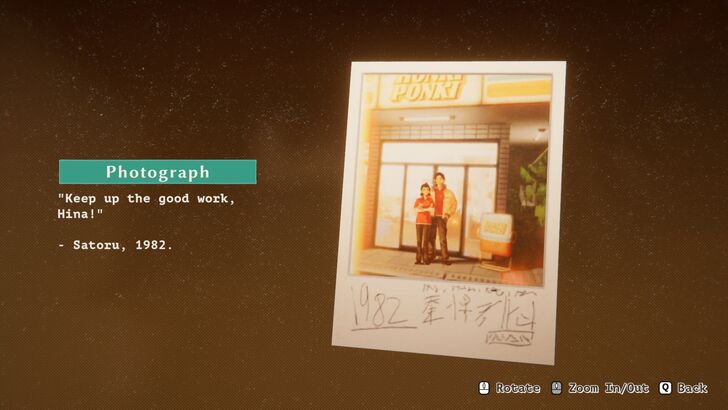
Complimenting that is the audio, a delectable set of soft-synth, almost city-pop tracks without the vocals. I’m not well-versed in music genres, but that’s what it definitely feels like to me, and it perfectly captures the serene, comfortable vibe the whole game is going for. Sound design further elevates the experience with meaningful sounds—the clink of the cans being stocked, the telltale ding of the konbini door chime, padding footsteps, the exciting ting of the capsule machine, the earworm of a beeping sound from scanned items at the cash register (easily my favorite part of the simulation gameplay, obviously), and many more. It’s basically an interactive 5- to 6-hour ASMR experience.
The only missed opportunity here is the lack of voice acting past the introduction. I find that narrative games are much more enjoyable and immersive if they’re voiced, but to each their own. Makoto and the customers don’t really speak but give reactionary grunts and expressions of approval or disapproval, which I guess is something. It would have been such a better experience if they could speak properly, though.
Is inKONBINI: One Store. Many Stories Worth It?
Good For An Afternoon
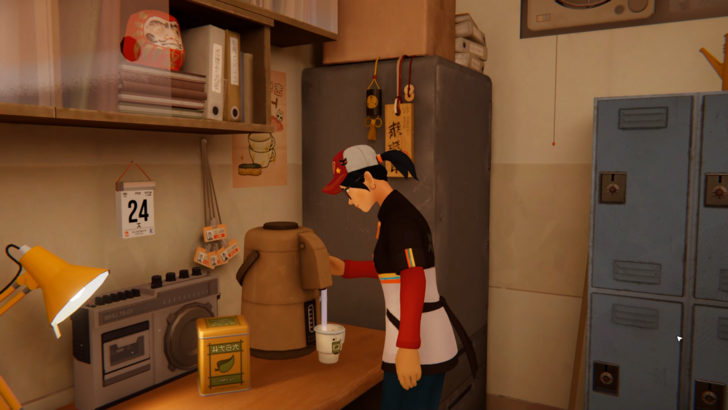
inKONBINI: One Store. Many Stories is a brief but charming countryside tale with ordinary, relatable people just going through whatever life throws their way. Much of the story is deeply rooted in its narrative, and I’d like to refrain from saying anything else here because it’s a game best experienced hands-on as I and many others have. While it’s definitely not the best of the best and can feel inauthentic sometimes, it still manages to deliver a decently memorable gameplay experience.
Solid visuals and audio, a short but satisfactory story to follow, all for the cost of a free afternoon and around $20. If you have the cash to spare and are looking for a bit of respite from the fast-paced life we all seem to lead, then inKONBINI might just be your next stop on your bucket list.
| Digital Storefronts | ||
|---|---|---|
| Steam |
||
| $19.99 | ||
| Playstation |
Xbox |
Switch |
| $24.99 | ||
FAQ
Is inKONBINI a management simulator?
No, it’s NOT a management simulator. It’s more of a cozy, slice-of-life narrative adventure with minimal simulation elements.
Who are the characters in inKONBINI?
The characters shown on screen are Makoto, Chief, Naomi, Satoshi, and the Mystery Man. Other characters are introduced through bits of lore or word of mouth.
Game8 Reviews