



| Hololive Dreams | |||
|---|---|---|---|
| Release Date | Gameplay & Story | Pre-Order & DLC | Review |
Hololive Dreams is a rhythm game where players perform Lives, build an island theme park, and collect their favorite Hololive talents. Read our review to see what it did well, what it didn't, and our overall impressions of the game.
Overview
What is Hololive Dreams?
Hololive Dreams is a free-to-play rhythm game centered around the members of Hololive Production. Set on Harmony Island, players follow the Hololive talents as they work together to transform the island into a thriving theme park, with players progressing through story chapters, completing rhythm game Lives, exploring Harmony Island, and taking part in a variety of side activities. Along the way, players can collect and strengthen their favorite talents, build teams with unique skills, customize their experience through Photo Mode and unlockables, and team up with others online for multiplayer Lives and minigames.
Hololive Dreams Features:
⚫︎ Responsive Rhythm Gameplay
⚫︎ Relaxing Island Exploration and Activities
⚫︎ Deep Character Progression Systems
⚫︎ Expressive Chibi Art Style and Polished Presentation
⚫︎ Online Multiplayer for Lives and Minigames
⚫︎ Photo Mode and Customization Features
For more gameplay details, read everything we know about Hololive Dreams’s gameplay and story.
| Digital Storefronts | ||||||||
|---|---|---|---|---|---|---|---|---|
 Google Play Google Play |
 App Store App Store |
 Steam Steam |
||||||
| Free-to-Play | ||||||||
Hololive Dreams Review: The Polish Goes Far Beyond the Performance
The Curtain Rises

Hololive Dreams marks Hololive's first original rhythm game, combining music, exploration, multiplayer activities, and long-term progression into a single live service experience. It aims to capture the appeal of Hololive's talents while offering enough substance to keep players engaged long after the first Live.
Bringing those elements together is easier said than done. The rhythm gameplay needs to feel responsive enough to carry the experience, progression has to reward continued play without becoming overwhelming, and the live service framework has to encourage players to return without letting monetization take center stage. Each system has to support the others instead of competing for the player's attention.
For the most part, Hololive Dreams finds that balance. Responsive rhythm gameplay anchors the experience, while its progression systems and multiplayer features reinforce that foundation rather than distract from it. Although a few rough edges remain, it proves itself to be more than a celebration of the franchise, standing as a polished rhythm game in its own right.
A Relaxed Slice of Hololive
Hololive Dreams doesn't put much emphasis on its story, but there is enough of one to tie everything together. The Hololive talents gather on a remote island where they get to pursue their dreams while turning it into a bustling theme park. The story doesn't lean on major conflicts or dramatic twists. Instead, it follows the talents as they develop the island, unlock new facilities, and gradually open up more of what the game has to offer.
The real highlight is the interactions between the talents themselves. The dialogue is packed with references to iconic Hololive moments and inside jokes, so it's clear the game is written first and foremost with fans in mind. That said, I never felt like I was missing out whenever a scene focused on a talent I wasn't particularly up-to-date with. The banter was entertaining enough on its own, and it gave each character plenty of room to bounce off one another.
While the first chapter spreads its attention across a large roster of talents, that broader focus leaves less room for individual interactions to develop. The second chapter benefits from narrowing its attention to a smaller group, giving its central cast more room to breathe, while also letting the story weave in a few bits of setup and payoff that make it feel more cohesive than I initially expected. It's still a fairly relaxed story at heart, but those later moments give it a stronger sense of momentum without losing sight of what it's trying to be.
The story still feels less like the main attraction and more like a reason to spend time with the cast. That's honestly where it works best, giving the Hololive talents plenty of opportunities to bounce off one another while gently moving players from one activity to the next. It knows its audience, and by the time I reached the current end of the story, I found myself enjoying the journey more than I expected to.
Running Toward the Main Stage
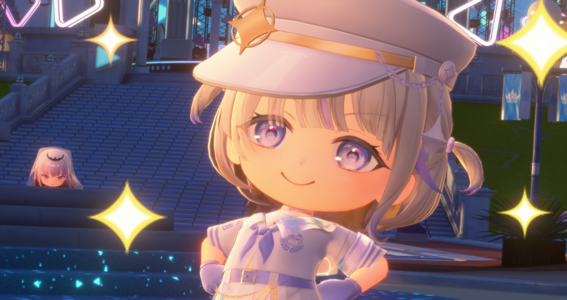
I didn't expect I'd get to run around the island as a chibi version of my favorite Hololive talent, but here we are.
Movement feels surprisingly good, too. There's plenty of freedom to explore the island, with the only real invisible barrier preventing players from diving into the surrounding sea. Jumping doesn't really serve any mechanical purpose, but I still found myself doing it anyway. There are multiple jump animations, including one where your chosen talent spins around to face the camera, and it's honestly adorable. It's a tiny detail, but one that adds a lot of charm and whimsy.
That said, the real heart of Hololive Dreams is its rhythm game, known as Lives.
If you've played Project SEKAI or BanG Dream!, you'll feel right at home. The fundamentals are all here, from taps and holds to flicks, with Shiny Smily Story serving as a simple but effective tutorial that eases players into each mechanic. Like most rhythm games, Hololive Dreams also lets players calibrate their timing, unlock different UI skins, and gradually unlock more songs as they progress through the game.
Gameplay during Lives feels responsive throughout, and I never ran into any issues with the charts themselves. My only gripe is with the calibration process. I would've preferred being able to fine-tune my settings on the spot. Instead, I found myself repeatedly jumping into a song, backing out, adjusting the timing, and trying again until everything finally clicked. Since rhythm gameplay is the heart of the experience, I would've liked to see that process streamlined a bit.
Life Around the Island
While Lives are at the heart of the experience, Hololive Dreams rounds things out with plenty of other activities. Hoppin' Rope is one of the first minigames players unlock, asking them to survive with three lives across Easy and Normal difficulties before putting their skills to the test in Score Attack, an endless mode built around chasing higher scores. Obstacles can block your view of the rope, while the rope itself occasionally changes its swing to throw off your timing. Even failing has plenty of personality, with your chibi talent getting launched off the side before hopping right back into line after a short break.
As the story progresses, the game gradually opens up with even more ways to pass the time. Mega Circuit pits 16 players against one another in a two-lap obstacle course, with layouts changing between runs to keep each race feeling fresh. It also finally gave all that jumping I'd been doing a purpose, even if clearing every obstacle proved easier said than done. Meanwhile, Collect Cooking has players racing against the clock to match ingredients and prepare meals for Hololive talents, with Score Attack returning as a mode for chasing even higher scores.
Hololive Dreams also supports multiplayer through a facility called the Fortune Network, letting players tackle both Lives and select minigames together. Whether testing your reflexes or performing songs, multiplayer adds a social element without changing the core gameplay. During Lives, players contribute to a shared score, encouraging everyone to work together toward a common goal.
Beyond its minigames, Hololive Dreams also includes a surprisingly capable photo mode. Players can adjust the camera angle, depth of field, and pose their chosen talent however they like, making it easy to capture fun screenshots around the island. My only real complaint is that photos are limited to the currently controlled member, so group shots with other unlocked talents aren't possible. Getting the perfect shot can also take some patience, as there's no way to pause during emotes, leaving players to rely on timing if they're chasing a specific pose or expression.
Exploration is rewarded in other ways, too. Daily quests, hidden treasure chests, daily gifts waiting throughout Harmony Island, and facility upgrades all provide reasons to keep checking back between Lives. None of these activities are particularly involved on their own, but together they make the island feel like more than just a lobby between songs, with new distractions continuing to open up as the story progresses.
Born To Be Ultimate Idols
Hololive Dreams also features several progression systems tied to its collectible Members. Characters can be leveled up over time, while obtaining duplicate copies unlocks Blooms that further strengthen them.
Beyond their base stats, each Member also comes with Passive, Active, and Special Skills that can influence Live performance in different ways. Many of these skills activate only when specific team-building conditions are met, such as fielding Members of the same type or generation, rewarding players with bonuses that apply to either a single Member or the entire deck.
The node-based Holomem Board expands on that progression even further, allowing players to strengthen their chosen idol while unlocking bonuses for Members, Leader Skills, and additional score boosts when that idol is set as the Leader or performs as the featured artist in a song. As more systems gradually unlock throughout the story, team-building becomes increasingly involved, with Leader Skills, SP Training, and different Member combinations all playing a meaningful role in improving Live performance.
What stands out most is how closely these progression systems are tied to the rhythm game itself. Landing a Full Combo is still important, but it's only one part of achieving a high score. Team composition, Member progression, and account investment all have a significant impact on the final result, making optimization just as important as execution for players chasing better rankings.
Hololive Dreams doesn't clearly communicate when most Member passives are actually active. While Leader outfit passives indicate when their conditions aren't being met, Member skills offer little feedback beyond their descriptions, leaving me to constantly jump between menus just to compare effects while putting teams together. Outside of seeing my score improve, there isn't much feedback confirming that I've built around those passives correctly, making the learning process more cumbersome than it needs to be.
Packed With Personality
That level of polish doesn't stop at the gameplay, either. Rhythm games live and die by their audiovisual feedback, and thankfully, the game delivers on both fronts. The soundtrack is every bit as energetic as I expected from Hololive, but what impressed me even more was how satisfying the UI sounds. Every button tap is accompanied by crisp, distinct feedback that makes even routine interactions feel satisfying. The island itself also feels lively thanks to small ambient touches, from spinning fans to animated decorations scattered throughout the park.
That attention to detail carries over into the rest of the game. Almost nothing in Hololive Dreams feels static, with animated menus, loading transitions, and even little flourishes like the Jump button animating whenever it's pressed. They're the kind of details that don't really change how the game plays, but they add a surprising amount of polish.
The Hololive talents have also been faithfully recreated as chibi versions of themselves, preserving their signature designs while giving them expressive animations that are just plain fun to watch. Swapping to another playable idol even changes the game's UI colors to match them, making each one feel a little more personal beyond simply being another avatar.
My only real nitpick is that story scenes are only partially voiced. With such a massive roster of talents, fully voicing every interaction was probably never realistic, but I still found myself wishing more conversations had voice acting behind them. That said, the overworld helps bridge that gap, with each playable idol cycling through voiced idle lines while exploring the island.
More About Progression Than Pricing
Hololive Dreams follows a fairly standard free-to-play gacha structure. The gacha revolves around collectible Member cards based on Hololive talents, with each pull awarding Gacha Points that can be exchanged for a featured Member after accumulating 200 points. Alongside the premium Diamond currency and farmable Red Diamonds, the shop also offers value packs, while a free weekly pack provides Coins and upgrade materials.
Players looking to speed up their progression also have two familiar options. The monthly HoloPassport doubles rewards earned from Lives and minigames, making it a long-term progression boost for regular players. Meanwhile, the Premium Mission Pass follows the usual battle pass format, rewarding players with upgrade materials across both tracks, alongside a single cosmetic accessory shared across all talents on the premium track and up to 5,000 Red Diamonds over the course of the pass.
The Membership system is easily the game's most distinctive monetization feature. Rather than serving as another progression-focused purchase, players can subscribe to individual Hololive talents to earn themed fan badges, titles, stickers, and Membership Medals that can be exchanged for cosmetics. It feels more like a way for dedicated fans to support and represent their favorite talent than another avenue for increasing player power.
More than the pricing itself, what stood out to me was how monetization fit alongside the game's progression systems. Stronger Members, better team compositions, and continued investment all have a noticeable impact on Live scores, giving players who spend another avenue to strengthen their accounts.
At the same time, throughout my playthrough, I never reached a point where spending felt necessary to continue progressing. I was able to complete story content, build multiple teams, and steadily improve my scores without opening my wallet. While spending can certainly accelerate account growth, Hololive Dreams never left me feeling like it was a requirement to keep up with its content.
Is Hololive Dreams Worth It?
A Standing Ovation

Hololive Dreams left a positive first impression, but what surprised me most was how well that impression held up after spending considerably more time with it. Its responsive rhythm gameplay remained consistently enjoyable, the island steadily expanded into more than just a hub between songs, and progression gradually revealed far more depth than it initially let on.
Not every aspect lands perfectly. The story still feels secondary to the gameplay, and some progression systems could do a better job of communicating how they work. Even so, those shortcomings never overshadowed what the game does best: creating an experience that oozes personality while giving players plenty of reasons to keep coming back.
As a live service game, Hololive Dreams will naturally continue to evolve with new songs, Members, events, and features. But based on the experience available today, it already stands as a polished rhythm game with a surprisingly rewarding progression loop, making it an easy recommendation for both Hololive fans and rhythm game enthusiasts alike.
Game8 Reviews