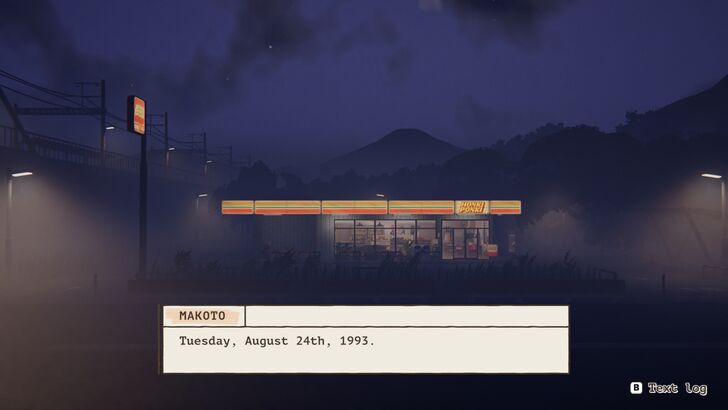




| Coffee Talk Tokyo | |||
|---|---|---|---|
| Release Date | Gameplay & Story | Pre-Order & DLC | Review |
Coffee Talk Tokyo is a visual novel with light point-and-click mechanics centered around tending to your own café business and listening to stories.
Overview
What is Coffee Talk Tokyo?
Coffee Talk Tokyo is a visual novel with light point-and-click mechanics centered around tending to your own café business. Like its predecessors, the game is all about talking to its cast of unique patrons who find a strange sense of comfort over a cup of joe, sharing their stories through brewed coffee while also forging relationships with other customers.
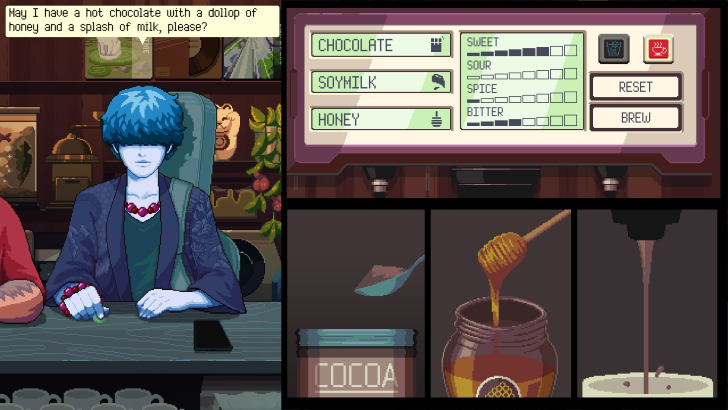
Throughout the game, players listen to these stories while mixing drinks based on each patron’s preferred taste as well vibing to the game’s selection of lo-fi tunes. With new features like stencil art alongside the existing latte art system, creating drinks now comes with a bit more variety.
Coffee Talk Tokyo features:
⚫︎ Cozy Visual Novel Experience
⚫︎ Good Lo-Fi Music
⚫︎ Vibrant Pixel Art Style
⚫︎ Coffee-Making Simulator
⚫︎ Endless Coffee-Making Mode
⚫︎ Memorable Characters
For more gameplay details, read everything we know about Coffee Talk Tokyo’s gameplay and story.
| Digital Storefronts | |||
|---|---|---|---|
 Steam Steam |
 Playstation Playstation |
 Xbox Xbox |
|
 Switch 2 Switch 2 |
|||
| $14.99 | |||
Coffee Talk Tokyo Review: Familiar Brew with a Strong Aftertaste
A Familiar Blend of Indie Game
When it comes to indie games, there’s often little holding developers back from experimenting with unconventional gameplay mechanics that don’t necessarily cater to focus groups or industry trends. When VA-11 Hall-A, developed by Sukeban Games, pioneered the idea of a patron-style game where you play as a bartender mixing drinks while listening to strangers talk about their lives, it found success with a niche audience that simply wanted to sit down, relax, and stay immersed in those quiet conversations.
Then came Coffee Talk, which built on that same “bartender-like” formula. In its original release, launched during the height of a global pandemic, it resonated with the right audience and went on to inspire a sequel that retained that same comforting aftertaste. Fast forward to 2026, and Toge Productions moves away from its Seattle-based stories and into the land of the rising sun with Coffee Talk Tokyo, a new entry centered on fresh characters and a plethora of new drinks.

As the third entry in a quietly underrated series, Coffee Talk Tokyo refines the art of simply letting you, the player, listen to the woes that weigh on its customers and respond with a warm cup of coffee. It’s not a radical reinvention of its predecessors, and there are still areas that could have used more refinement, but even within its limited scope, the care poured into its storytelling is evident. It consistently manages to hit close to home.
When Fantasy Meets Reality
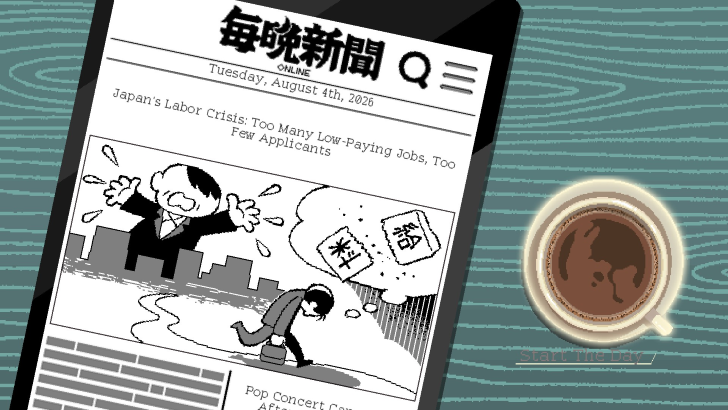
The world of Coffee Talk Tokyo is pretty much like our own, although you’ll need to get used to the occasional sighting of ghosts and yokai, as Toge Productions seamlessly blends myth and fantasy into a single universe. Moving away from the series’ US roots in the first two Coffee Talk games, Tokyo takes place in the heart of an alternate version of Japan where humans have peacefully lived alongside the very beings found in children’s stories and campfire songs. These are not everyday horrors in the traditional sense, but rather beings who, despite their cultural differences, share the same underlying sense of humanity, even if shaped by different beliefs.
Throughout the course of the game, players can meet anthropomorphized characters like kappas wearing business suits looking dapper than Dapper Dan and sea dragons rocking an emo hairdo that resembles that of J-pop artists. While they act like fishes out of water, they’re pretty much normal beings moving to and fro in its world. Others, like ghosts pulling pranks and a kitsune dad living life as a stay-at-home-dad come all go through the motions inside your café, where they find a safe space that they share stories about living in a world that still mirrors ours, complete with the same struggles of burnout, grief, loss, and romance.
This is not a completely different direction from previous Coffee Talk games, where races like elves and werewolves were common sights. Elves were often portrayed as the high and mighty figures of society, while werewolves lived under the burden of their full-moon Fury curse, creating a sense of social hierarchy without directly mirroring our own world.

In Tokyo, there’s a fictional racial prejudice among yokai, especially between the kappas and the sea dragons due to disputes over their sacred rivers. However, compared to the original Seattle setting, where many of the stories focused using a Western lens, Tokyo’s tales lean more into Japan’s lingering societal pressures, like what it means to live as a salaryman or how to navigate a sense of lost purpose after severe burnout.
I would compare Coffee Talk Tokyo’s story to JRPGs like Metaphor: ReFantazio and, maybe unironically, the movie Bright starring Will Smith. This alternate-reality gimmick becomes a safer and more creative lens for exploring these mature themes without relying too heavily on direct real-world parallels.
Business is Brewing!
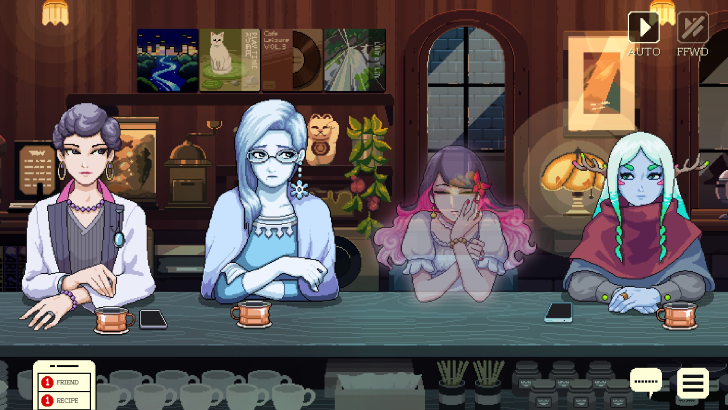
Central to the series has always been you, the bartender tending to your budding café business aptly named Coffee Talk. While you serve as the game’s protagonist, you’re not exactly the main character here, but rather a bystander, listening to each of these stories while serving drinks and enjoying a selection of relaxing lo-fi beats evoking the spirit of Nujabes. You have no full control over your character apart from giving them a name and a voice in your head. Since the original game, it always shifts the focus away from the player and places it squarely on the patrons, who have always been the beating heart of these games.
These patrons have always been the strongest “recipe” in every Coffee Talk game. As you tend to your café over its two-week timeline, you meet these wayward souls passing through, each sharing their stories while lamenting the current state of the world.
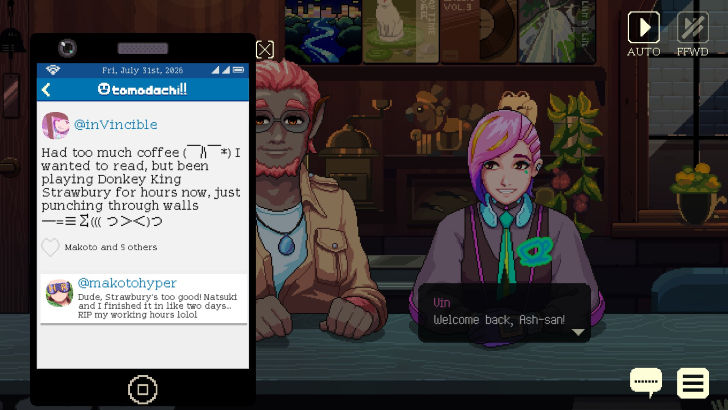
One character, Vin, acts as your assistant, similar to Freya in the first game. However, here they are dealing with complications from a new medical procedure that causes them intense pain. It is a grueling sight to see characters dealing with lingering medical issues.
Additionally, characters like Kenji, a salaryman who has recently retired after 40 years of work, serve as the game’s sage-like voices, sharing stories about his journey and his newfound band of millennial friends.
As a millennial myself, its themes of purpose and pain struck a chord with me as I listened to these mature conversations spoken so casually, almost like talking to actual friends who genuinely care about you. They only come together when you lend an ear and listen, which is ultimately what Coffee Talk has always been about.
Choices and Coffee-quences
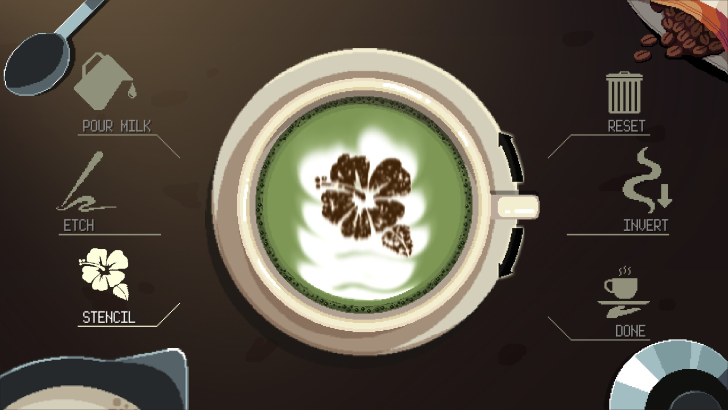
Gameplay isn’t really the most important element in Coffee Talk Tokyo. As a visual novel with point-and-click mechanics, all you really do is read and interact with a few simple inputs. This may be off-putting to players looking for more freedom and activity, similar to other visual novels with heavier systems like modern Persona games, though those titles are ultimately large JRPGs with a slice-of-life focus in between.
Coffee Talk Tokyo is a visual novel at its core and, honestly, it has always been very mechanically shallow. The gameplay loop goes like this: a customer walks in, shares their story, and asks for a drink. These events do not always follow the same order, but that is essentially what you can expect across the game’s 15-day cycle.
It has always been what worked for the series since its first entry back in 2020, but that does not mean you are left with nothing to do beyond listening to your honored guests. Instead, the game keeps you lightly engaged by having you blend drinks for your patrons, breaking you away from the long conversations and giving you moments to think about their preferred order.
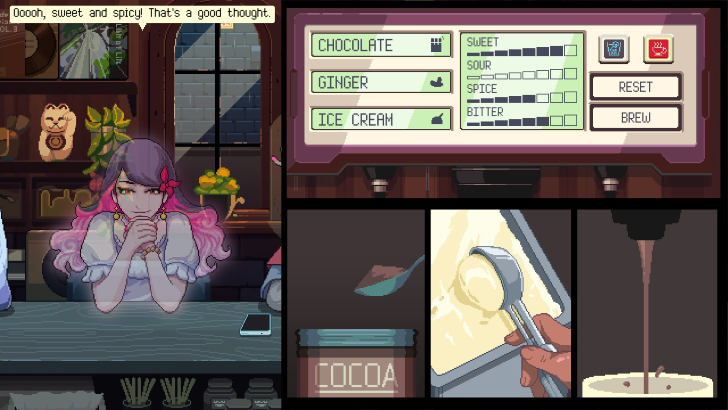
I personally found this to be a neat way of breaking up Coffee Talk’s usual rhythm of simply pressing the space button to continue conversations, while also keeping you mindful of whether you might mess up an order like a warm green tea latte or an iced hojicha if you have been zoning out for a bit. There was one instance where I intentionally failed a patron’s order after they were having a rough day, and I still felt bad about it afterward.
This is where the game punishes players who don’t pay attention to its story and just breeze through all the reading. If you fail to serve a patron their preferred drink, it means you won’t unlock additional tidbits of information on their social media page in Tomodachill and repeatedly messing things up locks you out of their best endings.

You see, Coffee Talk Tokyo has multiple endings, but it is not the kind of branching structure seen in other visual novels that completely alters the story based on a hidden choice counter such as games like Steins; Gate. These are visible results and progress you see in your diegetic smartphone. If you max out a character’s stats, you can see their best possible ending. If not, the outcome is more subdued and mundane, with no major breakthroughs in their plights. However, one particular ending requires you to max out two of the patrons, to which I’ll leave it up to you to find out. Failure to do so will result in a simpler ending.
While this may sound worrying, it’s not actually a major fail-state as the game doesn’t leave you in the dark all the time. Even if my own knowledge of coffee-making is very limited, it does a good job of guiding you toward what you need to do through subtle hints and gentle nudges, like adding extra details about temperature, new Stencil art or specific ingredients you should include in the mix.
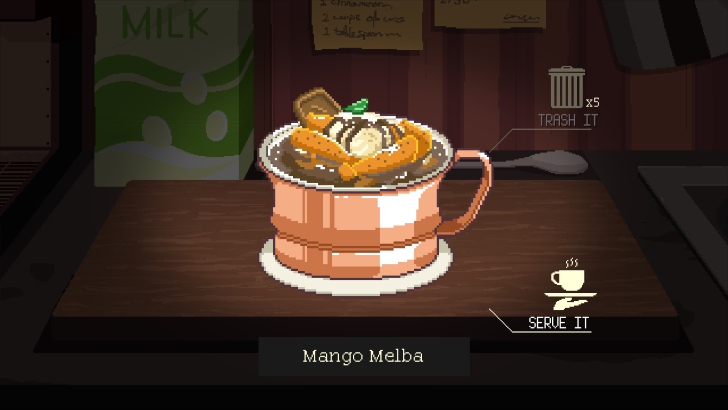
But then again, there’s a lot of risk in serving the wrong drink, and considering their limited appearance in your sanctuary of coffee and tea, you won’t always find another opportunity to get things right apart from rolling through the game’s credits and using chapter select.
But that’s not all. Once you’ve trudged through its six or seven (heh) hours of story, you can always jump into the game’s Endless mode. Here, you are free to mix and match drinks however you like, or simply use it as a way to unlock recipes you may have previously missed. That means there are still plenty of reasons to come back, even if you just want to relax to its lo-fi tunes in the background or randomly create drinks that might catch the attention of Tokyo’s health inspectors.
Crafting that Perfect Blend
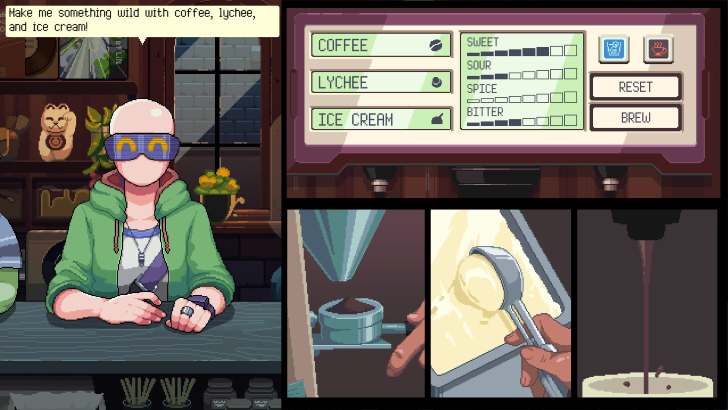
And this is the part where I've always enjoyed in Coffee Talk games is the sense of satisfaction you get when you correctly fulfill a customer’s order. Most of the time, these patrons are intentionally vague about what they want, leaving you to figure things out on your own. If not for a quick Google search for a yuzu tea recipe, I usually have to read between the lines and deduce what ingredients I have on hand.
Patrons who have had a rough day, like a prankster ghost finding comfort in your café, do not necessarily have a sense of smell due to her being, well, a ghost, but she still wants to order a drink just to experience its aroma. However, she is not always direct about what kind of drink she wants, leaving it up to you to guess which recipes might appeal to her spectral senses. Thankfully, with a bit of luck, I managed to get it right the first time, although subsequent drinks for her did require a handful of online searches.
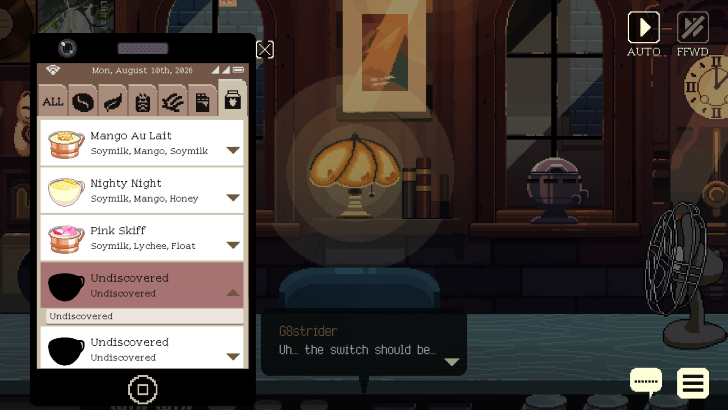
It is not exactly helpful that recipes in Coffee Talk, even in Tokyo, are locked until you discover them by brewing them yourself. Traditional Indonesian coffee like Jahe Tubruk cannot be found in your recipe list at first, but is instead unlocked through experimentation. If you get some of a patron’s orders right, you can unlock these recipes, but if not, you are left searching for them online or browsing the game’s diegetic social media channel called Tomodachill.
It also goes without saying that each drink comes with its own stylized pixel-art design that always gets me frothing at the mouth. These drinks, while many of them are entirely fictional, still have their own stories to tell, ranging from cultural inspirations to custom creations requested by each patron. This makes every drink in Coffee Talk Tokyo, as well as in previous entries, feel intentional rather than mere filler.
Not Much Has Changed for Coffee Talk
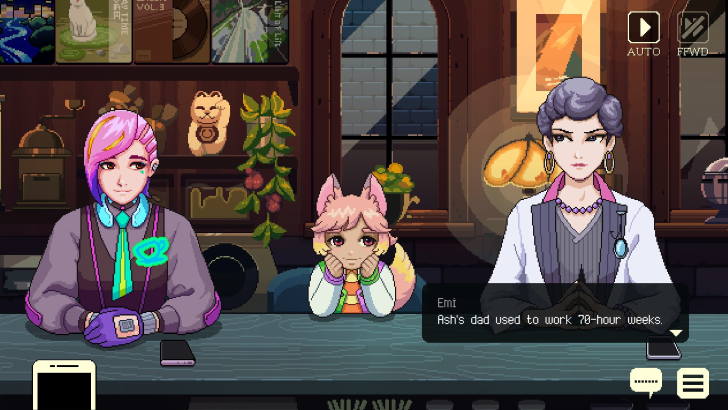
While I wholeheartedly enjoy Coffee Talk Tokyo’s new brand of flavors in its characters and gameplay features, there is one thing that holds me back from giving it a higher score: there is simply no real evolution in its gameplay. I know you do not necessarily need to fix what is not broken, but this is already the third game in the series and it is set in an entirely new location. I would have loved to see Toge Productions expand the experience, perhaps by letting players roam around the café soaking in the sights of the busy streets of Tokyo, similar to how Catherine uses the Stray Sheep or Persona 5 uses Leblanc as hub spaces.
Considering it is the third entry in the Coffee Talk series, it still remains the same visual novel with bartending sim mechanics.
What we have in Tokyo remains similar to its Seattle roots, giving me a sense that I have played the same game for the third time with no meaningful gameplay changes apart from its fresh cast of faces. You still interact with guests in a limited sense, which adds to the monotony of simply listening to conversations and mixing a variety of drinks. It is unfortunate that despite its Tokyo setting, there is barely any strong sense of place when talking to each patron. There is nothing particularly distinct or remarkable about being in Tokyo aside from its specific brand of yokai. Beyond that, visually it still feels quite similar to Seattle, which is a bit of a disappointment, especially since I expected more from this new setting.
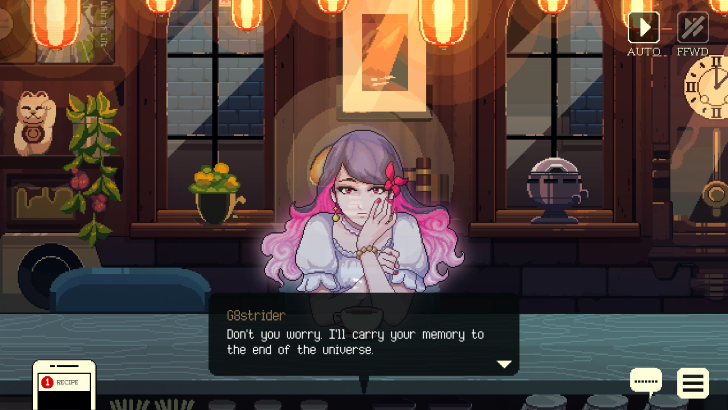
Voicework is also still something missing in this third entry. It would have added more weight to each of their well-written character arcs, especially if supported by a talented voice cast. I admit it can become tiring having to assign mental voices to each character, but at the same time, imagination still does a lot of heavy lifting in a game like this. Characters like Erika, a young Kitsune who also happens to be my favorite character in the game, I tend to imagine with Nanako’s English voice actor from Persona 4 Golden. For other characters like my own bartender and my assistant Vin, I have to get more creative and come up with voices on my own.
But who am I kidding? While these missing features could have added a layer of immersion to the bartending experience, they are ultimately nitpicks that could be considered non-issues. The overall experience of Coffee Talk Tokyo is still nothing short of fantastic. If Toge Productions plans to release a second episode similar to the way they did with the first game, a more radical shift in gameplay, such as explorable mini-hubs, could do wonders in enhancing its cozy vibe.
Sit Down, Be Humbled
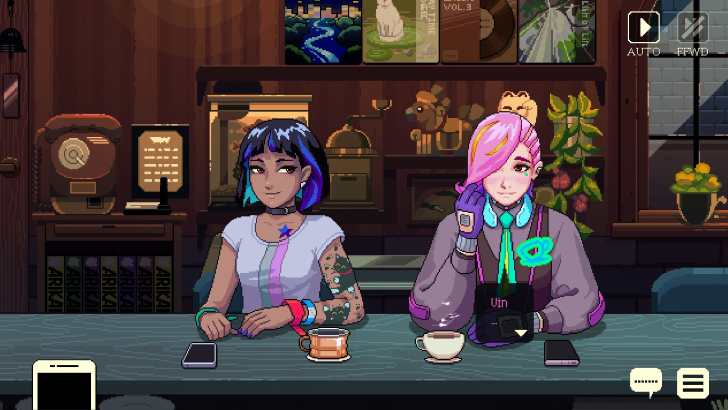
Character writing is Coffee Talk Tokyo’s greatest strength, and it has always been the same across its previous two games. Like talking to a friend, these conversations feel so natural that the characters allow themselves to become vulnerable. This, in turn, makes Coffee Talk Tokyo a kind of safe space for players who find themselves struggling through life, or just wanting to find new meaning in conversations. I honestly found myself feeling like they are real people dealing with real-life problems. One tinfoil hat theory I have is that these might be some of the developers’ personal stories etched into the game’s plot, minus the fantasy elements, of course.
It is these conversations that always grab my attention the most, even beyond the lo-fi soundtrack that pulses softly in the background. These patrons always have something to say, and not just for the sake of talking, and I, as a lowly bartender, can only listen and observe. But this is exactly where I enjoy the game the most.
As mentioned earlier, they are already living in a messy world, like the kappas and sea dragons who are constantly fighting for their territory for decades, or a budding tech-bro finding a new kind of comfort in his polycule of three girlfriends, only to realize he cannot juggle everything at once. These patrons do not come into my café creating problems out of thin air. These stories already exist in the background, and they simply stumble into the comfort of my café as I brew a cup of hojicha the moment they walk in.
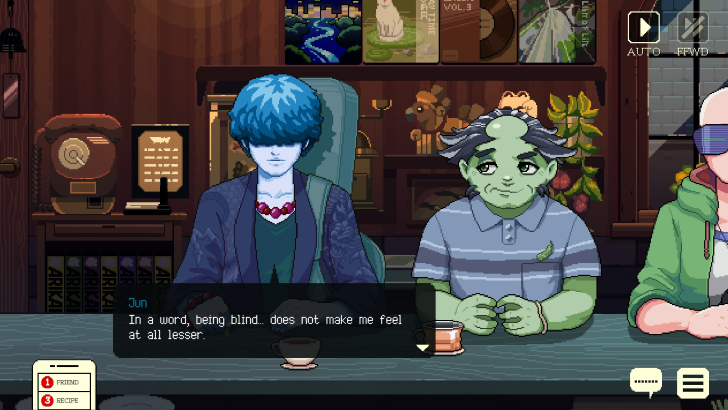
Take Jun, for example. He is an extremely talented sea dragon with a J-pop-like aesthetic and over a thousand followers on Tomodachill. After his album fails to generate positive reviews, he begins struggling with creative burnout, cancels a highly anticipated concert, and is forced to go dark. He eventually becomes a regular at my coffee shop, talking about how he feels and trying to understand what went wrong.
Jun’s problems are pretty specific, but it can resonate with an audience who is constantly searching for a sense of purpose in life. His tete-a-tete with Kenji, who is proud of having been a salaryman for 40 years, feels genuinely relatable for millennial audiences who find traditional corporate perspectives rigid.
Eventually, as more characters chime in, these conversations begin to overlap and influence one another. They each share their grounded stories told through the lens of their yokai type, and when these perspectives clash and blend, it creates an explosion of ideas that feels surprisingly human and often hits close to home. Characters like Jun and the kappa, Kenji, eventually find common ground between their issues once the chaos subsides.
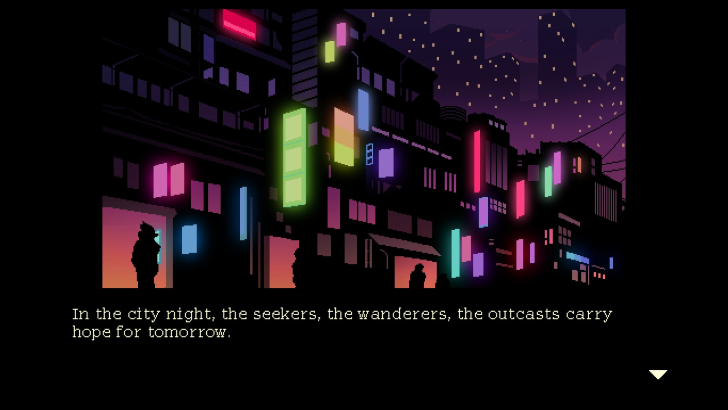
Other conversations can also find their audience in Coffee Talk Tokyo as each patron has their own diverse character arcs that’s best left for you to discover.
Listening to each of their stories, while appreciating their vibrant character sprites, is what I love most about Coffee Talk games. Like straight out of Edward Hopper’s Nighthawks painting, these characters feel real with a sense of community.
These exchanges become filled with nuance, often surfacing heavy realizations about real-life issues that deserve more attention such as purpose and what it means to have an absentee father. Conversations between older and younger generations often come into tension, and Coffee Talk Tokyo does a great job of balancing these two sides of the same coin. It eventually leads to a kind of standstill that only asks you, as the player, to sit with it and reflect.
Is Coffee Talk Tokyo Worth It?
A Familiar Brew, But Leaves a Strong and Lasting Aftertaste
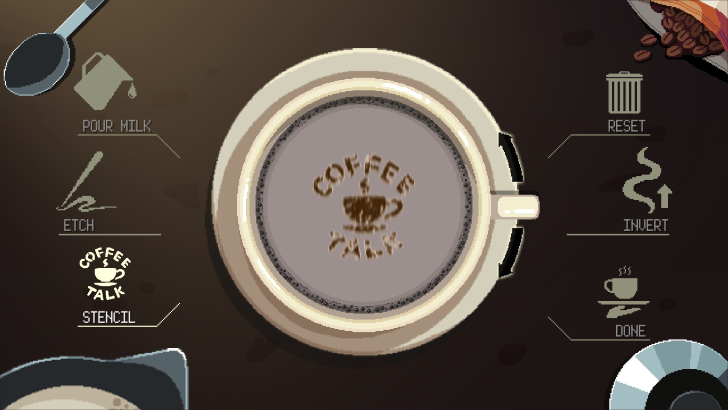
While there are noticeable issues in Coffee Talk Tokyo, it is a fantastic visual novel that only gets better the more you mix drinks and listen to its compelling cast of characters. Even with its limited gameplay loop of serving drinks and preparing the occasional matcha latte, you are never left lost, as the game constantly encourages you to pay attention to its regular patrons who find solace in your budding café, often rediscovering purpose through conversations with like-minded people, regardless of background.
While the game could benefit from additional gameplay enhancements, such as brief exploration inside its cozy bar or voiceover work, it does not necessarily need them. Coffee Talk Tokyo still works because of its strong and nuanced writing that does not mince words, keeping you invested in its characters and making you feel right at home. Their struggles are grounded enough to mirror real-world issues, and when you strip away the veil of myth and fantasy, you realize they are not all that different from us. In the end, all it really asks is that you sit down and listen, because once the credits roll, you might have to pour one for yourself.
FAQ
Should I play the original Coffee Talk and Coffee Talk Episode 2: Hibiscus and Coffee to understand Coffee Talk Tokyo?
No, you don’t have to play the previous games to understand the story in Coffee Talk Tokyo, but it doesn’t hurt to try out the old games so you can recognize easter eggs and cameo appearances.
What are the System Requirements to Play Coffee Talk Tokyo on Steam?
The System Requirements as listed on Steam are as follows:
| Specifications | Minimum | Recommended |
|---|---|---|
| OS | Windows 10/11 with the latest updates | |
| Processor | 2.4 GHz or faster processor | 2.4 GHz or faster processor |
| Memory | 2 GB RAM | 2 GB RAM |
| Graphics | 512 MB display memory | 512 MB display memory |
| Storage | 850MB | |
| Additional Specs | Version 9.0c/Direct X12 | SSD/HDD required |
Game8 Reviews