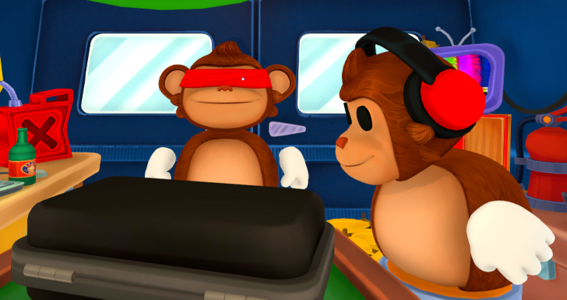



Bombanana is an explosive co-op puzzle game where 3 blind, deaf, and mute monkeys must work together to defuse a bomb before time runs out. Read our review to see what it did well, what it didn't do well, and if it's worth buying.
Overview
What is Bombanana?
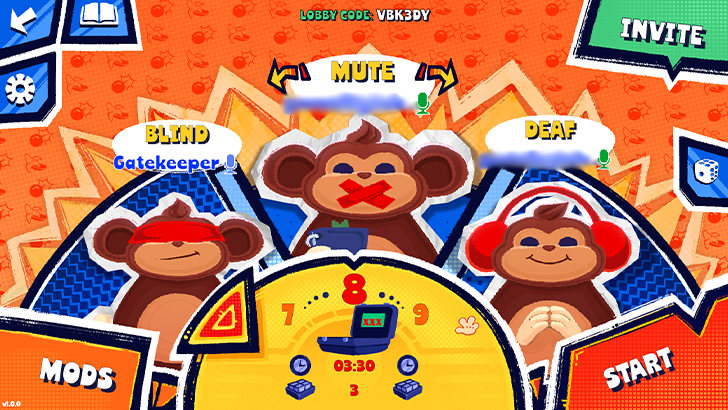
Bombanana is a high-stakes 3-player co-op puzzle game where blind, deaf, and mute monkeys must work together to defuse a bomb by solving increasingly difficult puzzles. The blind monkey can touch the bomb, the mute monkey can read the defusal instructions, and the deaf monkey bridges communication. With the wrong monkeys in charge of the job, chaos and misunderstanding are bound to ensue.
Bombanana features:
⚫︎ Three Unique Ways to Play
⚫︎ Campaign, Endless, and Custom Mode
⚫︎ 30 Levels, 14 Puzzle and Chaos Modules
⚫︎ Cartoon Style with Hand-Painted Textures
⚫︎ Chaotic Miscommunication
⚫︎ Online Private and Public Lobbies
⚫︎ Slapping
⚫︎ Voice Chat
| Digital Storefronts | ||
|---|---|---|
 Steam Steam |
||
| $7.99 |
Bombanana Review: Communication is Key, But Misunderstanding is Fun
Monkey See, Monkey Do
Miscommunication always creates chaos. But when used correctly in gaming, it reliably leads to intense, unforgettable fun. Take Instructor-Operator video games, where one player holds the manual while another operates the controls. Miscommunication made Keep Talking and Nobody Explodes a viral hit in the late 2010s. It’s also behind charade’s success as a timeless party staple that has inspired countless variations, such as the board game 3 Monkeys and the card game Team3.
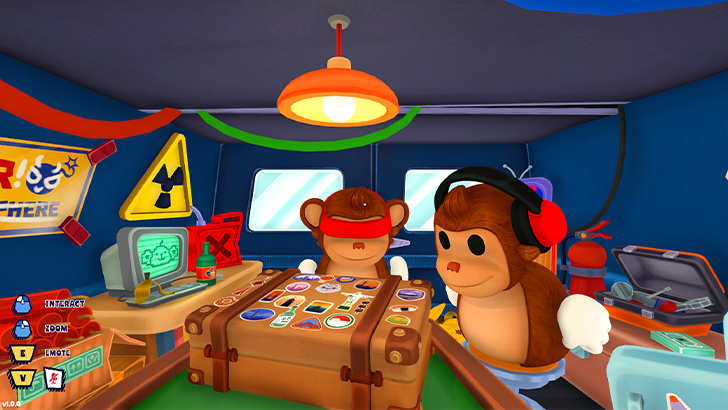
Bombanana understands the potential of chaos to create a fun game. It takes miscommunication to the extreme by multiplying the people you can misunderstand and maximizing the ways you can. This game throws a blind, deaf, and mute monkey in the cluttered back of a van or plane with a ticking bomb in a briefcase. Restrictive communication is balanced out by simple instructions and highly intuitive player actions. You have all the tools you need to win, but using them to communicate clearly is where the fun and challenge is.
Chaotic, Ironic, and Absurd
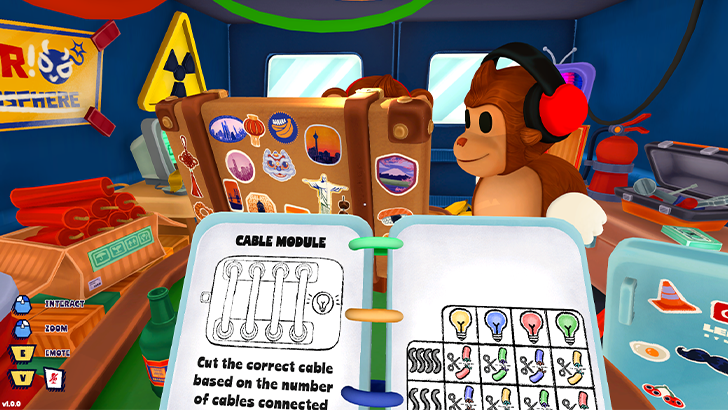
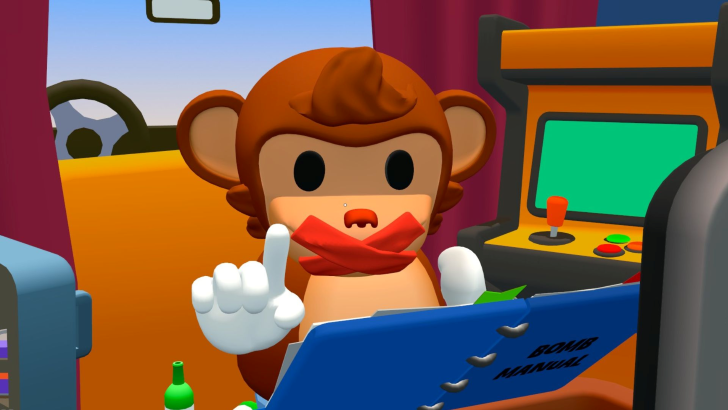
Bombanana is a co-op puzzle game where three monkeys work together to defuse a bomb. Each monkey has a specific role to fulfill and an impairment to overcome. The blind monkey works the puzzle modules by listening to the deaf monkey’s instructions. The deaf monkey bridges communication by relaying instructions that the mute monkey acts out. The mute monkey holds the manual and acts out instructions via charades.
However, none of them can overcome their impairment alone. Each monkey faces unique obstacles that require a teammate to solve. On top of that, they must all coordinate at every turn to crack genuinely challenging puzzles under intense time pressure if they hope to escape the back of a van or plane in one piece.
Each brightly colored location is cluttered with items that reinforce the game’s nonsensical monkey theme and double as essential puzzle-solving aids. Yellow bananas, green bottles, and red dynamite sticks emphasize how silly this game is and remind you not to get too frustrated when you fail repeatedly. But these color-coded items are also functional and can be hurled to fix a broken radio that’s drowning out the voice chat or to indicate the color of a button on a puzzle.
Juggling out-of-the-box puzzles, frantic time management, and deadly environmental hazards will drive you and two partners completely bananas. Chaotic because it’s ironic, this co-op-only game demands efficient communication despite taking away your ability to hear, speak, or listen.
Smooth Controls, Tough Puzzles
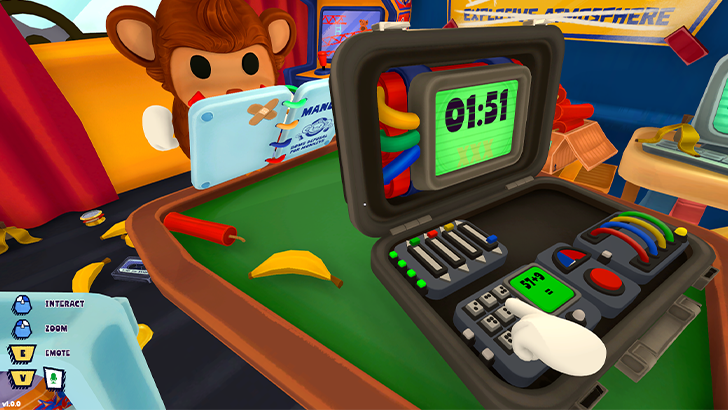
Bombanana takes away primary modes of communication to effectively create chaos, but it keeps gameplay fair by providing all the tools needed to win. Each monkey gets an emote wheel with seven gestures and a number wheel they can use to hold up 1 to 10 fingers. Combined with a full range of head motions, throwable items, creativity, and teamwork, these tools effectively compensate for intentional communication restraints.
The mute monkey, who must fully rely on gestures and items to speak, can use a red dynamite stick to signal a red wire or tilt their head to tell teammates to press a directional button. Although the blind monkey’s screen is blank except for the bomb outlined in white, they’re the only one who can read Braille symbols and can use the number wheel to translate the symbols for the deaf monkey. The deaf monkey has the least use for gestures and items because they can talk, but can still slap their teammates to emphasize a point.
Because actions are highly responsive, monkeys do exactly what you want when you want, so there is no reason to believe that a loss was due to anything but a lack of player skill. Exaggerated character models with big heads and hands and a bright color palette give the game a look typical of family friendly co-ops, which prioritize functionality of graphics over style. However, its hand-painted textures provide some interesting visual uniqueness. These features also double as functional puzzle-solving aids, as they allow ease of expression and make player actions easy to read.
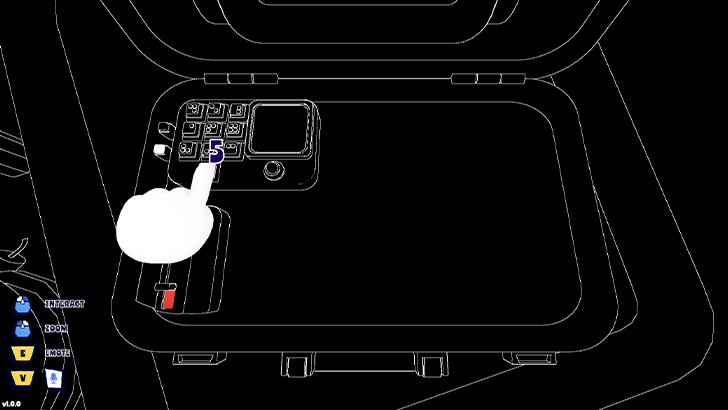
Due to great sound design, audio cues from modules, which can only be detected by the blind monkey, are also unmissable—unless the radio is broken. This case highlights the game’s core theme and mechanic of interdependence; audio ties directly into gameplay by adding a layer of difficulty, as the blind monkey must fully rely on their teammates to fix something disrupting their gameplay.
There is zero cognitive friction from a mismatch in what you see and hear, especially with the monkeys’ cute, speech-accurate mouth movements. Therefore, you don’t have to worry about anything but the hundred other things the game deliberately makes you worry about. Controls feel good, and actions sound real, significantly improving immersion and maintaining fairness in gameplay.
Importantly, the in-game voice chat is crisp and clear for monkeys who can talk and hear. There are no technical issues that stand in the way of focusing on the puzzles. The deaf monkey will have no problem getting their voice across, nor will the mute monkey in hearing them. The challenge is where it should be: in the deaf monkey figuring out what they should say, and the mute monkey making sense of what they’re being told.
Genuinely Reaching Flow State
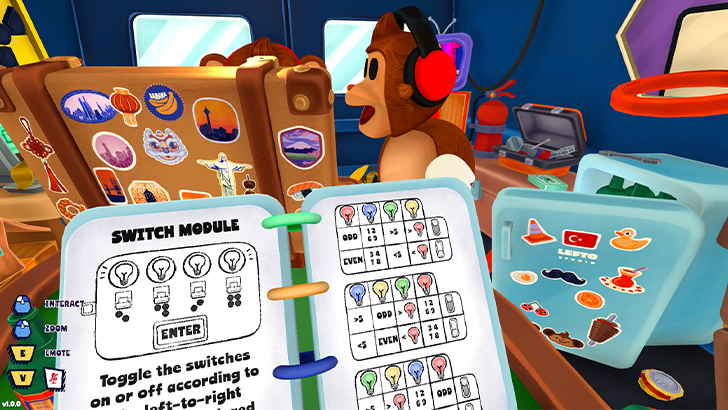
With intuitive controls, sufficient tools, and flawless visuals and audio, the only hurdle your team has to jump is the huge communication gap from each other’s impairments. The game deliberately widens that gap with each new puzzle and level, complicating communication by introducing more complex concepts to convey. The mute monkey will have no problem expressing simple instructions like yes or no, since highly articulate graphics ensure that the deaf monkey can easily identify a nod or shake of the head. The chaos kicks in when more intricate puzzles demand more creativity and impose a shorter time limit.
Harder puzzles have more steps and are more elaborate. Sometimes, even the sequence of steps changes, leaving the mute monkey scrambling for a way to tell their teammates that the blind bomb-handler needs to press a certain button on a module, or turn a knob and listen for a sound cue, before they can proceed.
More difficult puzzles require multiple playthroughs, creating an exhilarating, fast-paced trial-and-error loop. Although you can figure out puzzles through gameplay alone, post-failure debriefs in the lobby are sometimes crucial for harder puzzles, especially if you’re playing with strangers unfamiliar with your communication style.
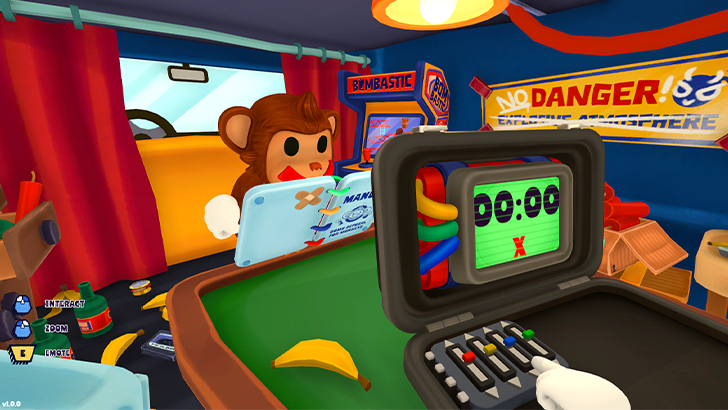
A combination of repeated gameplay and lobby debriefing is the most efficient way to move through levels. Sometimes, a puzzle looks very different from how it sounds, or looks very different in black and white than it does in color. So, swapping roles and seeing puzzles from each monkey’s point of view can expand the team’s understanding and speed up puzzle-solving. A eureka moment during gameplay after seeing the same puzzle four, five, six times is common, and not to mention incredibly rewarding.
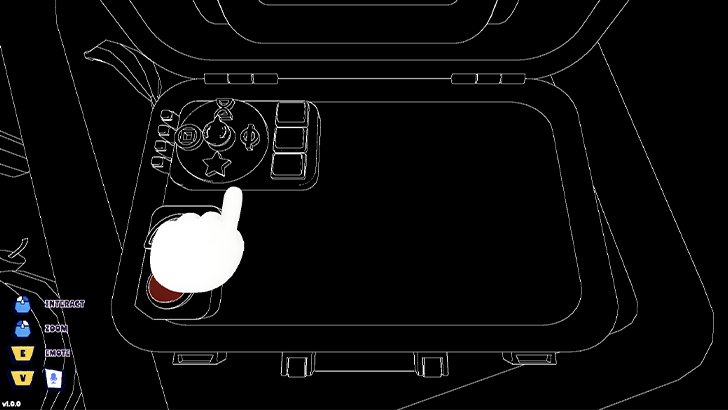
The game’s fast-paced trial-and-error loop—unbroken by intermittent cutscenes or dialogue due to the absence of plot—is built for multiple playthroughs and perfect for the game’s exclusively co-op setup. Although giving the monkeys some personality or backstory would have created an emotional connection that could provide motivation for harder levels, this uninterrupted flow keeps tension and focus high and ensures that failing a level doesn’t break the team’s momentum.
On the other hand, this fast-paced system guarantees mental strain, eventually leading to fatigue as puzzles start to feel repetitive. With 11 puzzle modules available at the time of writing, fatigue never kicks in too early, but it is always inevitable.
That said, although puzzles become more challenging and the time limit gets tighter, it’s not frustrating to progress through Campaign Mode’s 30 levels because difficulty scales at a fair pace. You get ample time to familiarise yourself with modules before newer, harder ones are introduced.
Endless and Custom Mode
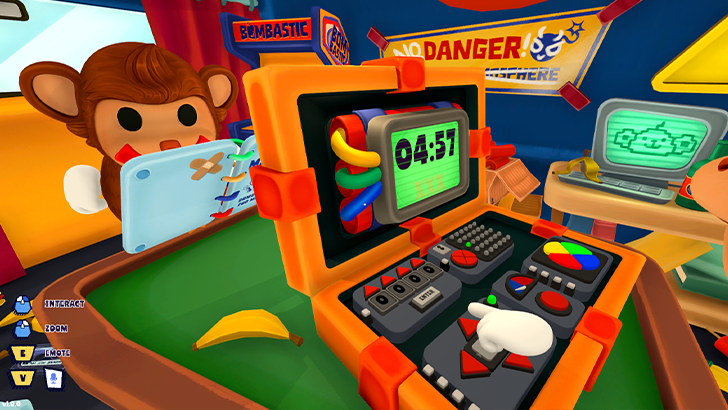
Endless and Custom Mode extend replayability past Campaign Mode. Endless Mode offers infinite bombs to complete with steadily scaling difficulty, and Custom Mode lets you create a stressful situation of your own design.
Endless Mode raises the risk and regret of not solving puzzles in time, as failing means breaking a streak. But the rush of beating your own record is a great motivator to play again. That said, playing too many logic-intensive puzzles in succession is mentally draining, even after becoming familiar with them. Breaking too high a streak usually leads to the session ending, with everyone too tired to immediately try again.
Custom mode allows variations in modules, difficulty, and playtime set by the lobby creator. All modules are immediately available, so you can tackle puzzles at your own pace. However, this design misses a prime opportunity to incentivize progression. By locking modules and custom mode settings behind level completion, the game could provide players with a stronger motivation to push through harder campaign levels, which typically require more playthroughs to complete. Although the game’s small collection of puzzles inevitably leads to repetitiveness, its multiple modes effectively prolong enjoyment before burnout.
Monkeying Around in Public is Mandatory
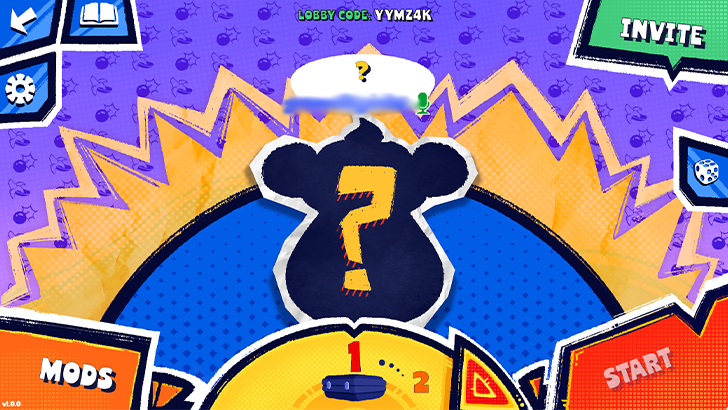
Bombanana’s exclusively multiplayer setup means you can’t play at all unless you have a complete team of three. If you got the game with two friends, you’re all set. Otherwise, you can join numerous public lobbies.
Playing with strangers naturally begins with a bit of awkwardness. In public lobbies, puzzles are usually figured out in the field instead of strategized beforehand, which is sometimes made even more chaotic by language barriers. However, shared failure quickly breeds familiarity, and a tough puzzle usually breaks the ice. Playing with different groups also greatly helps the game’s replayability. Overfamiliarity with puzzles is avoided by playing with people of different communication styles and skill levels, as you’re bound to discover new ways to interact. It’s entertaining to see the different ways people panic as the timer ticks down, and just as fun to hear the countless ways puzzles can be misinterpreted.
Like other online co-op games, playability depends on the quality and quantity of the game’s active player base. Fortunately, as of writing, Bombanana’s player base is very warm and welcoming. There are numerous lobbies open and many solo players looking for others to play with.
Is Bombanana Worth It?
Yes, This Is My Circus and These Are My Monkeys
$7.99 is a bargain for a game as entertaining and polished at launch as Bombanana, provided you have friends to play with. Otherwise, its strict multiplayer system limits you to online player lobbies. That said, as of writing, its current player base is active and welcoming. Its long-term appeal remains to be seen, but Bombanana deserves praise now for being a stylish, well-crafted, and very fun game.
FAQ
Does Bombanana have a Steam demo?
No, only the full game is currently available.
Does Bombanana have couch co-op?
No. Multiplayer is available via private or public online lobbies.
Can I play Bombanana if I’m alone?
The game requires 3 players. You can open a public lobby and wait for random players to join.
Game8 Reviews