



Overview
What is Battlestar Galactica: Scattered Hopes?
Battlestar Galactica: Scattered Hopes is a roguelite fleet management and strategy game developed by AltShift and published by Dotemu. Set in the 2004 Battlestar Galactica series, the game sees players assume the role of a Colonial Fleet commander returning to the Battlestar Galactica. Players will be navigating through the Cylon threat in real-time combat phases, while dealing with the inter-faction politics, crises, and Cylon impostors in the Fleet during the management phase.
Battlestar Galactica: Scattered Hopes features:
⚫︎ Roguelite structure and gameplay
⚫︎ Fleet, Gunship, and resource management
⚫︎ An original story and cast set in the classic 2003 Battlestar Galactica Miniseries
⚫︎ Real-time space battle strategy combat
⚫︎ The Gunships, squadrons, and enemies from the 2004 reboot
⚫︎ Conflict resolution and management between factions
For more gameplay details, read everything we know about Battlestar Galactica: Scattered Hopes’s gameplay and story.
| Digital Storefronts | |||||
|---|---|---|---|---|---|
 Steam Steam |
 GoG GoG |
||||
| $24.99 | |||||
Battlestar Galactica: Scattered Hopes Review | It’s Frakking Excellent
The Unbearable Weight of Colonial Leadership
Science fiction is pop culture pulp at its finest, an exercise in human imagination that dares to imagine the absurdity that lies outside our understanding of the world. In a genre full of campy, silly alien worlds and bombastic, over-the-top space battles, Battlestar Galactica earns its critical acclaim and relatively more niche audience by turning that absurdity inwards.
The show’s bleak, uncomfortably intense atmosphere is earned by looking at the extreme, logical conclusion of humanity’s innovation and discovery and turning it against them. The resulting fallout of that - the Cylons, the paranoia towards your fellow person, the fine line between technology-as-ally and technology-as-foe, and the relentless, seemingly unstoppable outside dangers that threaten a deeply damaged civilization - became the basis of one of the most barren and profound sci-fi shows ever made.
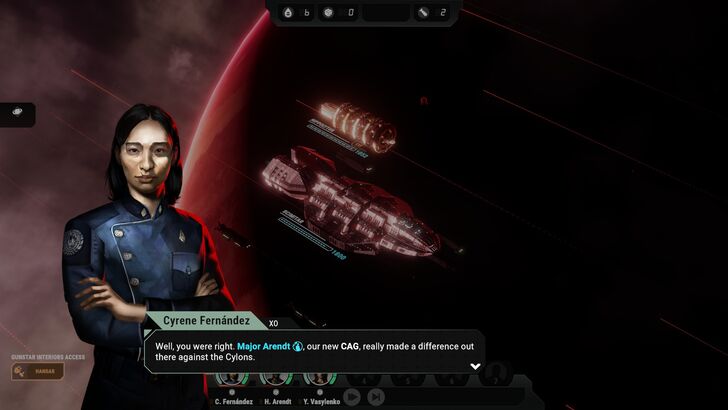
In both gameplay and atmosphere, Battlestar Galactica: Scattered Hopes captures the heart of the series quite well. It is, at most points, a dire, stressful, and overwhelming experience where you’re thrust directly into the role of a Colonial Fleet commander.
You’ll have to manage your fleet and perfectly maneuver through 12 Cylon-controlled sectors to return to Admiral Adama and the Battlestar Galactica. As the game progresses and you grow more familiar with your crew, you slowly feel the weight of your responsibilities crash down on you as every preparation and every decision seems destined to fail.
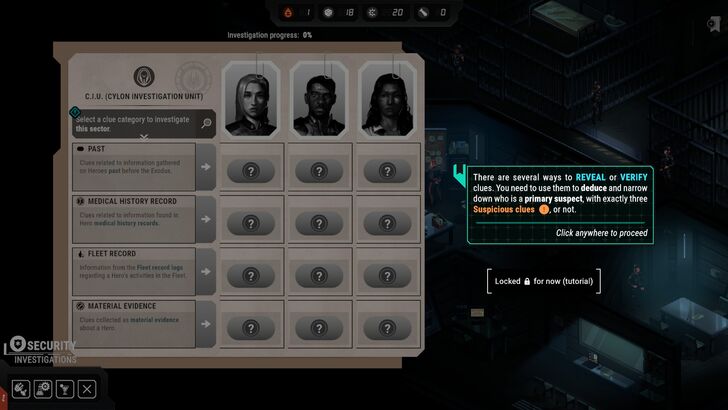
It’s not going to be for everyone, especially if you’re into the campier or more action-packed sides of sci-fi games. The goal of the game is to survive, not necessarily win, and it is in that focus that the battlefield feels claustrophobic even in the vastness of space.
The tension created by both gameplay segments is exhilarating and helps create a sense of dread across every mouse click and decision made. Every battle survived is a reward unto itself, and every run completed is a testament to well-informed strategizing and sharp decision-making. No one said leadership would be easy, nor should it be when your fleet’s survival rests on your shoulders.
Failures? Setbacks? All of This Will Happen Again
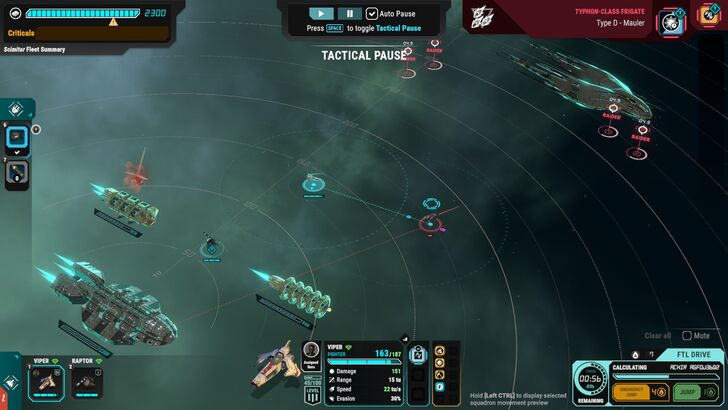
Battlestar Galactica: Scattered Hopes is an immediately overwhelming experience, and it doesn’t really let up as you go on. Even after the game’s lengthy tutorial section, I was left feeling more confused than anything else. The instant sense of dread and tension was also palpable and intimidating, and I felt like failure was more of an inevitability than anything else. This, however, is a good thing for what Scattered Hopes sets out to do.
Battlestar Galactica: Scattered Hopes places you in charge of both the combat and everyday survival of your Colonial fleet through its two main, shifting gameplay loops. The fleet management section of the game has players navigating through the politics of the caravan, gathering resources, and trying to prepare for the battles ahead. I found this to be the most consequential and compelling part of the game, with decision-making and resource management perfectly evoking the hardships of being a leader.
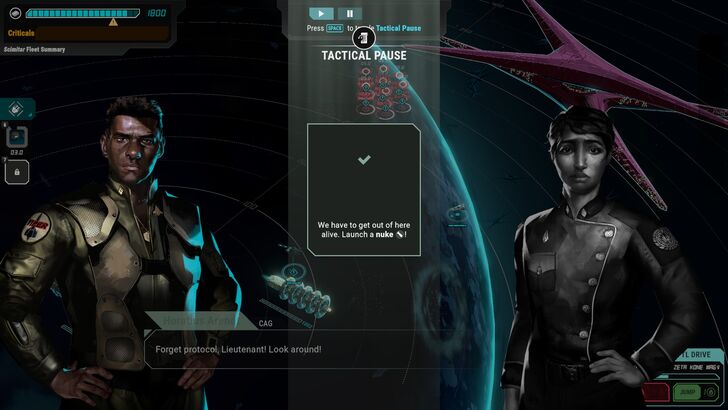
There was a moment during the game when the Worker and Military factions were having a conflict over the distribution of certain supplies and manpower. I sided with the Workers at the cost of my relationship with the Military, and that resulted in an uprising Crisis where several civilians were killed. This is just one of the many crucial decision-making moments in the game, where everything has a cost and nothing ever really works out quite in your favor. Leadership demands compromises and hard choices, after all.
Frankly, it’s a lot to take in, especially with how fleet management is only done through a limited number of actions every time. Every decision counts towards survival, and wasting a turn or resources can snowball into a catastrophe for the crew sooner or later. Furthermore, trying to maintain positive relationships with everyone on the fleet while also managing resources properly and maintaining your control over everyone is a tightrope act in and of itself.
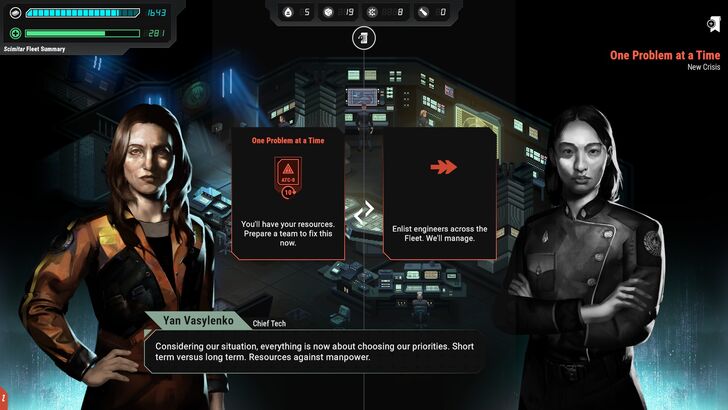
For a part of the game that’s mostly stationary, it’s an incredibly intense and moving part of the game. Fleet management heavily rewards good critical thinking and planning with smoother combat encounters, upgrades to the ships and crew, and even just a greater insight into your Fleet's many personalities and factions.
When things inevitably spiral out of control, the game’s roguelite structure allows players to do things differently and approach the game’s crises from a new perspective. However, as the game progresses and players unlock new staff, weapons, and ships, Scattered Hopes does scale up its difficulty significantly. This not only keeps the game exciting to progress through but makes the Cylons feel even more dangerous, a threat that evolves and grows further as we try to catch up.
My Scattered Hopes For the Narrative
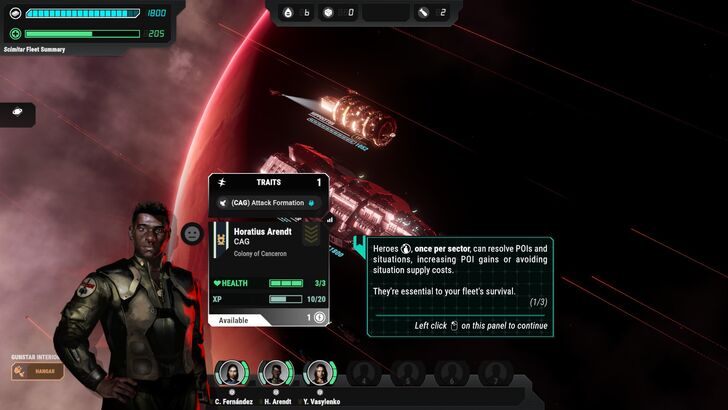
Scattered Hopes’s story, primarily set around the start of the 2004 TV series, takes very few creative liberties from its source material. It draws directly from the general inciting events, namely an impending Cylon invasion by impostors, as a central mystery that undergirds every run. Since the Fall of the Twelve Colonies is such a large-scale event in the world of Battlestar Galactica, it only makes sense that this would remain untouched. If it ain’t broke, don’t fix it.
By taking from such an iconic and well-written piece of science fiction, I think that Scattered Hopes’ story was always fated to be good at a fundamental level. The story’s themes of paranoia, despair, and perseverance still ring profoundly two decades later, and it’s all backed up by excellent character writing and worldbuilding. All of that is strong and unmistakable here in Scattered Hopes, but it’s how the game works this foundation into a roguelite setting that it largely finds its own narrative identity, even if some cracks start to show.
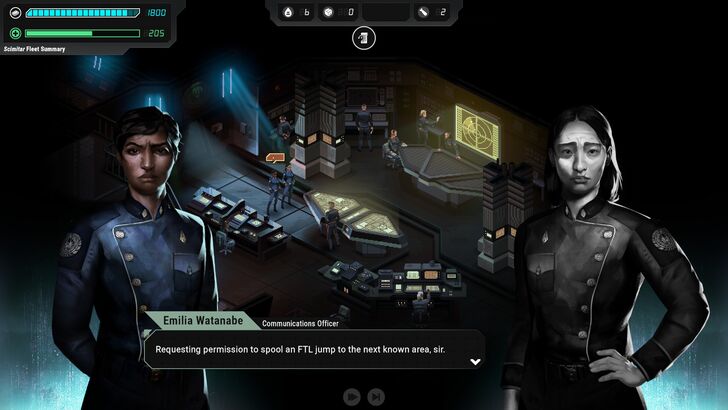
The biggest win with Scattered Hopes’s story is its use of emergent narrative and storytelling, where every story moment is dependent on your choices. Every run tells a slightly different story, contains slightly different conflicts and characters, and it makes repeated runs more memorable as a result. It’s a smart way of using the roguelite gameplay loop to spice up an otherwise established narrative flow.
Unfortunately, from the outset, none of the characters or factions are too interesting. Since runs take 2 hours on average and are dependent on a limited number of turns, it takes a while to get to the crux of your inner circles’ character arcs. This is made even shakier by the fact that characters shift around after every new playthrough and the prompts to start their individual arcs seemingly appear at random. As a result, I found it hard to connect to a specific character or even remember their names.
To the game’s credit, when I did get the chance to complete a character’s individual episode, I found that they were usually pretty well written. Some of them found a reason to continue fighting amidst a crisis of faith. Others were able to process pretty heavy grief, and some of them were just happy to fight for a good cause. Showing how the Cylon threat and the general air of paranoia and tension have been weighing the crew down gave me more of a reason to care for their safety and keep them playing to their strengths.
What I do find genuinely boring about the narrative, however, are the factions. Much like the original show, factions in Scattered Hopes are pretty dry and clear-cut groups of people with specific roles. There are three factions: the Workers, the Military, and the Underground (which are basically the shady individuals and petty criminals of the fleet), and despite their established roles, they felt indistinguishable and inconsequential.
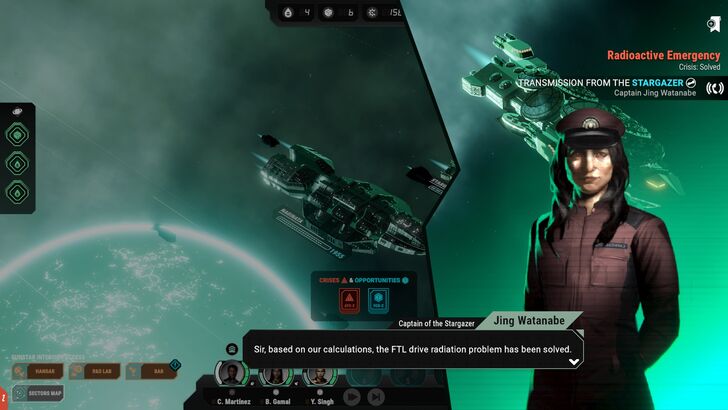
This is because the game treats the factions more as gameplay functions to balance decision-making around rather than an integral part of the narrative. Conflicts between factions boil down to violent spats about resources or disagreements about certain traditions and customs. Even without comparing it to the dark ethical dilemmas and political power struggles of the show, it feels elementary. It's a strange misstep for a game that’s gone through such lengths to capture the heart of a series whose ethos is incredibly clear-cut.
While I have my gripes, I do think that the gameplay does a great job of contextualizing your relationship to the narrative and characters. Simply by virtue of being their leader and being responsible for their safety, I grew to care about my fleet and the hard work they put in. Given its adherence to the original series, the narrative certainly works as a way to integrate the game into the larger Battlestar Galactica mythos. It functions quite well as a believable side story in the grander scale of the universe, even if it doesn't stand out beyond that.
The Lords of Kobol Look Favorably on Persistence
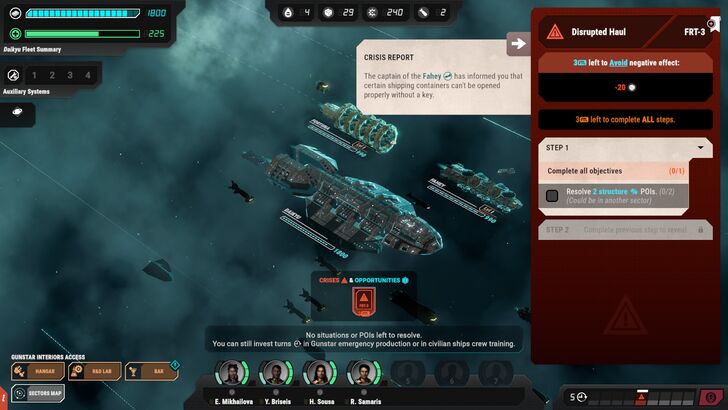
When checking the difficulty in Scattered Hopes, the game itself tells you outright that the experience was designed to be challenging. Even on normal difficulty, it stays true to this promise. With an oppressive and seemingly endless barrage of Cylon assaults, faction infighting, and unpredictable crises, it feels like the game is designed to be a hopeless uphill trek that's destined to feel. Thankfully, the game rewards persistence and insists that players try again, even in the face of inevitable failure.
Getting past the initial tutorial run and the learning curve of the combat unlocks the main meta-progression of Scattered Hopes, letting players choose between a vast array of Gunship fleets and configurations, as well as run modifiers called Favors.
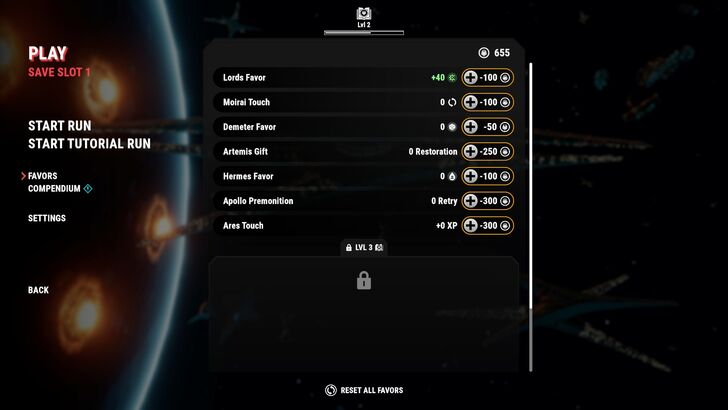
Favors can be unlocked and selected after collecting Fate, a form of currency earned after every run, regardless of its success. They modify everything from the number of resources available at the start of a run to the number of times you’re able to retry boss fights after failing.
Scattered Hopes’s meta-progression system can feel slow at first, with modifiers and upgrades feeling inconsequential in the face of the scales you’re constantly facing. This, ultimately, is by design, as players will eventually figure out the builds and favors that will work out best for them.
For example, I struggled with the basic Callisto-class Wanderer Fleet in my first few runs, but I got through my first successful run by putting all my Fate points into retry and XP-related Favors. This let me basically min-max my way through the combat sections and focus entirely on Fleet Management, which I felt was more crucial to the success of the run.
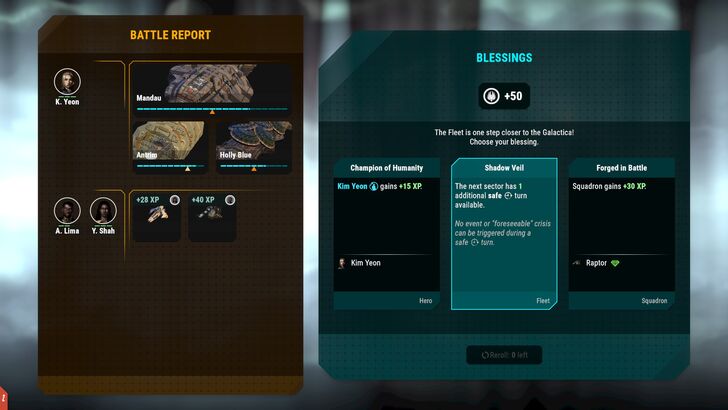
Meanwhile, while starting a run with the more fragile and defense-oriented Xanadu-class Wanderer Fleet, I put more points into bonus resources so I could buy as many ships and squadron docks as I could. This is where the game’s meta-progression becomes more of a puzzle to solve, with these numerous pieces eventually slotting in together to form a cohesive gameplan against the Cylon Raiders.
The Favors system and the different starting Fleets tap into that classic roguelike thrill of trying to break the game by experimenting with as many crazy combinations as you can. It certainly works to the game’s advantage, as subsequent runs and their inevitable superbosses become much less daunting in the face of the absolute units your fleets can become with the right upgrades. All this experimentation, somehow, doesn’t come at the cost of atmosphere or challenge, as the long run times and unpredictable crises still kept me on my toes during gameplay.
There’s Beauty in the Struggle
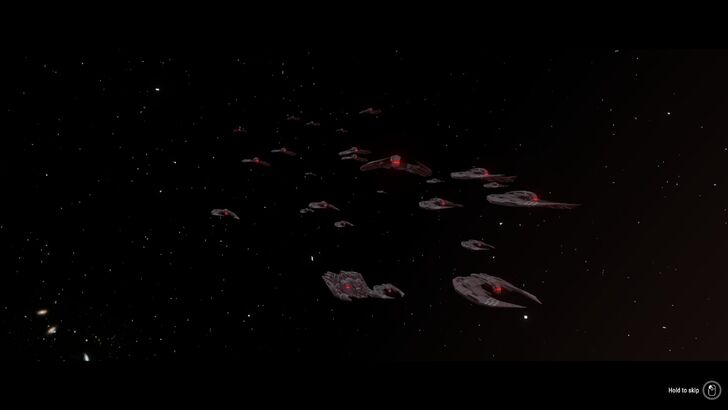
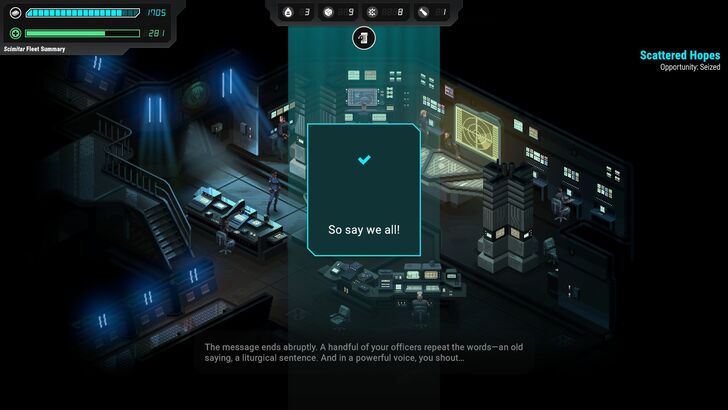
Something I also found immediately striking about Scattered Hopes is its memorable aesthetic style. The art style is a wonderful oscillation between pixel-art backgrounds for the different interior sections, smudged and painterly character portraits during dialogue, and pixel-lined 3D models for ships in the fleet management and combat phases.
These otherwise disparate styles all meld together quite well, a ragtag aesthetic that’s synthesized into a beautiful contrast tied up by the gorgeous planetary backgrounds. The UI, unfortunately, is a bit too overwhelming with the text explanations, even if it eventually melts into a familiar interface. That being said, combat scenarios are surprisingly clear and comprehensible, no matter how many Cylon ships are attacking you.
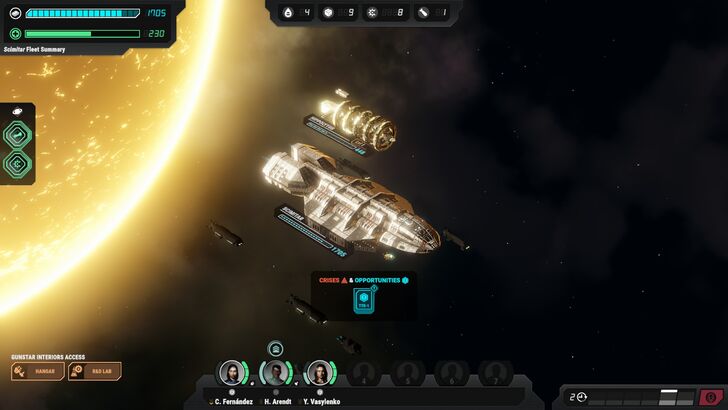
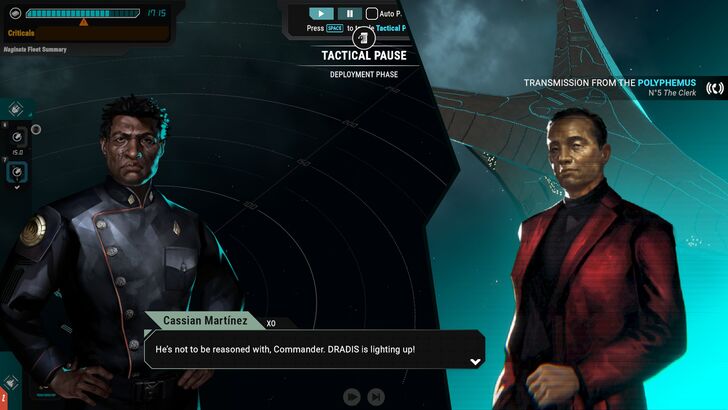
Regardless of the number of explosions, text, or active threats on the battlefield, I could very easily understand the flow of combat and feel the increasing tension thanks to the well-placed UI and battlefield layout. The grids and trajectory lines on the battlefield, alongside the Tactical Pause button, which allows players to assess the fight at their own leisure, helped make combat much more digestible even as the 500th Cylon missile approaches.
Tactical Pause is a key mechanic for Scattered Hope’s gameplay, slowing the gameplay down and allowing players to closely examine the battlefield and assess their positioning and possible tactics. It’s worth mentioning here because it's an incredibly effective way to both catch your breath during combat and to reduce any possible visual clutter to a non-issue. I found myself using it to great effect, especially during the later, harder stages of runs when my screen would be filled with Cylon fleets and explosions.
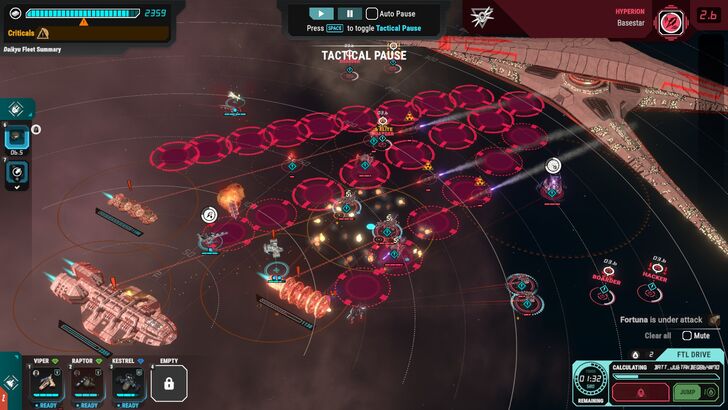
Scattered Hopes’ visual design is beautiful and distinctive without sacrificing the downtroddenness that lies at the core of the series. This is easily the most impressive part of the experience, as the gritty, faded coloring of the environments and smaller scale of the game keep its downbeat, gloomy atmosphere intact.
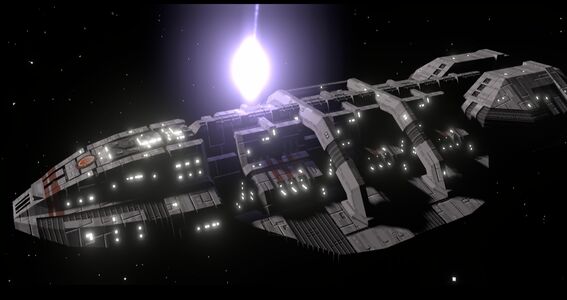
Furthermore, drawing directly from Battlestar Galactica in its ship designs and general sci-fi world keeps it tied to the source material while also letting its unique aesthetic style stand on its own. It is yet another part of the game where Scattered Hopes does the tightrope act of homage and distinction quite well, continuing to manage its duality excellently.
A Well-Mixed Soundtrack, With Some Notable Silence
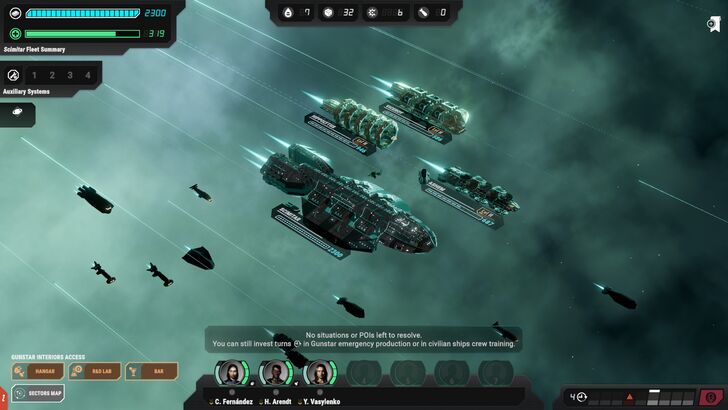
Scattered Hope’s sound design, meanwhile, is much more subtle in its adherence to the source material. The 2004 Battlestar Galactica series’ soundtrack is one of the many things it has received critical acclaim for, and for my money, it’s one of the best sci-fi soundtracks around. The mix between Eastern, Middle Eastern, and Polynesian musical influences and the pounding, techno-orchestral style made for a dynamic and thrilling score that perfectly underlined every scene of the show.
The game’s soundtrack doesn’t quite match those highs, lacking the daring experimentation and spiritual edge that made the show’s score so memorable. Nonetheless, the music that is here is still excellent and highly effective at conveying the pressures that lie with every decision and battle.
Fleet management songs are appropriately understated, with a lone violin dirge or a faint choir providing a silent eye to decision-making and crisis management. The combat soundtrack, meanwhile, uses a classic mix of beating drums and arpeggiated synths to get the heart racing as you navigate through Cylon-controlled space. It’s a mix of styles that works effectively and sounds great on its own, another point in Scattered Hope’s mastery of its own duality.
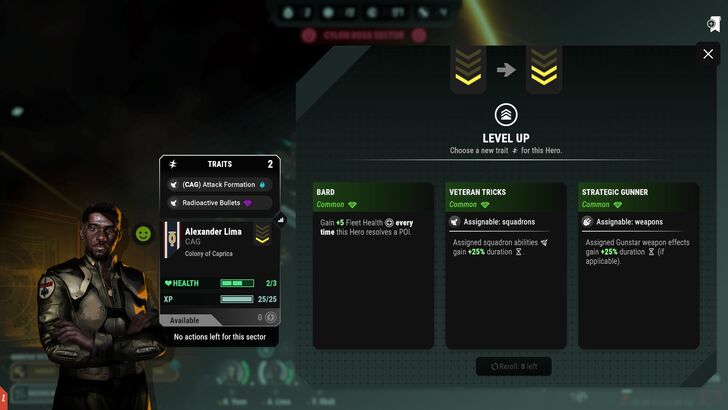
Elsewhere, Scattered Hope’s sonic design is more mixed. Explosions, gunfire, and even UI navigation are all accompanied by appropriately punchy and impactful soundbites. What’s truly baffling, however, is the lack of voice acting.
The game has no voice acting whatsoever, which really does hurt its presentation of the narrative and characters. It makes characters and specific story moments less distinctive, and the already straightforward dialogue is made less memorable as a result.
This, ultimately, is a rare (but noticeable) flaw in an otherwise distinct and well-realized sonic identity. Scattered Hope’s soundtrack is a critical component of maintaining the series’ classic atmosphere, echoing the original series’ score while integrating a more appropriately video game-y edge into it. The fact that some of the combat themes are certified bangers certainly helps in this regard, too.
Is Battlestar Galactica: Scattered Hopes Worth It?
A Worthwhile Purchase, So Say We All!
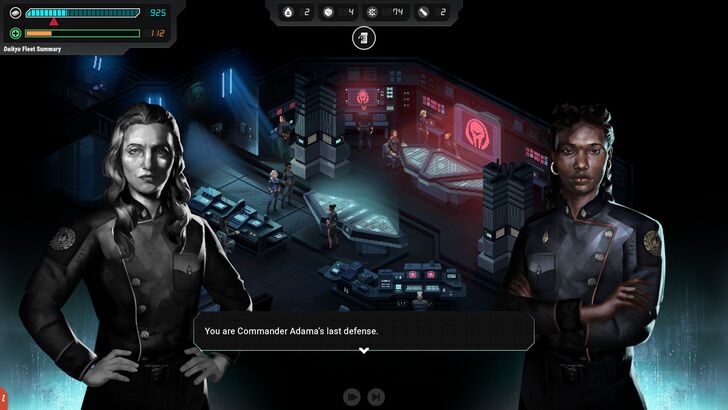
Battlestar Galactica: Scattered Hopes is a challenging, intense roguelite that demands compromise and perseverance amidst staggering odds. By effortlessly capturing its parent series’ signature dark, gritty, and hopeless atmosphere, it serves as a fantastic experience for fans of the 2004 series and a great entry point into the series for newcomers. As someone in between those two demographics, I appreciated that the game’s intensity and uphill battles never wavered. It’s a game that forces you to adapt, be better, and make the most of bad situations in the face of unending adversity, and nothing pushes its commanders to their limits quite like the Battlestar Galactica. You are, after all, Commander Adama's last defense.
FAQ
How long does it take to beat Battlestar Galactica: Scattered Hopes?
While a single run of Scattered Hopes will run around 1-2 hours, a full playthrough will take closer to around 8 hours. Fully exploring the game’s different loadouts, character stories, and branching paths will take around 20-30 hours.
Do I need to watch Battlestar Galactica to play this game?
It’s not required to watch the 2004 Battlestar Galactica series to play Scattered Hopes, as the game provides enough context from the show while starring its own original narrative and cast of characters.
Game8 Reviews