



Overview
What is Astro Colony?
Astro Colony is a co-op multiplayer base-building factory automation game set in the infinite void of space. Reeling from the aftermath of the players’ previous space station getting sucked into a black hole, they must now start anew and rebuild their station’s former glory from scratch. Using asteroids as fuel and hopping from planetoid to planetoid, it’ll take immense planning and efficient production lines to make something worthy of the stars.
Astro Colony features:
⚫︎ Tier-based factory automation gameplay
⚫︎ Voxel-grid construction across zero-gravity landscapes
⚫︎ Factorio-style tech tree progression
⚫︎ 1-8 player online co-op multiplayer
| Digital Storefronts | |||||
|---|---|---|---|---|---|
 Steam Steam |
|||||
| $19.99 |
Astro Colony Review: Satisfactory Ran So This Could Crawl
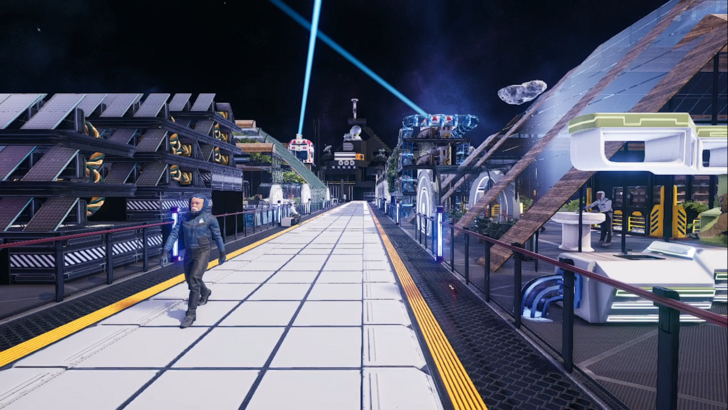
"What makes a good factory automation game?"
That’s the question that every dev dipping their toes into this genre asks before arriving at the wrong answer half the time. Some say that tight, synergistic mechanics and fleshed-out logistical pipelines are at the core of factory automation design. Others prefer relying on emergent gameplay and player creativity to make the automation experience memorable.
True enough, both are applicable and present in Astro Colony—this 1-8 player co-op experience I’ve been digging my heels into. The correct answer, though, is what Astro Colony lacks, and it’s what’s keeping an otherwise fun game from reaching the stars.
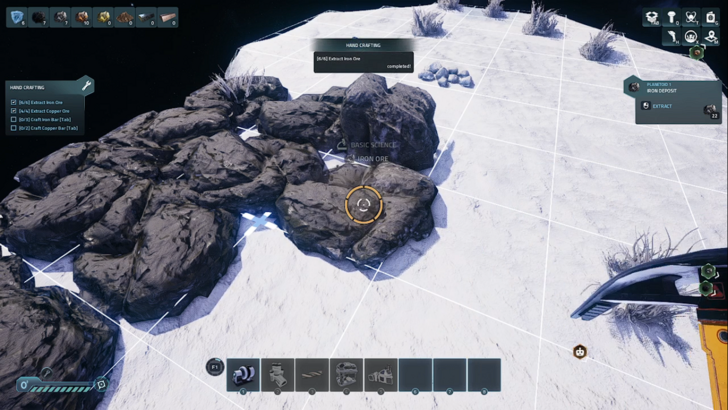
More than the so-so terrain visuals and the grating audio, this missing piece prevents the factory automation experience in this game from reaching the same highs as the best of its kin.
Together, let’s figure out exactly what this missing piece is, alongside every other bit and bob that went into this crawl of a game.
Rebuild the Station, One Floating Rock at a Time
We begin with the game’s story. I’ll just say it right out of the gate that this game barely has one. It doesn’t have a story so much as it has a set-up; a prologue to everything you end up doing down the line.
The player takes the role of an unnamed, unaffiliated, space-suited humanoid who survived the destruction of their previous space station—an open-air platform in deep space—at the hands of a black hole. They must then rebuild the station, presumably for other astronauts to gather on down the line.
Though I would’ve appreciated a bit more narrative presence, the same way Satisfactory had world-building thrown in, having a simple and effective story just at the start can work too if its themes are carried for the game’s entire run. This is what Factorio did, as it had a survival undertone to your constructions.
Astro Colony does not do either. It isolates all narrative to the beginning of the game and doesn’t carry it forward. It’s not a very complex start, but at least it precedes complexity without getting in the way, which is likely the intended design. If nothing else, it doesn’t overstay its welcome and fulfils its purpose, which earns it the " it exists" award, and nothing else.
So, is a narrative throughline the game’s missing piece? No. Its current state is inoffensive and forgivable considering what the genre focuses on anyway.
Making Raft’s Resource Gathering Seem Like Child’s Play
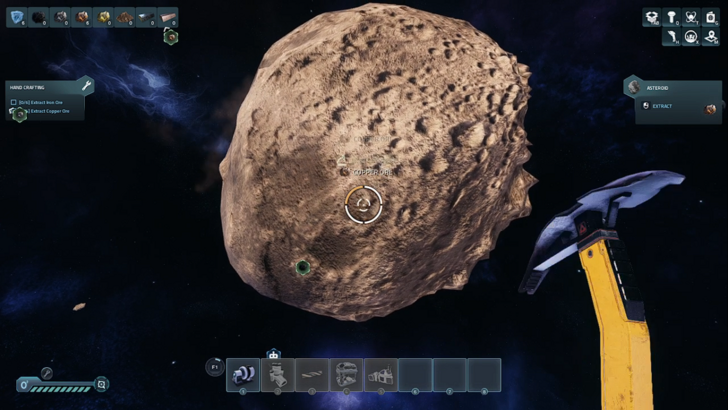
Moving on to gameplay, then, let’s talk about the baseline that all factory automation games begin at; then we’ll work our way through the tiers to see what’s up. All factories begin with resources and their nodes, and while most games in this genre are happy to slap a resource deposit on the map and call it a day, Astro Colony is in deep space, so the "map" is 99% empty void that deposits can’t exist on.
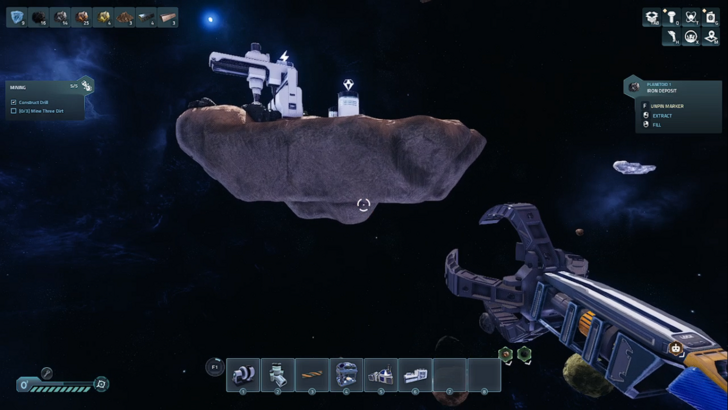
Instead, Astro Colony adopts a resource gathering system similar to Raft’s, which is to say that precious iron, copper, carbon, and ice resources are found on moving asteroids that players need to chase, catch, or otherwise harvest from as they pass by.
I don’t hate this, unconventional as it may be. Sure, it’s a bit tedious flying from one rock to another at the start, but once you’ve got some automatic asteroid catchers set up in the mid-early game, it becomes a complete non-issue while also being novel, so I won’t dwell on it too much.
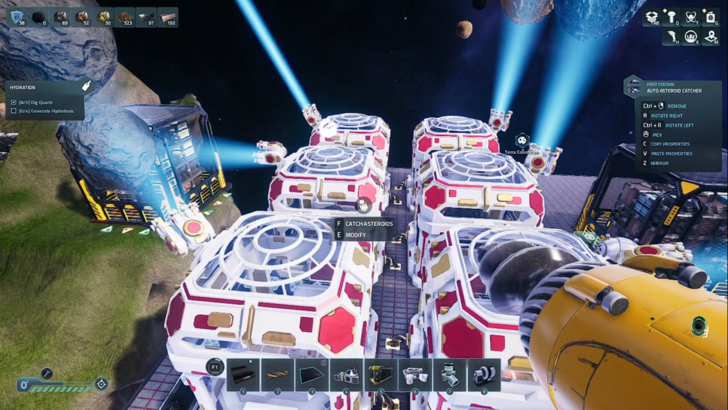
Now, the next step in any factory after getting resources is logistics, and Astro Colony has multiple ways of making Resource X travel from Point A to Point B. The main way is through conveyor belts, which are supplemented by Wires, Pipes, and even automated drones down the line.
Accompanying them are logic gates, which serve as a means to filter and guide resources as they go from one part of the factory to the other. These come in flavors of filters, pushers, splitters, timed pushers, and more.
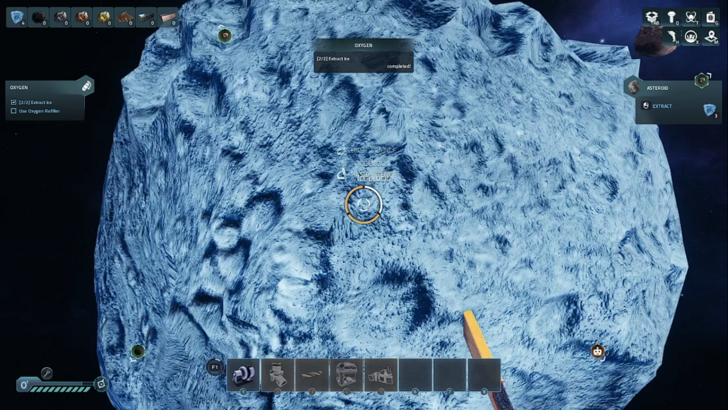
Overall, I’d say this was an effective logistics pipeline that would be welcome in any game. It has great variety, viable uses for each kind, and a strong means to edit basic movement even across vertical places.
I would say that, if not for the absolute travesty that is the rogue’s gallery of machines these logistic chains lead into and their awful, AWFUL input and output port placements.
The Worst Game of Tetris You’ll Ever Play
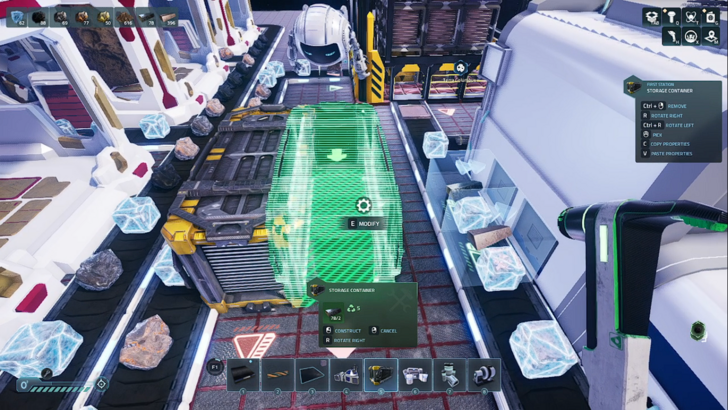
Belts, pipes, and wires should all lead to something, and that something in Astro Colony is the machines that process resources into new forms. Resources go in through an input, are processed after some time, then are released through an output, usually to be processed further.
This is well and good—basic, even—but it’s also a nuanced bit of design that I think the devs didn’t get quite right. See, both scalability and efficiency are affected by input and output placements for processing nodes, since both of those usually depend on repeating patterns and logistical accessibility. This is further compounded by the number of similar logistical chains vying for the same access ports.
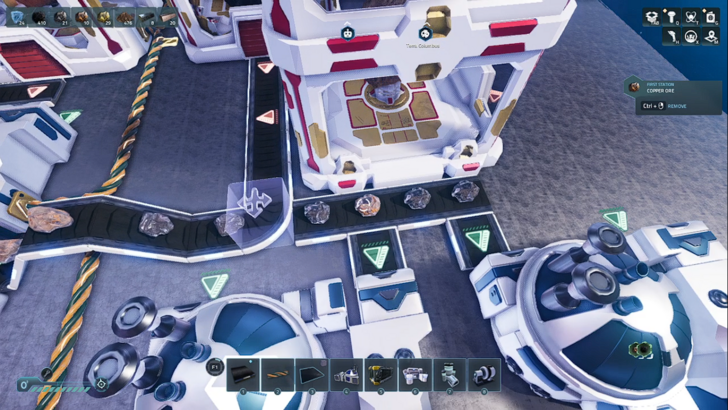
All of that is to say that if you design your machines to have defined resource inputs and outputs, it’d serve you to position them in such a way that both can be scaled efficiently, and are not in the way of each other, or even other resources going in or coming out.
Satisfactory solves this issue by eliminating energy logistics entirely using its power poles, making the logistical chain you worry about most—belts—be the main thing they design around. Factorio navigates this by being two-dimensional and being more flexible with its input and output directions.
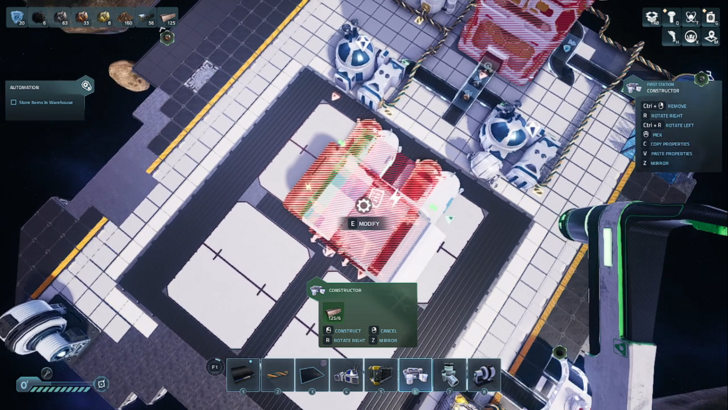
Astro Colony has the worst-designed input and output placements I’ve ever seen, and all logistics being completely voxel-based means they’re all fighting for the same space. Power, liquids, belt-fed resources - all of these vying for the same real estate, even if they don’t have the same entry and exit ports. And what’s this? Resource inputs one way, energy the other, intersecting with its own output? How did it get this bad?
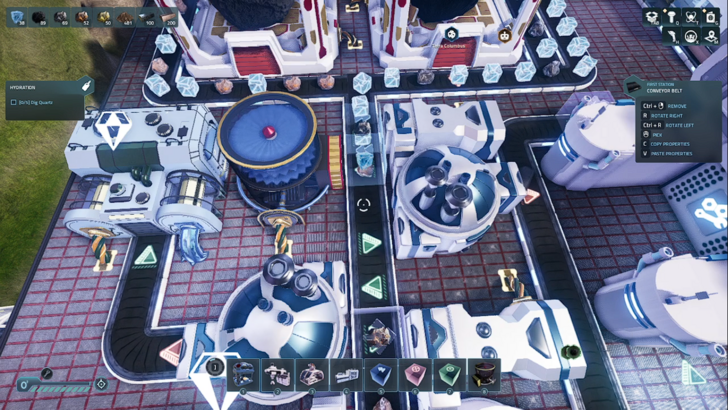
This forces so many spaghetti junctions that you’d mistake this deep-space excursion for a trip to Italy, and that’s just for the beginning. Once drones and astronauts join the mix, it becomes a complete mess, unless you’ve planned three, four, five steps in the worst game of Tetris you’ve ever played.
So that must be what’s missing, then? Good input and output design to cap an otherwise serviceable logistics system? Well, it’s certainly a problem, but only if the true missing piece is in play.
Mostly Acceptable Visuals with Mute-worthy Music
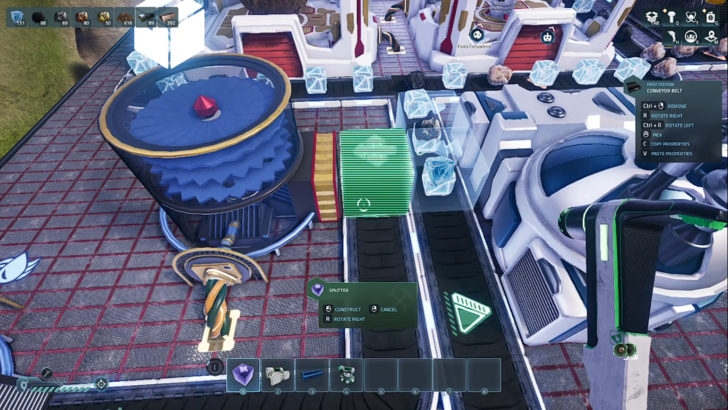
What about presentation? If the fundamentals are only conditionally bad and the story is acceptably frontloaded, surely the missing piece is the game’s visual and auditory presentation. Well, a case can certainly be made for the latter.
Astro Colony’s visuals are fine. Far from perfect, but fine. The machine and tool models are sufficiently on theme and well-made, though having pitch-black space with pinpricks as your backdrop most of the time does get exhausting. What trips the visuals is the laughably rough terrain texture the game uses for its planetoids, though that doesn’t occur enough to be too large a problem.
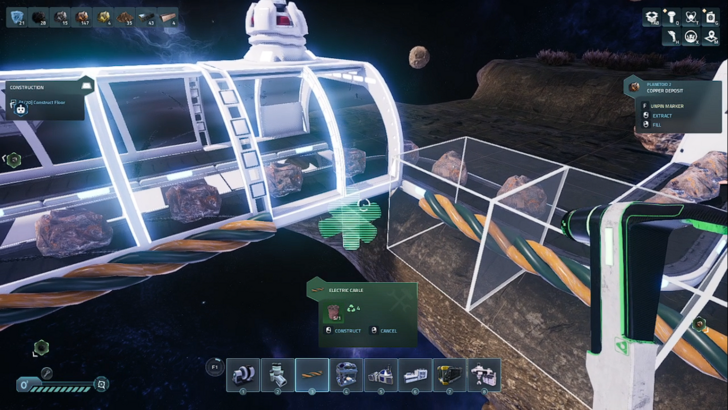
The music is really where the presentation catches a snag. UI sounds and SFX are fine, and no voice acting is just standard for the genre. It’s the music that makes me want to mute this game. It’s not that it’s awful; it’s actually quite inspiring; it’s just very repetitive and not really thematic outside the main menu.
I just end up getting overwhelmed by its volume and the dissonance between its upbeat crescendos and the slow, steady chug of my factory. It doesn’t serve the game to exist, and I’d either remove, replace, or expand it, given the chance.
Poorly Equips Players for the Hostile Loop to Come
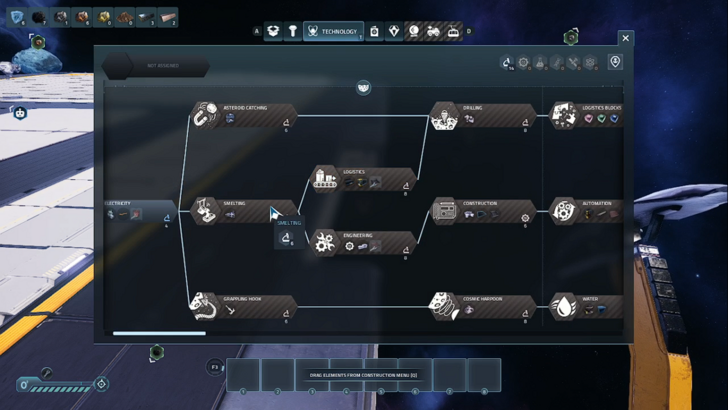
Here we are at the end of the production line. We’ve scoured story, fundamentals, finer mechanics, and presentation to find the missing piece that drags this game down, and now, we’ve reached it.
Onboarding. There’s a reason Satisfactory has that title. Apart from the obvious pun, the game never feels like a job unless you want it to. It’s satisfying because it’s rare for the player to ever feel lost in its intricacy, allowing ambition and creativity to take the lead. This is largely thanks to the game’s onboarding sequence, which guides you through every in and out of the game’s fundamentals, such that you’d only have to put two and two together come the game’s more complex ideas.
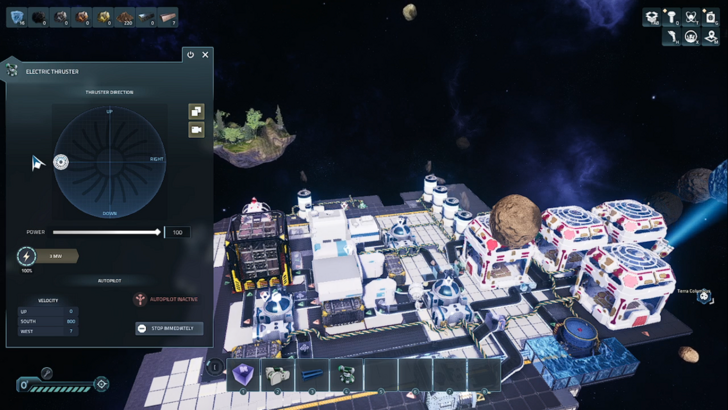
Astro Colony’s tutorial and onboarding are atrocious, consisting of passable step-by-step instructions at the start before plummeting straight into vague "progress more, and I’ll tell you what to do next" territory.
This seems to be an attempt to ease players into the game’s Factorio-style tech tree that uses factory-craftable resources as research currency, but it goes up in flames when you realize that you, as a player, were just left to fend for yourself in the void of space with unknowable expectations of progress forced upon you.
Now, figuring things out is part of emergent game design, and for a factory automation game, forcing some tinkering really isn’t a bad idea. Unfortunately, since the game ill-equips the player for later advancements, what they ended up making in their haze of ignorance becomes a roadblock they have to dismantle down the line, and sometimes, that equates to a softlock.
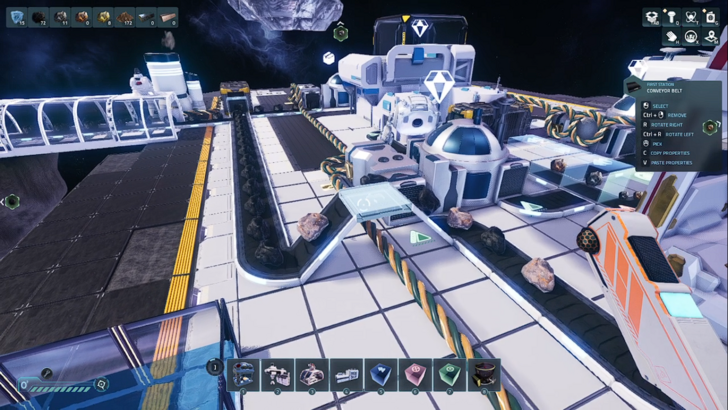
My experience with this was a good example. Vertical integration is a thing in this game; that much was clear from the verticality of the logistics. I created a top layer of machines and belts, with wires, power, and liquids coming up from under the floor from a lower level. The problem is that vertical integration comes in the late-mid game, and I didn’t have the means to unlock it.
The tech tree has required unlocks I can’t quite reach because doing so would require me to tear up everything and rebuild. That much is doable if the game’s dismantling system was as direct as Satisfactory’s, but no. It’s slow, clunky, and doesn’t translate dismantled structures into materials, instead turning them into recyclable versions of themselves for later use.
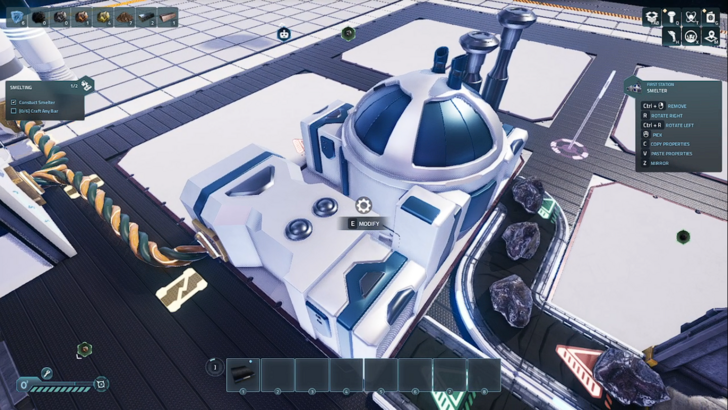
I felt kneecapped from the start, progressing through sheer will and creative ideas despite my ignorance. Now I face an obstacle of my own creation. As a veteran, I can take that much, but a newbie would likely consider this a deal-breaker and would dislike the game as a result.
All Parts Amount to A Slog
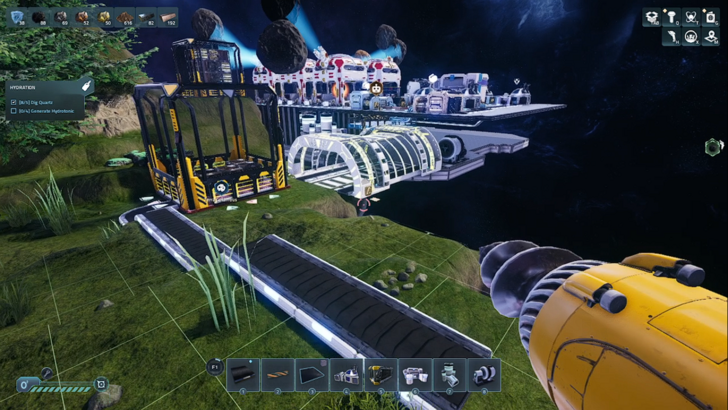
Astro Colony is a slog, but a fun one. You can genuinely get up to some crazy and amazing builds when you do manage to get the hang of it, but the journey up until that point will be anything but smooth. Progressing for the first time will be slow, with lots of doubling back and reapplying what you’ve learned, which, in essence, can be fun if that’s what you’re into.
Unfortunately, this poses an accessibility issue for this game, since not everyone has the time or attention to spend to go through the entire song and dance of learning what does and doesn’t work.
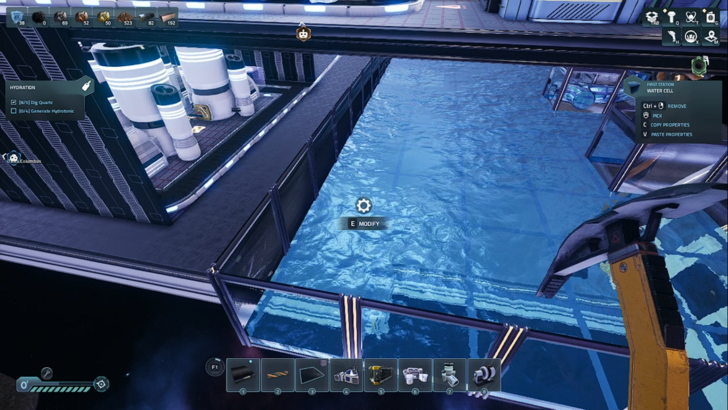
This is a good game with some very notable pitfalls, particularly with the optimization of its processing node accessibility and the quality of its music. But with the game itself working against you, keeping its goals vague and letting you make progress-halting mistakes, every major development feels like a step forward followed by a kick in the pants, then two steps back.
Is Astro Colony Worth It?
It Ain’t Great, But It Is Cheap!
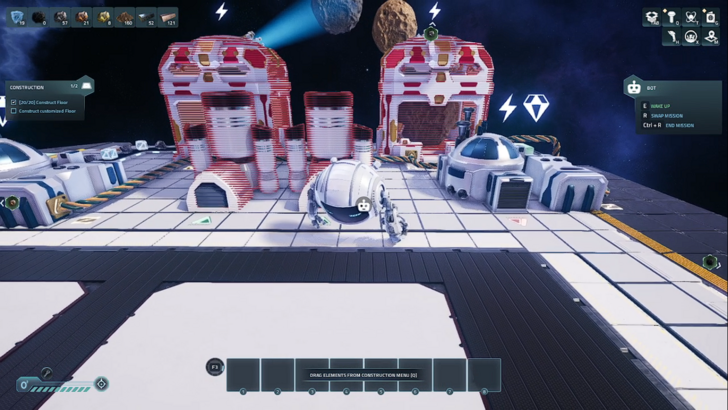
This game is not great at a baseline; every ounce of satisfaction you’re going to get from an optimally built factory will have to be bled from your veins. Normally, I wouldn’t even bother recommending this to anyone, but this isn’t a normal situation.
This is half the game Satisfactory is, but also at half the price, coming in at $19.99. It has enough fun potential to maybe be worth twenty bucks, and, once you’re past the massive slump of its learning curve, as capability of being just as good as the better titles of its genre. Just know what you’re signing up for, and this might just be a good enough purchase until you can save for the guarantee of a better game.
FAQ
How Do You Unlock Blueprints in Astro Colony?
Astro Colony's Blueprints mechanics allows you to copy base layouts and share them via the Blueprints Library. It is an inherent feature that is unlocked once players reach Astronomy Science in the technology tree.
Does Astro Colony Have Mod Support?
Yes, Astro Colony mods. The game's developers released a dedicated official MODKIT and an in-game Mods Hub that allows players to download, install, and uninstall mods directly.
Game8 Reviews