




Overview
What is All Will Fall?
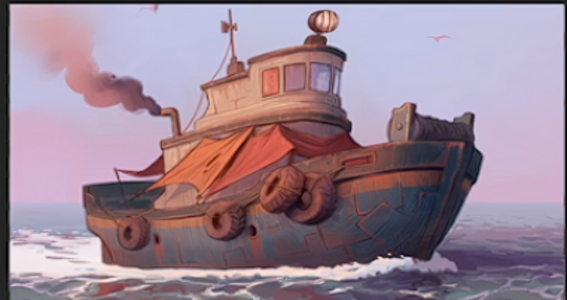
All Will Fall is a 3D colony builder/simulator set in the raging waters of a flooded Earth. Forced to survive among disparate islands of concrete in an endless ocean, players must use wood, stone, and junk from a fallen society to rebuild civilization once more.
All Will Fall features:
⚫︎ Physics-based building limitations
⚫︎ Multiple starting scenarios, including roguelite and random start modes
⚫︎ Water-level mechanics
⚫︎ Faction approval mechanics
| Digital Storefronts | |||||||
|---|---|---|---|---|---|---|---|
 Steam Steam |
|||||||
| $29.99 | |||||||
All Will Fall Review: Falling Short of Its Own Promises
Jenga and City Builders Shouldn’t Mix — And They Didn’t
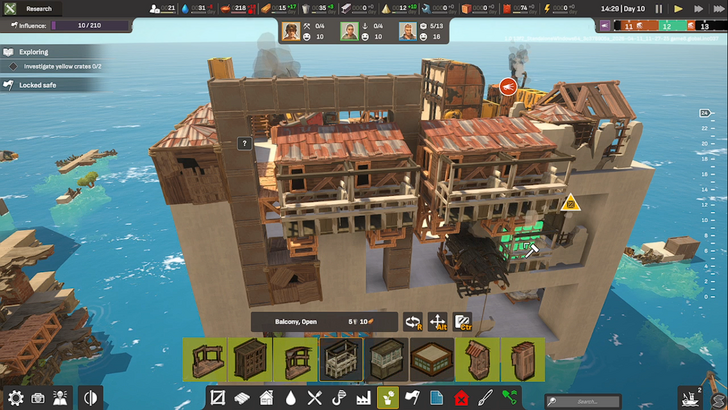
Among the many concepts city-builder games have tried to employ over the years as gimmicks to the tired, old staples of its genre, physics-based building limitations are among the most volatile. On one hand, they provide an interesting design limitation that forces creative urban planning above the usual grids and highways. On the other hand, they’re usually make-or-break systems that can amplify one small errant calculation into a district-leveling disaster.
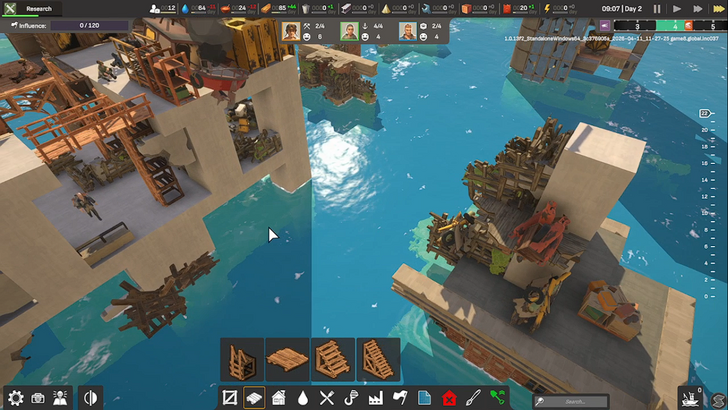
Something like Airborne Empire tried to do that with its weight and balance mechanics for the flying cities of its setting. As much as I want to put All Will Fall as the counter to that inspired implementation, it doesn’t even ping on the radar, because for all of its mentions of "physics-based" city-building where every structure can collapse, that barely plays a role in the game’s ups and downs.
There’s much to discuss about this game: its best, its worst, and its non-existent, despite what all the ads would have you believe.
Fishing Out Civilization from Rough Waters
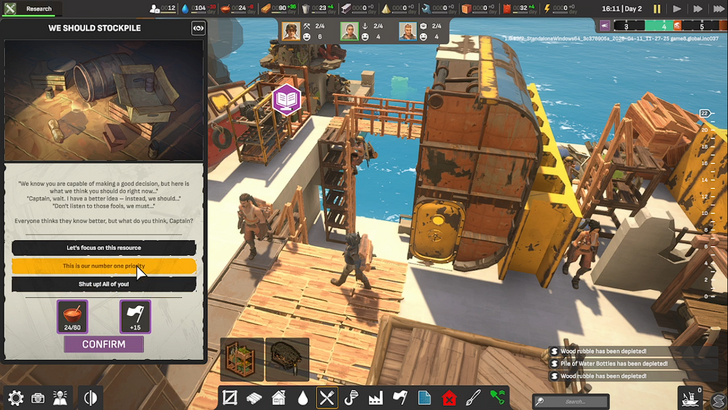
Before everything else, let’s set the scene for All Will Fall, because it’s actually one of the game’s better aspects. All Will Fall takes place in a world ravaged by rising sea levels to the point where the survivors were forced to take refuge from the raging waters on top of skyscrapers, which have been reduced to islands of concrete and junk.
Buffeted by slicing winds, ravaging squalls, and deadly Junk Storms, where scrap metal rains from the sky, it’ll be up to human ingenuity to rebuild civilization on a world without a surface.
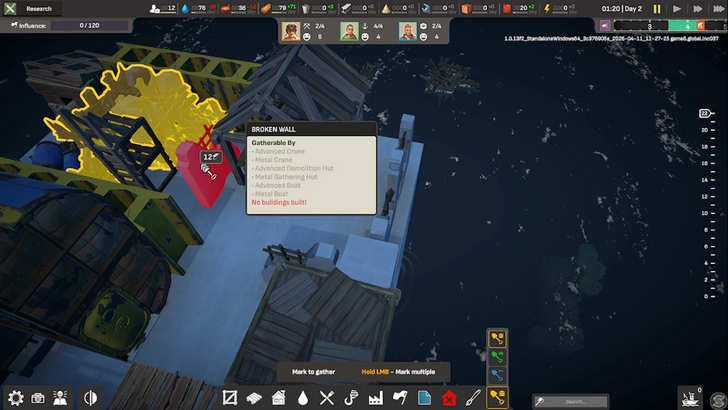
From the get-go, this is a solid foundation for a story despite the lack of characterization or literal building foundations. City-Building on water isn’t new, or at least colony and survival sims aren’t, but expanding that base concept into municipal management is a particularly inspired move that has many design connotations to consider. We’ll get to those shortly.
And consider them, the devs did, for everything about this game reeks of Waterworld’s rust and salt, and I, for one, appreciate the creativity. After that initial hit of world-building, it’s all standard-fare, city-builder open-endedness, where your decisions decide your city’s fate. It’s not all just you at the helm, though, since your city is made up of different factions of citizens: Workers, Sailors, and Engineers, and they’re all equally fickle.
Unexpected Depth Within The City’s Faction System
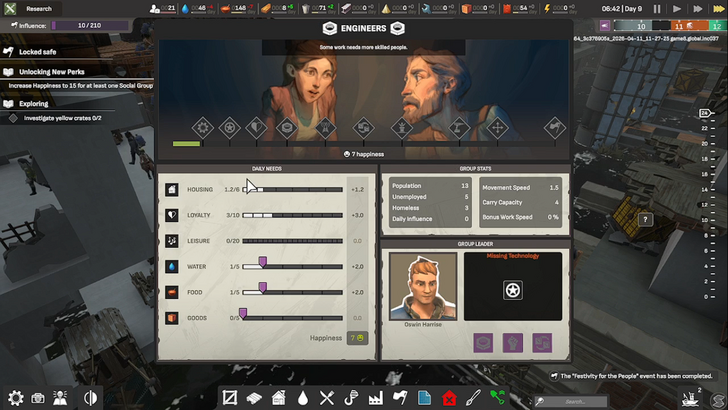
Though it doesn’t make sense to start with the game’s faction system over its city-building, the former is the better of the two, and actually worth talking about. We’ll get to the offending mechanics later.
All Will Fall’s faction system stretches across the three aforementioned working classes: Workers, Engineers, and Sailors. These factions, though generally similar in role and behavior on the day-to-day, have major differences that grow more prominent as your city grows.
Specific buildings will only allow certain factions to operate them, and narrative choices will treat each faction as a separate entity when it comes to the consequences of your decisions. Each faction has a happiness meter, and both this meter and the overall population of each faction will determine their average happiness.
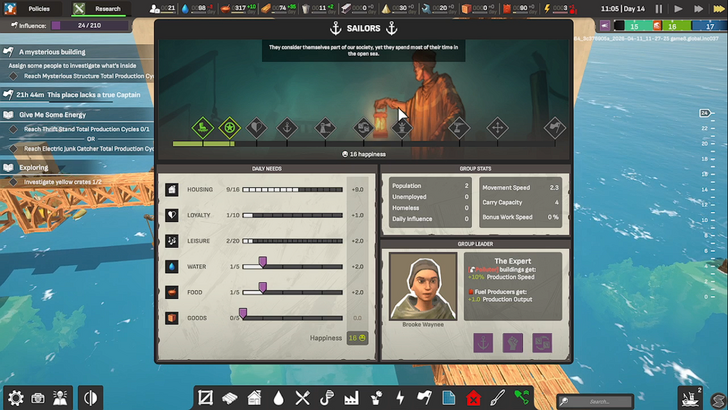
Once this happiness reaches certain thresholds, bonuses are unlocked, faction leaders are assigned, and the faction itself will gain a bigger and bigger hold on your city, until they’re the dominant among the three. So far, so Frostpunk 2.
What truly makes this mechanic rather great for All Will Fall is the fact that it’s not purely narratively. Depending on who you appease, certain actions and plans become easier to achieve. Woo the engineers, and you have all the industry you could want. Play to the Sailors, and the sea becomes your playground for building and resources. Give the Workers their demands, and your city becomes a utopian society for the little man.
Alternatively, you can appease all three, though this is considerably more difficult. This choice of path gives All Will Fall great replayability, as no two runs would be exactly the same, given your myriad opportunities to tip the scales in whomever’s favor you wish to curry.
That said, the game has great replayability for other reasons.
Great Tutorial with Plenty of Scenarios to Try
All Will Fall has a great many scenarios for players to get lost in, and the tutorial is just one of them. Yes, the tutorial is its own dedicated scenario, with missions and the option to play it past the instructional portions to match. It’s a great training ground that holds your hand as needed, but lets go when it should, making it among the most helpful tutorials I’ve had for these kinds of games.
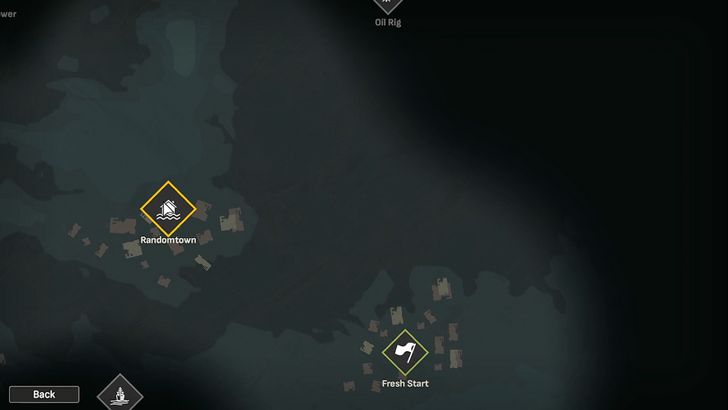
Once you make it past the tutorial, you’ve got lots of other scenarios to check out, which are all unlockable on an achievement-based system where reaching milestones grants you new ways to play. The Random Town scenario is solid, giving you a randomized start for greater replayability. Other scenarios, like the Abandoned Tanker, the Roguelike Scenario, etc., boost the game’s value further, making sure there’s always something new for your city to stake its claim on.
Standard Survival Aesthetics, Passable Music
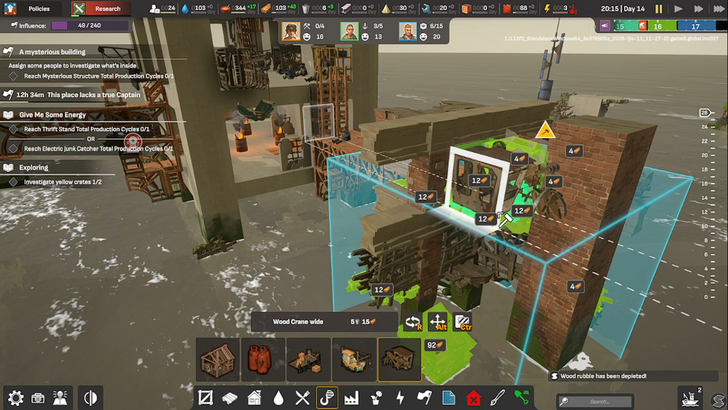
Talking about the game’s presentation now, it’s not completely impressive in either its visual or auditory aspects, though it isn’t completely awful either. The game looks exactly how you think a civilization built on the waterlogged ruins of an older one would look. Not much creative liberty was taken in that aspect, and even Waterworld looks shinier and more creative in comparison.
I just think the setting and premise both had such potential that the game’s visual identity didn’t capture, at least not entirely. The people are just people, the buildings won’t look lost in any other island-based survival-crafter, and there’s really nothing to write home about regarding visual style.
The music’s much of the same, with minimal identity and charm given to its backing soundtrack or its sound effects. Overall, a mediocre presentation, but a competent enough one that it only pales in comparison to the genius of the Faction system instead of being a complete liability.
Can Barely Run Itself
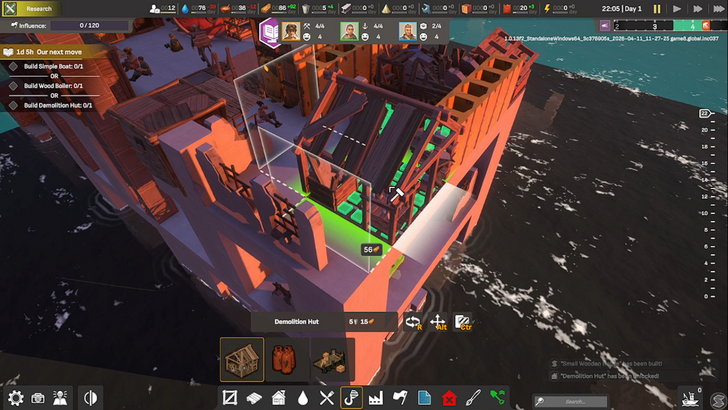
What is a complete liability is the game’s optimization. If you guessed that having water be the ground you build on—you know, the famously graphically intensive aspect of 3D landscapes—would be what FUBARs this game’s average framerate on middle-to-lower-end systems, you’d be right.
The game runs very poorly, even on the lowest settings, if your PC is even a couple of years old. This isn’t necessarily a bad thing, but bigger games like Cities: Skylines 2 at least managed to fix itself for such systems after a few months. Nothing is stopping this game from doing the same, but until it does, you can’t expect it to be reliably optimized.
Barely Any Jenga to Be Had
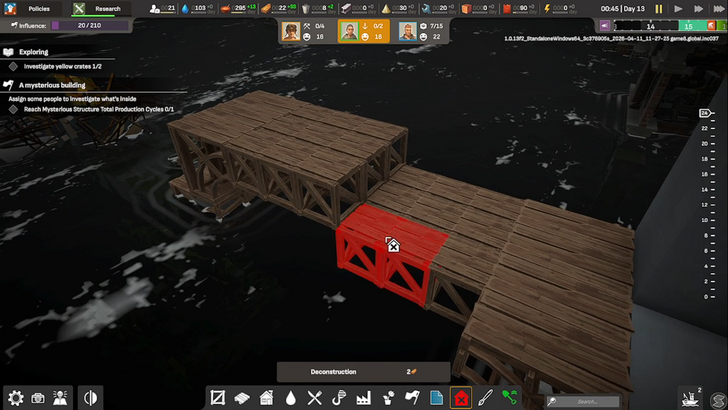
Now we reach the big pain point of the game’s whole facade. Fitting that this is the part that crumbles, because it is insufficient to bear the weight of its own spotlight with how inconsequential it ended up being. I am, of course, referring to the game’s physics-based city-building mechanics. The Jenga of this game, if you will.
Simply enough, there’s not enough of it to be a genuine design limitation. The game touts in its ads and media that every structure could collapse if you don’t pay heed to the game’s weight and overhead limitations. This, in theory, makes sense for the setting and premise, as skyscrapers have limited footprints, and building too vertically runs the risk of storms destroying everything.
When you think about it, this is the only way for this city-builder to work. You need to build platforms outward, stack buildings on one another, bridge gaps between skyscraper rooftops, and make the most of what flotsam comes your way. When you try it out, though, you realize that this "restriction" can be solved by just…slapping on more supports.
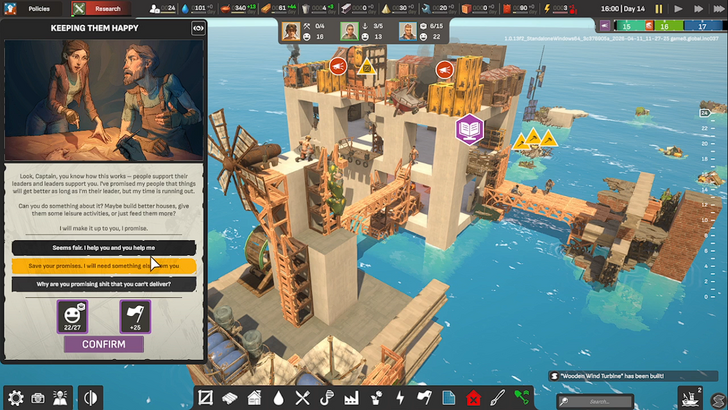
There’s no physics here, no semblance of balance and weight differentials, no centers of mass and material integrity to note. Just pile on the supports, and you can build the Burj Khalifa on the Empire State Building if you want.
This is disappointing. I wanted a city where my brain had to be challenged and warped in every which way to make the usual city-builder gameplay work with these physics restrictions in mind. Instead, I just got a weird Lego build.
Of course, it’s not all bad, as the core of the city-building is very solid and by-the-book. I just think the game overblew its unique aspects to the point of hyperbole, and my expectations weren’t met as a result.
Not Bad, Just Not as Good as It Said It Was
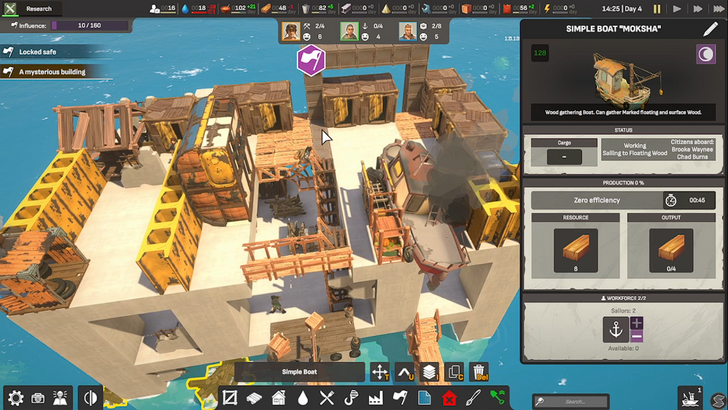
All Will Fall isn’t a bad game; it simply overpromised. It’s not quite a No Man’s Sky situation in that it didn’t reach sky-high expectations, it kinda just overplayed its hand with how much physics-based city-building there actually was. There was no lie, but I certainly would’ve preferred more than what I got with this game.
As a city-builder without the frills, the game shines with its faction system and city-building staples. It’s unoptimized for lesser systems, though, and both the visual and audio aspects of its media aren’t special. It is an overall competent attempt at something unique that messed up a few steps.
I appreciate that the devs tried to make something of this waterworld they cooked up. Unfortunately, it fell and drowned in the water before it could make too big a splash.
Is All Will Fall Worth It?
Only If You Can Run It anyway
Although All Will Fall isn't the most expensive city-building game out there, its value is suspect at best. There's much to enjoy because of the game's sheer replay value and novelty, but that's wholly dependent on whether you can run the game well in the first place. Its poor optimization and overstated main gimmick make its upsides moot in the long run. If you can't run it, don't buy it. If you can, wait for a sale.
FAQ
How Do I Unlock the Roguelike Mode in All Will Fall?
Players can unlock All Will Fall’s Roguelike scenario "Rogue Lake City" by leaving the crashed ship untouched during a standard playthrough. This will allow a prompt to fix the ship to appear randomly throughout the playthrough, which, when accomplished, takes players to the Rogue Lake City scenario and permanently unlocks it thereafter.
Leaving the crashed ship untouched entails not deconstructing it, or otherwise destroying it before the Rogue Lake City prompt is activated.
How Do I Unlock Faction Leaders in All Will Fall?
Faction Leaders are unlocked for each faction by increasing their influence to a minimum of 20. This can be achieved by managing resources in that faction’s favor and favoring choices that benefit that faction during every narrative event.
Game8 Reviews























Hello. And Bye.