


| ZERO PARADES - For Dead Spies | |||
|---|---|---|---|
| Release Date | Gameplay & Story | Pre-Order & DLC | Review |
Overview
What is Zero Parades: For Dead Spies?
Much like Disco Elysium, Zero Parades is a narrative-driven espionage RPG where players step into the role of Hershel Wilk, an operative navigating a city steeped in intrigue and betrayal. Presented from a top-down perspective, the experience emphasizes exploration, dialogue, and interactions with a diverse cast of characters, including international financiers, psychic doppelgängers, and rival factions.
The game also introduces new systems that build on ZA/UM’s signature style, such as Dramatic Encounters, Conditioning, and the Exert Option, which expand player choice and shape how each scenario unfolds.
Zero Parades: For Dead Spies features:
⚫︎ Espionage CRPG
⚫︎ 15 Skills to Work With
⚫︎ Pressures Act as Health
⚫︎ Exertion Rolls are High Risk
⚫︎ Conditioning System Internalizes Thoughts
⚫︎ Dramatic Encounters
For more gameplay details, read everything we know about Zero Parades’ gameplay and story.
| Digital Storefronts | |||||
|---|---|---|---|---|---|
 Steam Steam |
|||||
| $39.99 | |||||
 PSN PSN |
|||||
| Wishlist Only |
Zero Parades: For Dead Spies Review: There is Life After Elysium
Zero Parades Should be Judged On Its Own Merits
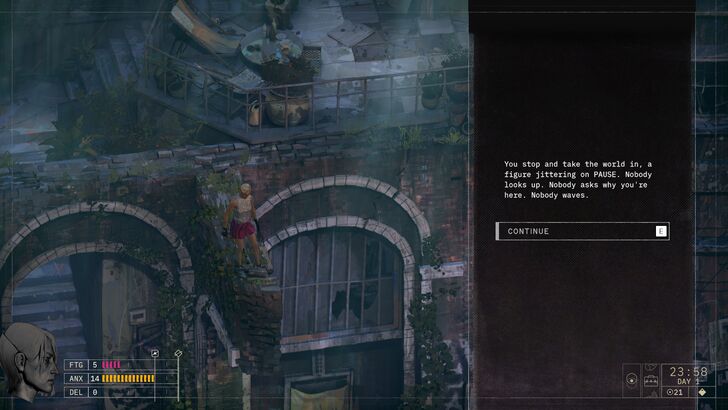
Zero Parades: For Dead Spies carries an enormous burden simply by existing. The shadow of Disco Elysium hangs over every part of it, made even heavier by the messy disputes and controversy surrounding ZA/UM. In the years after that game’s release, the industry has changed, and the studio itself has fractured. I will not rehash the painful fiasco between ZA/UM and Disco Elysium's key creators here. Everyone’s anger and skepticism regarding the fallout are theirs, and there is no separating Zero Parades from that history entirely. I completely understand why some people may approach this game cautiously because of it.
But those notions will not color what follows. Zero Parades deserves a fair trial, judged strictly on its own merits rather than the shadow of its lineage.
Disco Elysium remains my favorite game of all time. It was an experience so raw, and so deeply felt, that it set a standard I have spent years desperately trying to find elsewhere. I am certainly not alone in that sentiment. I will confess, though, that while nothing will ever truly replicate the magic of that game, Zero Parades comes astonishingly close.
The Name’s Wilk. Hershel Wilk.
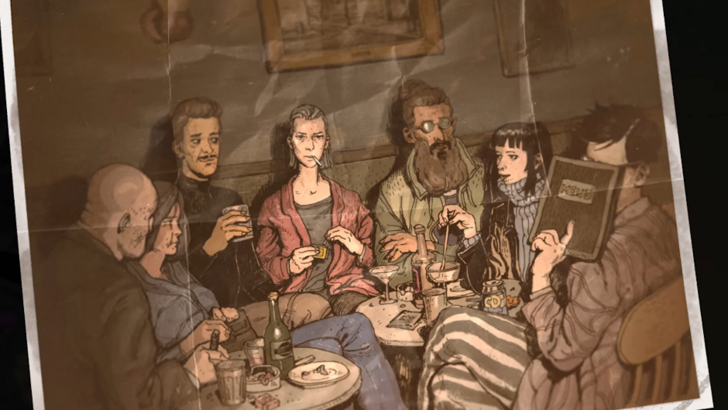
Hershel Wilk, aka Cascade, is a "brilliant" operative for the Operant Bureau. That, however, was before a mission went catastrophically wrong, resulting to bureau literally freezing her. She wakes up five years later, thawed into disgrace, pulled back into service because the bureau has a job for her in Portofiro, a decaying port city trapped in a political chokehold. Success here might buy back her ruined reputation.
However, the operation falls apart before it even begins. Hershel wakes up in an apartment with only fragments of what she is supposed to be doing. Psuedopod, her contact and partner, lies unresponsive across the room. She then is completely alone, left to piece the mission together by herself, while the bureaucrats back home watch her with chagrin.
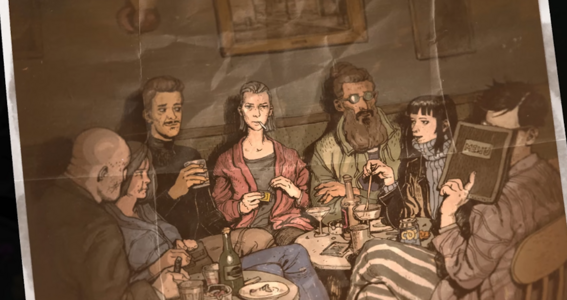
To say much more would ruin the best part of the game. Zero Parades is entirely at the mercy of its world and its plot. Much of it is about a broken person trying to rebuild a shattered network. To survive, Hershel has to find the surviving members of her old team, a group known as the Whole Sick Crew. Because this is spy fiction, nothing is ever that simple. You spend hours sorting through clues just to understand what your actual assignment is. You constantly question who you can trust, and more importantly, you question how much of Hershel’s own mind and memory you can rely on.
The backdrop of this paranoia is Portofiro itself. It is a dense city built on layers of economic collapse and failed political ideas. Below the quiet streets, different factions fight a cold war for ideological control. On one side is the communist Superbloc. On the other is the Illuminated Empire. It is a techno-fascist state, the remnant of a colonial empire trying to claw back its old power by winning a war of cultural dominance.
Portofiro deserves enormous credit. Exploration rarely revolves around clearing objectives off a checklist. Instead, the city feels like a massive web of political relationships, rumors, debts, propaganda, and personal history waiting to be untangled. I spent huge portions of the game simply talking to people, revisiting districts, following loose conversational threads, and realizing hours later that some seemingly meaningless interaction had unlocked an entirely different route through a mission.
Information is the real currency here, and Zero Parades understands how satisfying it can feel when scattered details suddenly connect together.
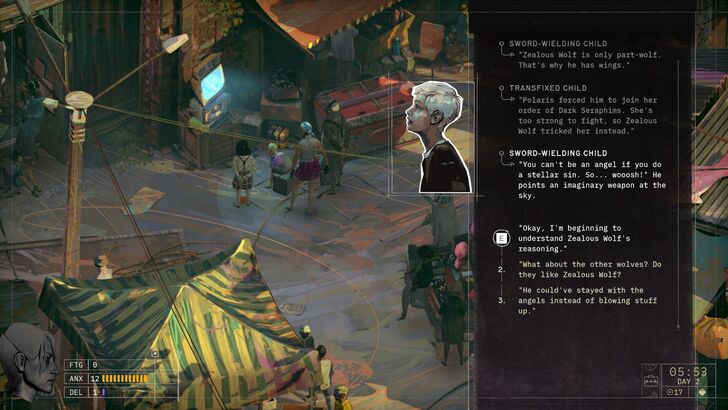
That being said, the game absolutely demands your patience. This is not an RPG you casually breeze through while half-paying attention. Conversations are long, politically dense, and often emotionally exhausting. Characters regularly drift into discussions about ideology with very little simplification. I loved that density most of the time, but there were stretches where the pacing became suffocating, especially during slower sections that buried important details beneath layers of political tangents.
Thankfully, the weight of this reading is balanced by the acting. When a character talks about what happened years ago, you can hear the smoke and the gravel in their throat. Almost every line in the game is voiced, and the actors deliver these heavy lines with skill.
Your Stress Levels Are at the Mercy of Dice Rolls
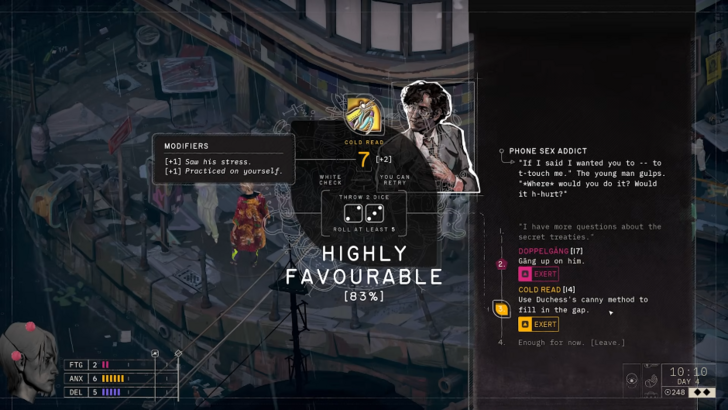
As I try to understand Portofiro’s political geography, figure out who to trust, and piece together exactly what happened to Pseudopod, the game throws an absurd distraction in my path. At a telephone booth on the far edge of town, I find myself watching a Phone Sex Addict completely ignore me, his blood visibly boiling in both of his heads as he sweet-talks his pretend lover in front of me. The game presents me a choice: let him be, or shove him out of the booth. Backed by an 80% success rate, I followed my Instincts and went for the shove. I actually failed the roll, but it did the job anyway, dislodging him from the phone. Hershel’s internal voices, however, come out disappointed. Nonetheless, it is easily one of the funniest sequences in the game.
Zero Parades is a dice-driven CRPG built almost entirely around conversations, skill checks, and roleplaying, but it pushes those systems far. There is no combat here, at least not in the traditional sense. Instead, every conversation is a negotiation between espionage tradecraft and Hershel’s very own emotional collapse. The game treats social interaction itself as combat, where a badly timed lie or a sudden spike in Anxiety can destroy an operation faster than a gunshot.
Instead of choosing a class, I shaped Hershel through different psychological faculties and conditions that influenced how she interpreted the world. My version of Cascade leaned into Relation and Instinct skills because I wanted a spy who could emotionally read people and survive through improvisation rather than know random facts about the city. That sounded smart until the game repeatedly forced me into situations where Technoflex checks stood between me and carrying my own firearm.
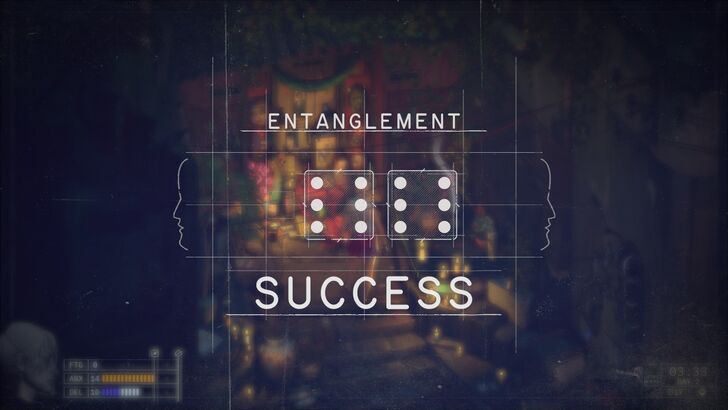
Skill checks in Zero Parades adds several systems that make every roll feel dangerous. During important moments, I could exert myself to add extra dice to a check, pushing Hershel beyond her limits for a better chance at success. The catch is that exertion increases Fatigue, Anxiety, and Delirium, the game’s three constantly looming psychological condition meters. Failure to keep these in check results in the lowering of one of her 15 skills necessary to succeed checks comfortably.
As a result, I would search Portofiro for a discarded beer or a neglected cigarette to keep these three stats in check. I usually save exertions for red checks, since you only get one attempt at them. White checks, however, can be retried after a few hours or once you level up the required skill.
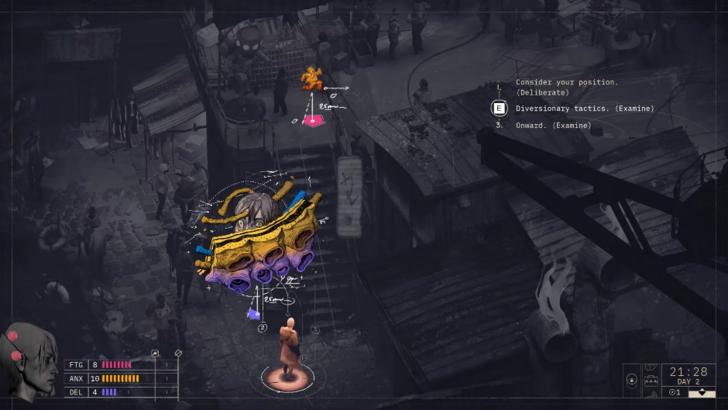
There are far more intense segments, however, that involve chains escalating dice checks during moments of crisis. One sequence had me navigating surveillance through a crowded district while desperately trying to maintain a disguise under pressure. The game slows down, music intensifies, internal voices begin calculating the best routes, and suddenly dialogue choices feel suffocating. They are some of the most tense RPG sequences I have played in years precisely because there is no easy way out of a bad dice roll, and I refuse to save-scum my way out of a tough situation.
Condition Cascade to Make Her Your Own
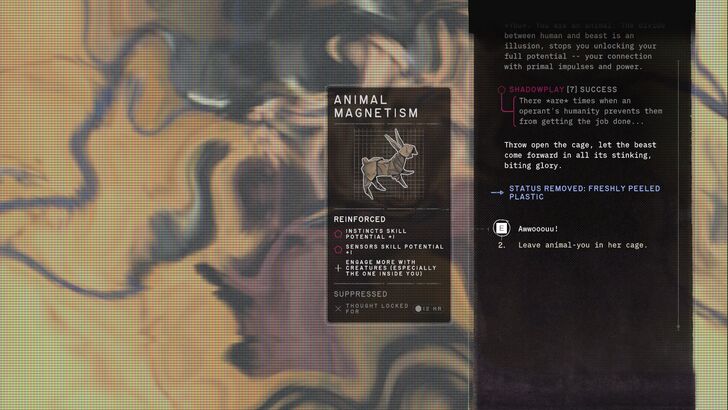
Tensions become even stronger through Conditioning. Instead of simply equipping passive bonuses, Hershel gradually internalizes ideas, coping mechanisms, political beliefs, behavioral patterns—thoughts that reshape both mechanics and roleplaying. Some Conditions helped me manipulate people more effectively. Others made Hershel more unstable over time, like replacing the word "kill" for "Wang." They give Hershel a significant boost in skills, but the payoff is an Action Disadvantage for said skills if you violate the rules governed by these thoughts.
For example, one early game thought you’ll encounter involves "the animal inside you." It increases two of Hershel’s skills while letting her "engage more with creatures." You get all these benefits as long as you do not hurt a single animal while you have it equipped. There are others with similar and whackier conditions, and I love how you have to ask whether the mechanical advantages were worth the changes in dialogue choices.
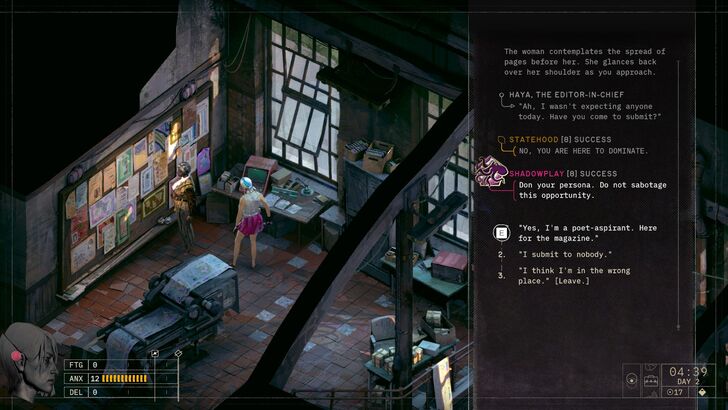
Over time, I grew attached to the version of Hershel I accidentally created by just exploring. Early on, I treated the Conditioning system like another RPG optimization tree, slotting in ideas and behavioral quirks mostly because the bonuses sounded useful. But somewhere along the way, those choices stopped feeling mechanical. Hershel gradually became this exhausted operative who coped with pressure through nicotine and alcohol and increasingly reckless improvisation because that was the direction I kept nudging her toward. Even when better Conditions became available later, I rarely swapped them out because the messier build felt honest to the character I had shaped. Hell, you can even make Hershel sound annoyingly Gen Z if you want.
That’s what’s so amazing with something like Zero Parades. Players who enjoy roleplaying can treat Conditioning as a reflection of Hershel’s evolving mental state, while min-maxers can absolutely break the game wide open by building around specific synergies between Conditions, skills, substances, and stress management.
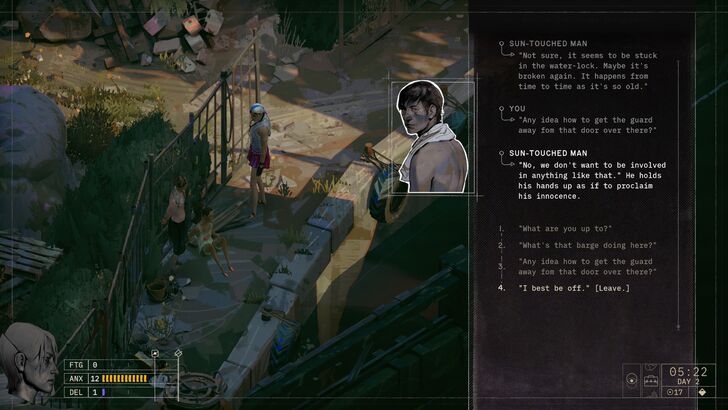
This gameplay loop, though, is heavily dependent on how much you enjoy reading and listening. Even with the excellent voice acting, Zero Parades is still fundamentally a game about dialogue and interpretation. Players hoping for elaborate stealth systems or more traditional espionage mechanics may find the structure repetitive after long sessions. The abundance of reading is thematically appropriate, but it also means the game has fewer ways to naturally vary pacing.
Is Zero Parades: For Dead Spies Worth It?
Yes, Even With the Enormous Shadow Ahead of It
Zero Parades will never have the luxury of simply existing in its own terms due to the shadow it’s chasing. And yet, after several hours of wandering through Portofiro’s collapsing districts and slowly shaping Hershel Wilk into a barely functional catastrophe of my own design, I came away amazed by what the team at ZA/UM accomplished here. The game wears its influences openly, sometimes almost dangerously so, but it also knows how these systems resonated with people and succeeds at transforming those ideas into something uniquely its own.
$40 isn’t a pocket change, but it’s still cheaper than most big-budget games today. It’s a reasonable price for 30 hours of playtime, especially if you explore Portofiro and aspire for all endings. It can get tiring because of how much you have to read and absorb all at once, I would gladly go through another run with Hershel and her crew. More than anything, though, I am just glad I got to experience another RPG willing to be this strange and this unapologetically human.
Portofiro is a city full of ghosts, and Zero Parades spends dozens of hours asking whether people can truly survive the ruins they leave behind. Sometimes the answer is ugly. Sometimes it is quietly hopeful. But long after I left Hershel Wilk behind, I still found myself thinking about exhausted spies chasing impossible redemption beneath neon lights and collapsing ideologies, searching for meaning in a world already convinced they have failed.
Zero Parades: For Dead Spies FAQ
How Long to Beat Zero Parades: For Dead Spies?
Zero Parades: For Dead Spies takes about 25-30 hours to complete. It is possible for completionists, however, to double that playtime by snooping around.
Game8 Reviews