

TOJIBO is a two-player-only 2D platformer where a robot duo must carry and toss each other all the way to the top. Read our review to see what it did well, what it didn't do well, and if it's worth buying.
TOJIBO Review Overview
What is TOJIBO?
TOJIBO is a two-player-only 2D platformer developed by Vermeil Soft. Taking on the role of the robots, T0J1 and J1B0, players must navigate through various levels, solving puzzles by carrying and tossing objects and each other around. Stages have various gimmicks designed to test players’ teamwork and reflexes, like carrying a giant Dodo Bird’s egg or floating with spinning turbines.
TOJIBO features:
⚫︎ More Than 15+ Stages
⚫︎ Couch and Online Co-op
⚫︎ Pixel Art Style
⚫︎ Native Controller Support
| Digital Storefronts | ||
|---|---|---|
 Steam Steam |
||
| $4.99 |
TOJIBO Review: Two Robots, Twice the Fun
Co-Op Is Alive
I still vividly remember the nights when my dad and I would play Mario games when I was a kid. A session would go like this: I’d watch his playthrough of a level, learn from both his mistakes and triumphs, think I’d do it better than he did, and finally try it myself after.
So when I saw TOJIBO, I immediately jumped at the chance to cover it. A part of my gut whispered that the box-shaped protagonists looked a bit like the one from HAL Laboratory’s BoxBoy!, which had you solve a bunch of box-shaped puzzles with your box-shaped powers. Having dedicated so many hours to those games and Pushmo, and feeling disappointed that there hasn’t been one like it yet, I thought I’d be trying out a spiritual successor.
Within the first few minutes, I realized how wrong I was for coming in with all these expectations: TOJIBO played nothing like BoxBoy! In fact, in a lot of ways, it’s its complete opposite. Levels are long, the difficulty curve is shaped like a cliff, and new gimmicks are thrown at you at a faster pace. Sure, it had the quiet atmosphere down to a tee, but playing through it requires a lot of patience.
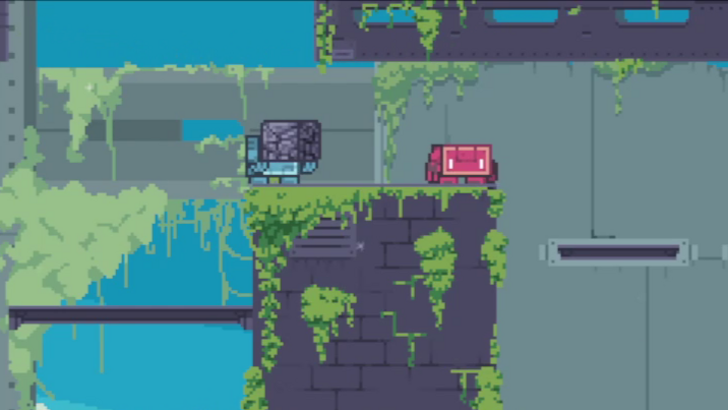
Despite my initial disappointment–one that I admittedly imposed on myself–I quickly got over it when we just kept playing. The more we played, the more I began to go back to those early Mario sessions I had with my dad. We would find a puzzle, debate how we’d solve it, test it, and if it fails? We start over.
And as we sank deeper, we eventually found ourselves captivated by TOJIBO, often playing it beyond our work hours just because we couldn’t give up on cracking the next puzzle. After all the hours, sweat, and chaotic squabbling, TOJIBO might’ve just proved itself as a worthy addition to the genre.
A Journey to the Endless Sky
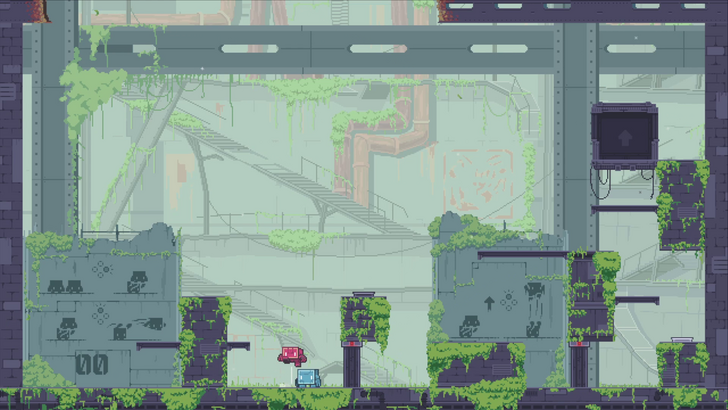
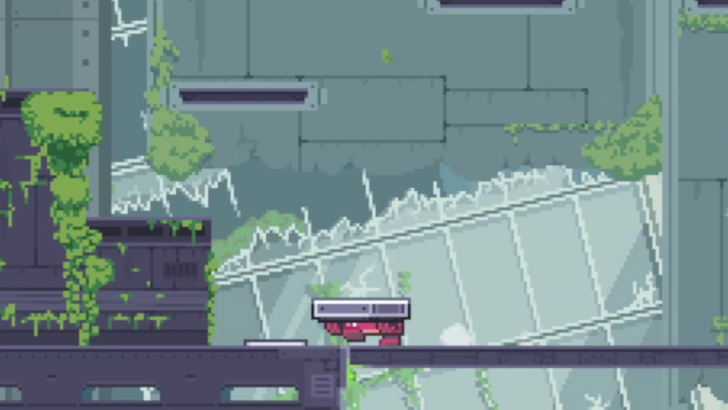
TOJIBO opened with two robot friends, T0J1 and J1B0, entering a building overtaken by rust and vegetation. With nothing but the mishmash of construction pipes, crumbled walls, and the platforms before us to go on, we pressed on. Eventually, the rows of buildings and steel plates began to recede, giving way to a blue sky adorned with tall clouds drifting over a land that had long forgotten civilization.
As we lost ourselves in the stages’ various puzzles, the slow reveal of this lush and isolated landscape only left us confused over why two fragile robots are trying to reach this tower’s summit. What happened to humanity? Are they trying to subdue a threat? These questions slowly poked at me as we continued to brave the traps and fish for clues, but these threads led nowhere.
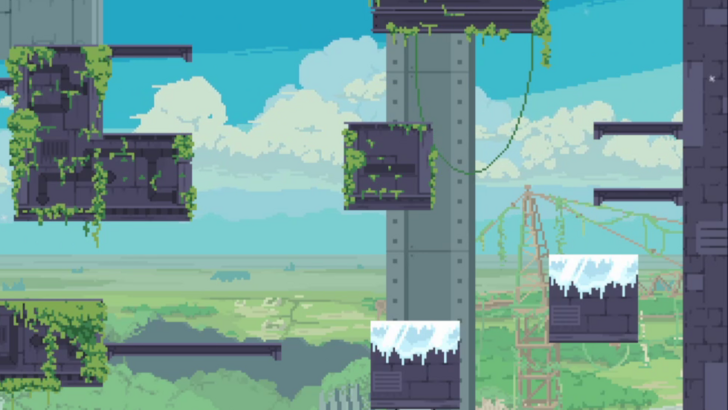
And so, as these mysteries began to dwindle from my mind and I began to hone in on simply getting through to the levels, I realized that the heart of the story isn’t so complex as I initially tried to piece together: T0J1 and J1B0 are truly alone in this world, and they only have each other to get through it.
TOJIBO may not have a lot of twists and turns or an exciting lore hiding underneath its cozy exterior. It is quiet. And perhaps its narrative, if it ever had one, had always been about two robots who formed a bond of trust… by throwing each other around.
Sticks and Stones May Break My Bones, But Throwing Me Around Won’t
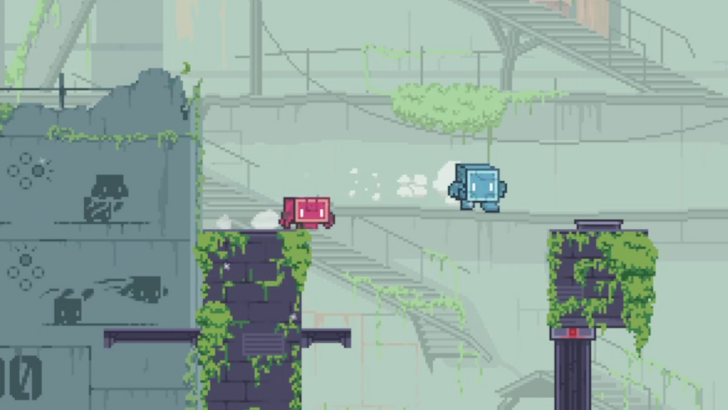
TOJIBO takes its simple movement and thrusts it into this crescendo of challenges. While they can be exasperating, it never feels like you’re in a race against time. It succeeds in inviting two minds to work together and patiently waits for them to finish at their own pace.
Movement is simple and predictable by design. You will always be moving forward and backward, jumping up and down, all at a set speed or distance. The limitations of this moveset breed coordination: if you can’t reach a high ledge, your friend will throw you up; if your friend can’t jump because they’re carrying something, you throw them across.
Simplicity works. And it works well for TOJIBO, where you need the movement to just be tight, intuitive, and predictable. Rather than master a complex set of moves, you’re given a lot of room to practice coordinating and communicating with your friend instead. It’s satisfying watching ourselves go from thirty seconds trying to toss an egg to another platform, to only needing five seconds to get it there later on.
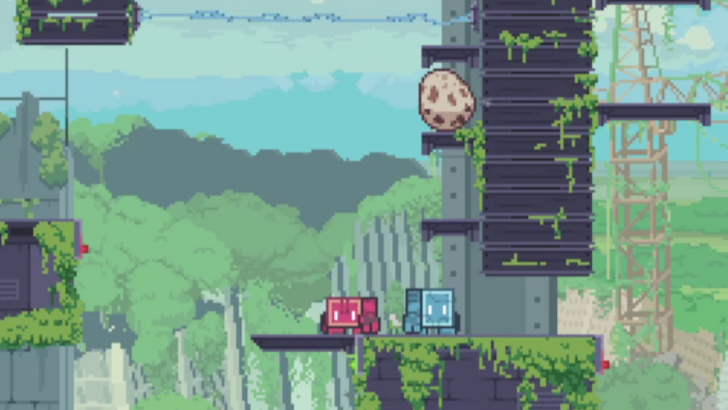
With that said, the controls could use some tweaking and a few options to make the gameplay feel better. The default mapped controls feel a bit awkward, especially the carry and toss buttons, which are so close to each other that it’s easy to confuse one with the other. If you’re not careful, you can even hold a self-destruct button by accident.
Because the UI is unobtrusive by design, you’re never reminded what actions are bound to your buttons, which led to a lot of mispresses even further into the game’s higher levels, making accidental throws and unfair level restarts common. Adding the option to remap these buttons or momentarily display an action list by holding a button could help keep gameplay smooth.
Gimmicks Can Make or Break Fun Levels
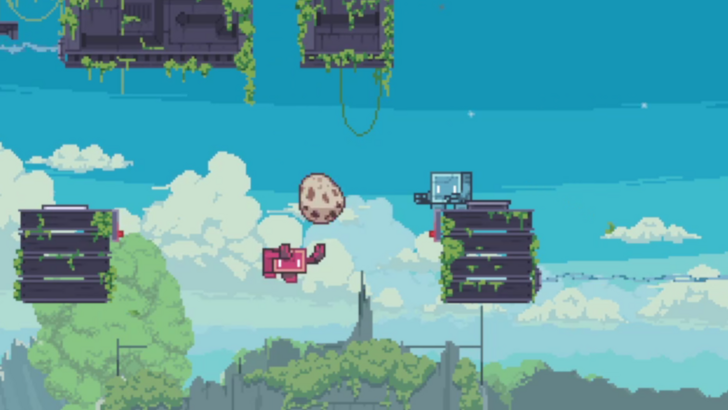
Neither T0J1 nor J1B0 will receive any sort of upgrades throughout the game; rather, every other level will introduce new gimmicks that force players to change their approach to puzzles with the same set of moves. This loop of adapting the moveset to new scenarios keeps each level from going stale, while not overcomplicating the game’s ritual of carrying, tossing, and jumping.
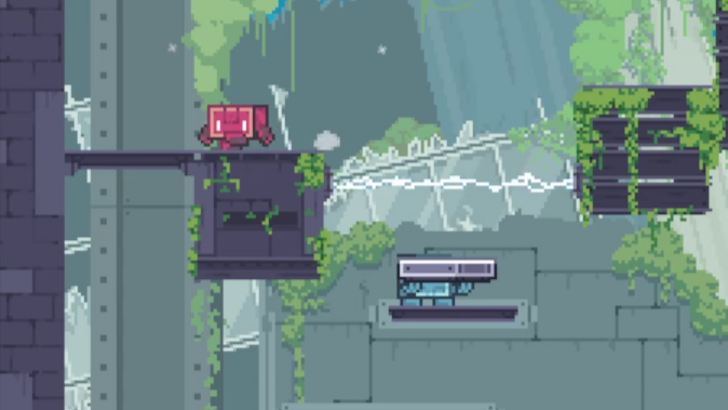
Most levels will start by plopping a mechanic in front of you. When we entered Level 5, we immediately faced an electric fence that burned us into a pile of scraps. After a series of frenzied panic and a few insults thrown about each other’s mothers, we found that we just had to throw this piece of metal over to the other side. By pressing a button, it will temporarily launch up in the air, which we can use as a stepping stone to reach a switch to turn the fence off.
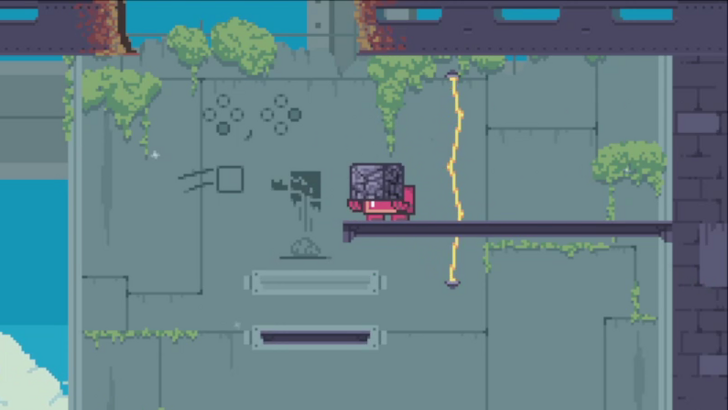
Because of how deeply integrated they are into each level, gimmicks like the electric fence dictate their flow—for better or worse. Despite how aggrieved I sounded describing Level 5, these early-stage gimmicks organically built on top of each other while still relying on the foundation it built using its simple movement system, making for some fun platforming sections.
That’s why it’s baffling that later stages would suddenly introduce brutally difficult gimmicks that make this moveset we spent the entire game mastering feel so frustratingly erratic. One of the worst offenders of this is Level 12: T0J1 and J1B0 are now magnetically pulled to each other and have to jump across icy platforms. All of a sudden, jumps are now floaty and unpredictable because we have to worry about our gravitational pulls while trying to gauge our acceleration when we’re walking on ice; Lag becomes an instant reset because if one falls, the other does too. It feels like we were playing a different game… and it does not feel good.
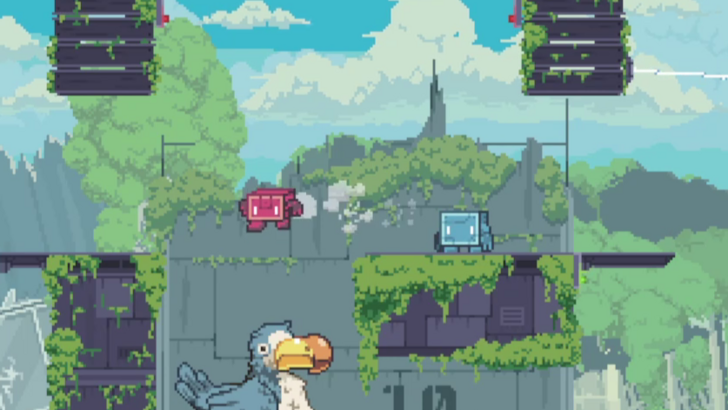
Certain gimmicks will also need some sort of accident to happen before you figure them out. Eggs, when thrown anywhere, instantly break, so another person has to wait on the other side to catch it… except when they’re thrown up, and the distance from the peak of the throw and the surface it lands on is short. There was no way we’d have figured this out, so when this supposed "eureka" moment happened, we just felt cheated from figuring out the solution.
This is further exacerbated by the fact that there are no mid-level save points in TOJIBO. While early levels, and Level 11 specifically, took us 5-10 minutes to finish, finishing later levels became a 20 to 50-minute affair just because failing to time your jumps or throws can cause you to fall to an earlier platform or, worse, at the start of the level.
Impressive Pixel Art, Not A Ton of Variety
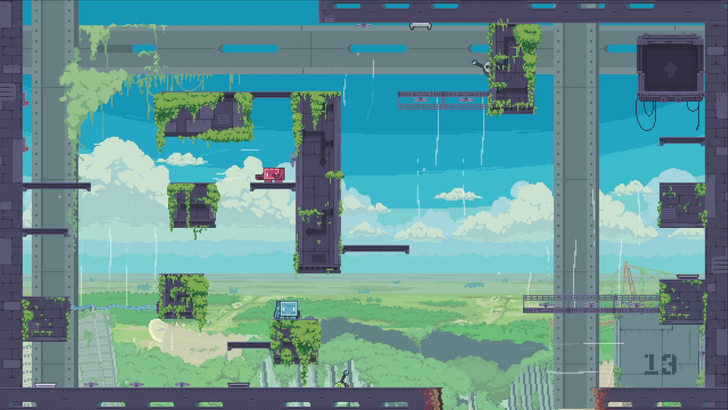
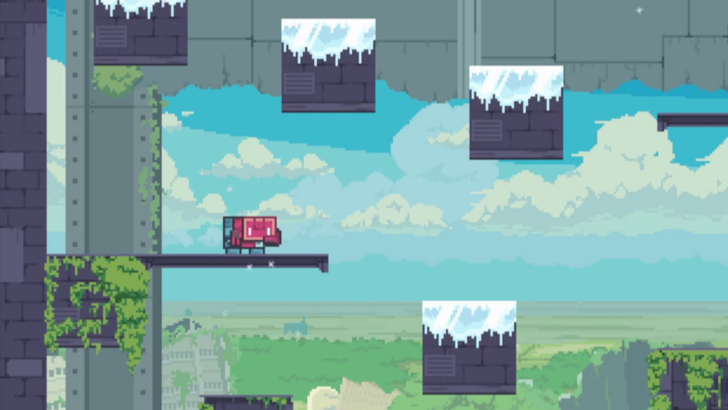
Visually, TOJIBO has one of the most atmospheric and adorable-looking pixel art styles that I’ve come across in video games.
Levels have a pleasing pastel palette, often portraying concrete scaffoldings slowly being embraced by flora and fauna, and a backdrop that offers a glimpse into the outside world, showing industrial complexes at first before giving way to the open sky. I often felt that I was in a total state of zen, even in the game’s brutally frustrating sections, because the environment didn’t make it feel like a race against time.
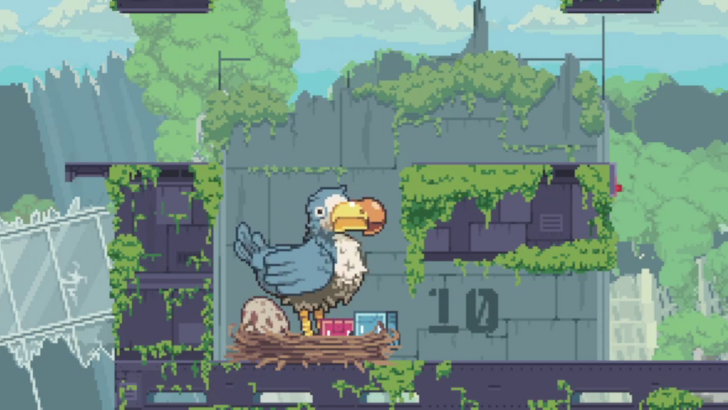
TOJIBO’s pixel artist, Haykira, also wasn’t afraid to flex some of their animation skills when it came to the characters. One that I visually love is the Dodo Bird, with its subtle breathing, its quick head turns, and its vacant eyes that occasionally blinked: it quickly won me over.
As the levels went on, however, the environments did start to feel a bit repetitive. The game used the same concrete and vegetation tileset even well beyond the 15th level, making it hard to feel that you’ve progressed at all. Even just reskinning this tileset with a different hue after Level 10 or so could’ve given the stages a more distinct identity from each other. It would be more visually interesting if these perspectives revealed a few objects of interest or showed the hue of the sky progressively crawling into different times of the day, for example.
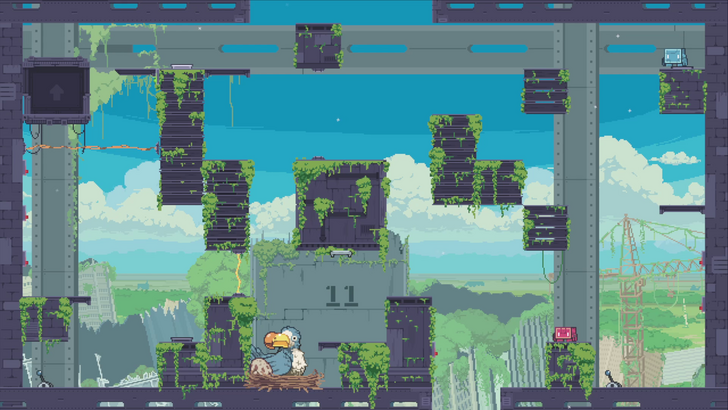
On the more technical side, TOJIBO’s version 1.0.3 has a display issue, forcing the game to only a certain resolution and moving a portion of the bottom of the screen out of view. For our playthrough, it only obscured half of the floor height, so it didn’t stop us from progressing. Moreover, it seems like a minor issue that I don’t doubt the developers would be able to fix in a later patch.
Perfect Track, But Needs More Songs
I was quite pleased with how the soundtrack easily receded into the background. It kept the game’s focus on the levels while adhering to the same zen quality the visuals established.
More attention is given to the audio of T0J1 and J1B0’s sweeping footsteps, their snappy carrying and tossing audio cues, or to the sounds of the environmental gimmicks like electric fences or spinning turbines. From a gameplay standpoint, these all should be mechanically enough for a game like TOJIBO, where you would want the audio to be clear and tactile.
However, it also falls into the same trap as the visuals of being boringly repetitive. Except this time, it’s even more extreme: TOJIBO only has one song—not one song with different variants, it’s just… one song, a piano track on loop. Don’t get me wrong, though, it’s perfect for the assignment it’s trying to fulfill. It’s soft and mellow, and has a ton of melodic variety, and honestly, it didn’t even ruin our experience at all.
With that said, using this one song, much like the lack of tileset variety, robs the game of its sense of progression. Level 13, even if the layout and gimmicks were different, didn’t feel any more different than Level 3, a monotony that the lone soundtrack magnifies. If we got at least one or two more songs, later stages would feel more exciting to reach.
Is TOJIBO Worth It?
Only If This Isn’t Your First Platformer
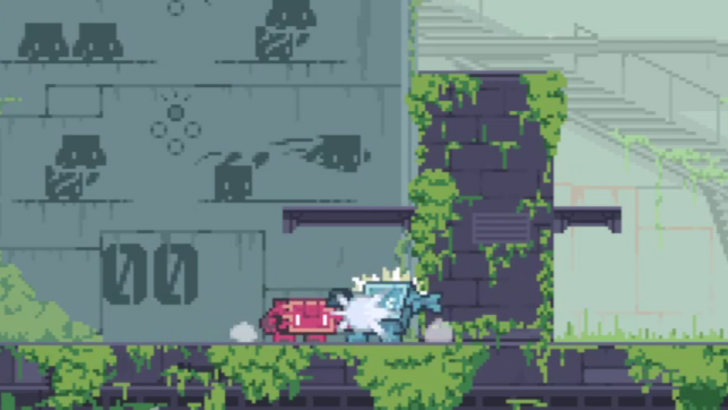
For all its faults, we had a fun time with TOJIBO. If the multiple occasions we decided to spend our after-work hours progressing through the game aren’t enough to show you we enjoyed it, I don’t know what will. Sure, stages are hardly replayable since puzzles mostly have just one solution, and frustratingly unpredictable gimmicks make speedrunning the game a slog. But at $4.99, it’s a solid deal for fans of the genre, with a decent amount of clever challenges and visually pleasing set pieces.
If this is your first platformer, however, don’t pick up this game, especially when it is nearly impossible for one person to carry you. Stages take a long time to get through, so unless you’re already something of a platforming master-in-training yourself, you might get burnt out by the time you reach Level 12. With that said, if you’re looking for a few hours of puzzle-solving fun with a friend, TOJIBO’s got you covered.
| Digital Storefronts | ||
|---|---|---|
| Steam |
||
| $4.99 |
TOJIBO FAQ
Does TOJIBO have local or online co-op functionality?
Yes. You can play with friends online or with a friend by connecting another controller.
Can you play TOJIBO in single player?
No. TOJIBO is designed to be played with two players.
Is TOJIBO a sequel?
No, TOJIBO is the first title developed by Vermeil Soft.
Does TOJIBO support other languages?
TOJIBO has English, French, Italian, German, Spanish, Japanese, Korean, Portuguese, and Simplified Chinese language support.
Game8 Reviews