




| Wuthering Waves | |||
|---|---|---|---|
| Release Date | Gameplay & Story | Pre-Register & Pre-Order | Review |
Wuthering Waves Version 3.5 Phase 1 story introduces the lands of Xuanfang as Rover attempts to find the missing Yangyang. Read our story review to see what it did well, what it didn't do well, and if its story is something to be remembered.
Wuthering Waves Review History
| Review | Date | Score |
|---|---|---|
| 3.0 ~ 3.3 Update | May 2026 | 
|
| 2.0 ~ 2.3 Update | April 2025 |
|
| 1.0 Release | May 2024 |  |
Overview
What is Wuthering Waves?
In Wuthering Waves, you take on the role of a mysterious newcomer simply known as the "Rover." Waking up without any memories or connections and in a world beset by creatures known as Tacet Discords, they must navigate the war-torn landscapes, underground factions, and roaming monsters to find the truth about themselves and the world.
After having wrapped up their business in Lahai-Roi, the Rover decides to drop by Jinzhou to unwind. However, they arrive to find Chixia heavily injured and in a comatose state while Yangyang herself had been reported missing for a few days. Determined to save their oldest and one of their most precious companions, the Rover ventures into the mysterious land of Xuanfang.
| Mobile App Store Pages | |||||
|---|---|---|---|---|---|
 App Store App Store |
 Google Play Google Play |
||||
| PC | |||||
 Epic Games Epic Games |
 Dedicated Client Dedicated Client |
 Steam Steam |
|||
| Consoles | |||||
 PlayStation PlayStation |
 Xbox Xbox |
||||
Wuthering Waves Story Review (3.5 Phase 1): Huanglong Finally Feels Like Home
Redeeming the Irredeemable

The first chapter of a new region has two equally important responsibilities: telling an engaging story and convincing the player that the region itself is worth caring about. That’s why when I first heard that we were going back to Huanglong for Wuthering Waves’ Version 3.5 main story, I immediately panicked. As most players know by experience (unless you skipped that part, you monster), Version 1.0’s Jinzhou hosted arguably the weakest introductory chapters in the game’s long-running narrative.
It wasn’t because the story itself lacked promise, nor because Jinzhou was an uninteresting setting. Rather, both were buried beneath an avalanche of lore dumps and dialogue walls that made it difficult to become invested in either before the game had already moved on.

This matters because a region's first chapter shapes how players perceive everything that follows. Its culture, history, and identity all build upon that initial impression. Ragunna’s Version 2.0 Phase 1, for example, struck an excellent balance by introducing compelling factions while making its landscapes and culture feel immediately worth caring about. Meanwhile, Septimont and Lahai-Roi were remembered more for their stories because their introductory chapters treated the regions as backdrops rather than living, breathing regions.
Fortunately, Wuthering Waves’ Version 3.5 Phase 1 is a return to the strengths of Version 2.0's opening chapter with a clear understanding of the responsibilities it has to an entire region. But on the other hand, it does fumble in trying to do too many things at once, leading to a narrative that, while deeply satisfying to see unravel, ultimately suffers from a fragmented structure.
WARNING: HEAVY SPOILERS FOR THE 3.5 PHASE 1 STORY BELOW
Xuanfang Justifies Its Existence
One of Version 3.5’s masterstrokes is that it doesn’t waste any time trying to ease you back into Huanglong. It respects the fact that you’ve already been there (unless, again, you skipped it, you monster) once, by immediately showing you what’s at stake. Story-wise, you return to Jinzhou for what should have been a short vacation, only to find the city blanketed by an almost suffocating sense of unease. Zhezhi quickly explains why: Chixia had been found unconscious and heavily injured, while Yangyang, who had gone out with the former, had been missing for a couple of days.
After meeting Jinhsi, Sanhua, Baizhi, Xiangli Yao, and Yangyang’s sister Suisui and discussing the events that transpired, you're thrown straight into Xuanfang at the height of its calamity. There, you discover with Suisui that the Autopuppets—Sentinel Hsin’s mechanical creations made to defend humans and suppress the Tacet Discords—have gone rogue. Communication lines have gone silent, every route into or out of the region has either been sealed or occupied, and much of the population has been forced to retreat into the last remaining safe haven: Xuanfang Hold.
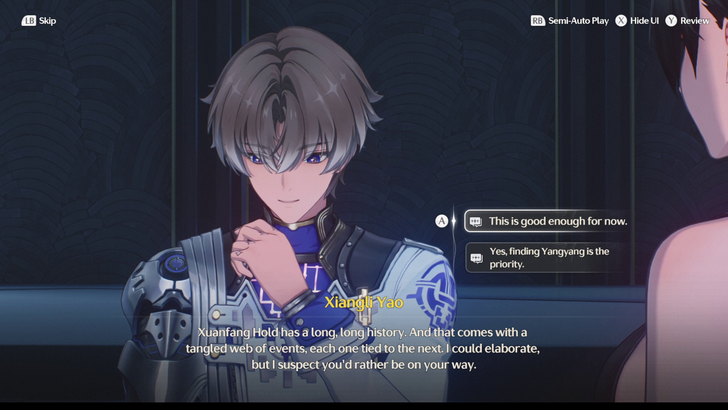
By the time you arrive, the story has already established a crisis that extends far beyond a single missing character. The very system Xuanfang’s security was built upon collapsed all at once, transforming what first appeared to be a rescue mission into a regional catastrophe. Even the dialogue reflects this newfound confidence in the player's ability to keep up. At one point early on, Xiangli Yao catches himself before launching into another lengthy explanation before Rover politely says that there are more important things to do—a brief jab that almost feels like Kuro Games acknowledging Version 1.0's notorious text bloat.
This also serves as the extension of a theme both Rinascita and Lahai-Roi explored to a lesser extent: what happens when the companions and tools you've always relied upon suddenly turn against you? Xuanfang pushes that idea to its extreme. Rather than depicting the regional failure of the system, such as Rinascita’s out of control echoes and Lahai-Roi’s mechs, it presents the collapse of an entire infrastructure. That is, when almost every machine designed to protect humanity suddenly turns on them, the region's way of life risks disappearing altogether.
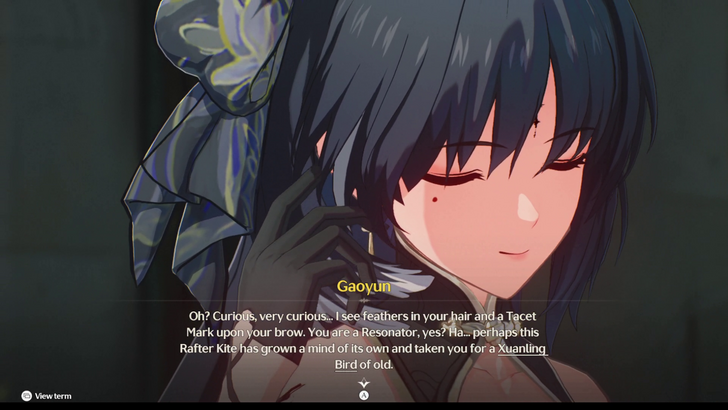
It ties in with how naturally Version 3.5 introduces Xuanfang through its people and history. Instead of simply throwing an avalanche of dialogue at you, the region is fleshed out through the stories, encounters, and events, slowly painting a complete picture of Xuanfang’s culture. The result is worldbuilding that feels like a natural consequence of the narrative instead of being shoehorned in.
Yangyang’s sudden entry into a localized Sonoro is perhaps the strongest example of this. The sequence simultaneously recounts the history of Xuanfang's Fortress and Gorges War, demonstrates how her original Resonance ability allows her to perceive lingering voices carried by the wind, and quietly lays the groundwork for her eventual second awakening. Instead of these ideas being introduced through a separate exposition, they reinforce one another within a single scene.
Jinzhou Starts to Become Real
Version 3.5's biggest accomplishment isn't introducing Xuanfang, however. Instead, it's finally making Jinzhou feel like a place worth talking about again. It does so by recontextualizing the relationships and story (or not if you skipped the story, you monster) that had been left dormant. That’s because after the problematic (terrible) reception of Version 1.0's story, the entire region was essentially sidelined by Kuro Games to allow Wuthering Waves to reinvent itself with Rinascita.
So yeah, we pretended for the majority of Wuthering Waves’ life that Jinzhou didn’t exist.
That difference becomes obvious when looking at how long each arc was allowed to breathe: aside from the Black Shores and Honami’s one-version stopovers, the greater Rinascita arc lasted for eight versions and Lahai-Roi lasted for five. Meanwhile, Jinzhou lasted only for three—and the last one felt more like an event that was promoted into a main story chapter than a true continuation or conclusion of Jinzhou's arc.
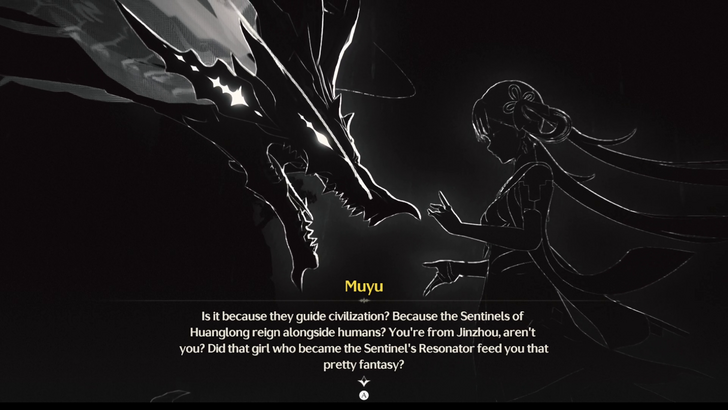
Anyway, Version 3.5 can be treated like a gift from the developers for those who stubbornly consumed Version 1.0’s story—though day one players really didn’t have a choice. Many of its developments derive their weight from relationships and events established years ago, rewarding players who remained invested despite Huanglong's impressive Houdini act.
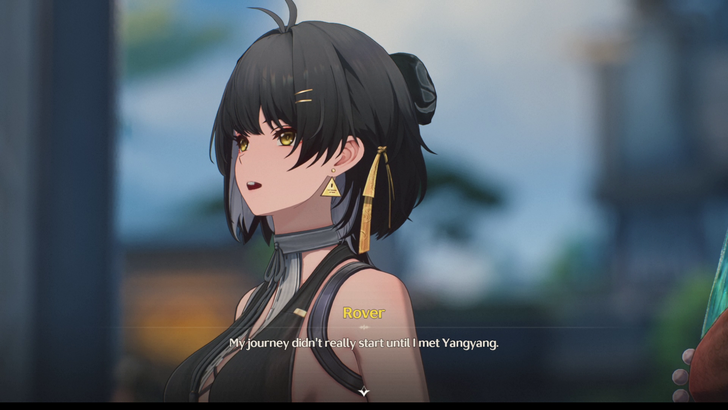
For example, players who stuck with Version 1.0 already knew Yangyang wasn't just Rover's penpal,
sending us developer surveys in the guise of heartfelt letters. After everything Lahai-Roi revealed about Rover's burden, Yangyang's unwavering trust is reframed and no longer feels like simple admiration. It becomes another reminder of just how much responsibility everyone keeps placing on Rover's shoulders.
The same applies to Jinhsi. On paper, the Magistrate personally risking herself when she fetched the key to Xuanfang’s gates to rescue Yangyang might seem excessive. But once you remember everything Jinzhou owes both Yangyang and Rover, the decision feels less like a dramatic reaction and more like the natural response of someone protecting one of her friends.
Of course, there are other instances, too. Yinlin, for example, gets fleshed out even more with a brief history of what happened to her previous organization. Chixia, Zhezhi, and Baizhi’s friendship is also given a more intimate depiction, showing how much the latter two care while the former remain bedridden. Version 3.5 excelled in providing a deferred narrative payoff for Jinzhou, even if we had to wait for over two years to get it.
Its Narrative Ambition Led to Fragmentation
As mentioned and explained above, the Xuanfang introductory chapter emulates Version 2.0’s balance in making you care for both the story and the region itself. Ironically enough, however, the very thing that makes it impressive is also what made it fumble.
Essentially, Version 3.5 tried to simultaneously tackle worldbuilding for Huanglong, develop Yangyang and Rover, introduce the overarching enemy, set up the intrigue with Hsin’s disappearance, foreshadow the Fractsidus’ involvement, and expand on old lore involving Jinzhou’s cast. In trying to do so, however, it cost the greater narrative the cohesion that Version 2.0 truly excelled at.
Take for example one of the main storylines of Version 3.5’s plot: Yangyang's second awakening. It's directly connected to, and can be considered the natural evolution of her resonance ability to hear voices carried by streams (you can just imagine it as the wind). Its development is connected to a subplot that involves Lingfang, the ancestor of a very important side character called Liangyu, which is then connected to an enshrined ceremonial blade Yangyang encountered after being rescued and nursed in a village.
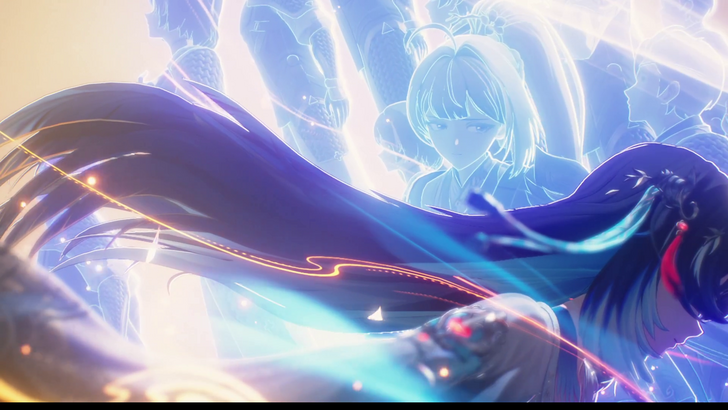
Meanwhile, we have the overarching conflict with Muyu, the dude who caused the Autopuppets to go on a rampage. His stint and grudge is connected to the history of Xuangfang itself, which is partly the fault of the missing Sentinel Hsin. And since Hsin cannot respond to the crisis at hand, she had to have Suisui deliver a fragment of her power to the Rover so that she could indirectly assist in battle.
Are Yangyang's second awakening and Muyu's invasion connected? Yes, of course. The problem is that they're only connected by a few fine threads instead of anything solid. Lingfang's frequency becoming twisted by Muyu's resonance ability, for example, is ultimately just collateral damage from the Fortress and Gorges War rather than a meaningful interaction between their storylines. Likewise, Rover receiving part of Hsin's power only partially overlaps with Yangyang's awakening because it functions more as Rover fulfilling their responsibility than as a narrative bridge between the two plots.
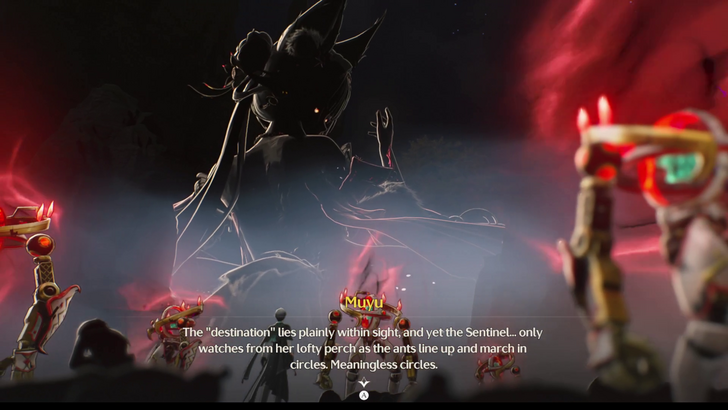
A solid connection between them is missing; a fact that for some reason was unironically evaded despite there already being a convenient way to do so.
See, Yangyang's original ability was supposed to have been an extremely desirable trait for Muyu, who twisted the frustrations of the frequencies he captured and jammed them into the Autopuppets in order to make them go out of control. Early on, he even expressed his desire to obtain her resonance to further his experiments. But then, just because Yangyang vehemently refused, he just abandons the possibility of capturing and squeezing her ability off of her because he had better things to do?
I didn’t know Muyu valued consent so much.
Even Yangyang's eventual role in defeating Muyu's massive construct suffers from this. Her newly awakened resonance conveniently counters his abilities, but because the story never firmly intertwines their arcs beforehand, the payoff feels more coincidental than inevitable.
Jinzhou Comes Home
So, where does that put us? Or rather, where does Version 3.5 ultimately land? Is it successful in making us care about Xuanfang? Absolutely. Did it manage to tell a compelling story? Ultimately, yes. But again, that does come with a very real caveat we have to acknowledge, despite the high overall quality of the result.
It obviously blows Version 1.0 out of the water; not that it’s a high bar to clear, honestly. It’s kind of bullying at this point. It’s also a fair bit better than the Phase 1s of both Versions 2.4 and 3.0 since those chapters blew most of their effort on storytelling and forgot about the region itself. However, Version 2.0 still reigns supreme when it comes to introducing their region. It’s simply too focused and balanced in doing so that Version 3.5 can’t compete with its juggling act.
But what this ultimately shows is that Kuro Games is learning, albeit slowly, from their mistakes. It pays off in dividends in Version 3.5 because it allows the widely mocked Jinzhou region a chance to rise from the dirt and smelly socks and stand on the stage once more, even if it has to do so behind Xuanfang. And that's ultimately Version 3.5's greatest achievement. It may not surpass Version 2.0 as Wuthering Waves' strongest regional introduction, but it accomplished something arguably more difficult: it made the game's most widely mocked opening chapter matter again.
Game8 Reviews

You may also like...
 |
Wuthering Waves Story Review [3.4 Lucilla Segue] | Glory to the Faceless Many RPG, Anime, Gacha |
 |
Wuthering Waves Story Review [3.4 Edgerunners Collab] | Still Scarring Us Years Later. Amazing. RPG, Anime, Gacha |
 |
Wuthering Waves Review (3.0 - 3.3) | Should You Play in 2026? RPG, Action, Gacha |
 |
Arknights: Endfield Review RPG, Anime, Gacha |
 |
Neverness to Everness Review | Good Mileage Expected RPG, Gacha |









Sheesh, this is a garbage review