



| Hell Let Loose Vietnam | |
|---|---|
| Release Date | Review |
Hell Let Loose: Vietnam is a new multiplayer shooter where players fight in large-scale military warfare. Read our review to see what it did well, what it didn't do well, and whether it's worth buying.
Overview
What is Hell Let Loose Vietnam?
Hell Let Loose: Vietnam is a multiplayer action shooter developed by Expression Games and published by Team17. It takes place during one of the most iconic battles in history, the Vietnam War.
Players are plunged into a 50v50 co-op battle and must work together to achieve victory as either the North Vietnamese Army or the US Armed Forces. With over 6 large-scale maps, 17 distinct battle roles, an array of weaponry, vehicles, and other resources, this new Hell Let Loose title offers a full-fledged war experience in the lush jungles and mountainous terrain of Vietnam.
Hell Let Loose Vietnam features:
⚫︎ 50v50 Multiplayer
⚫︎ 1950-1970 Vietnam Setting
⚫︎ Teamwork-Oriented Multiplayer Gameplay
⚫︎ 6 Large-Scale Maps
⚫︎ Multiple Roles and Specialties
⚫︎ Different Usable Vehicles and Transports
⚫︎ Variety of Game Modes
| Digital Storefronts | |||||||
|---|---|---|---|---|---|---|---|
 Steam Steam |
 Epic Games Epic Games |
 PS PS |
 Xbox Xbox |
||||
| $49.99 Standard Edition |
|||||||
Hell Let Loose Vietnam Review: Hell Needs to Let Loose a Little More
Hell Can Be A Lot Better Than This
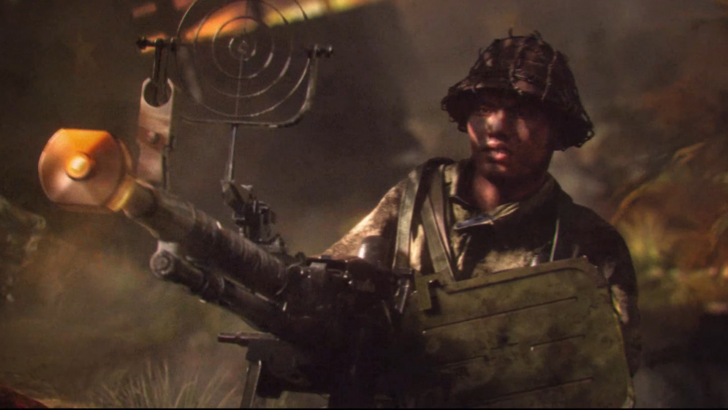
In the big 2026, there’s no shortage of multiplayer first-person shooters, but if you look even deeper, there are even more sub-genres that separate them from each other. You’ve got your tac-shooters like Counter-Strike, hero shooters like Overwatch, competitive arcade shooters like Call of Duty, extraction shooters like Marathon, and hardcore milsims like ARMA. But nothing, and I mean nothing, compares to the chaotic feel and grand scale of large-scale team-based shooters.
While the de facto representative of the sub-genre may be Battlefield, it has changed its formula so much that it can’t be considered a true
large-scale team-based game anymore, especially with its latest title favoring quicker gunplay and a more arcade-y feel. I would say the more apt representation of the sub-genre is 2021’s surprise hit Hell Let Loose, which just released its sequel today.
Hell Let Loose: Vietnam is a large-scale, squad-based 50 v 50 multiplayer shooter set during the 1955-1975 Vietnam War between the US Armed Forces and the North Vietnamese Army. The biggest feature that sets it apart from other titles in the same genre is its role-based system for massive battles, where players need to coordinate with their squads and Commander to dominate the battlefield.
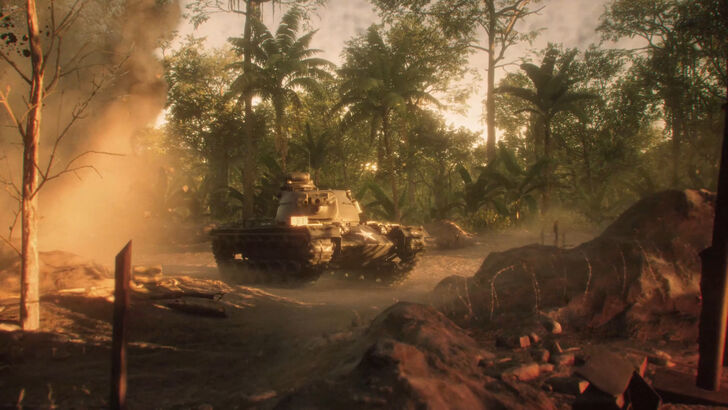
It’s more Hell Let Loose, keeping its core gameplay from 2021 while highlighting guerrilla warfare in the lush jungles and open wastelands across different parts of Vietnam. However, while the core gameplay remains fun, key issues and flaws across various elements prevent the game from reaching a higher standard. It’s still not a game for everyone, and a few games or two are enough to see if you’ll enjoy it or not.
In short, it has enough to be a good time with the right team and especially with friends, allowing you to let loose and get immersed in its large-scale battles, teamplay, and potential for role-play. But it has noticeable problems across the board that make it feel less than a proper sequel.
Teamwork and Role Play Make the Dream Work
The gameplay loop of Hell Let Loose: Vietnam is simple: two teams of 50 fight it out on different maps. These teams capture specific points across the map, eventually winning after either having the higher score at the end of the time limit or succeeding in capturing the enemy’s headquarters, depending on the game mode. So in terms of the core loop, it doesn’t seem all that different from any other large-scale squad-based shooter.
But that’s where the role-based "Chain of Command" system comes in.
Teams are divided into smaller squads, each consisting of Infantry, Armor, Recon, Mortar, and Helicopter (if you’re playing as the United States). These squads have specialized roles for each player, with players in an Infantry Unit able to serve as Riflemen, Medics, Specialists, Engineers, Machinegunners, and more.
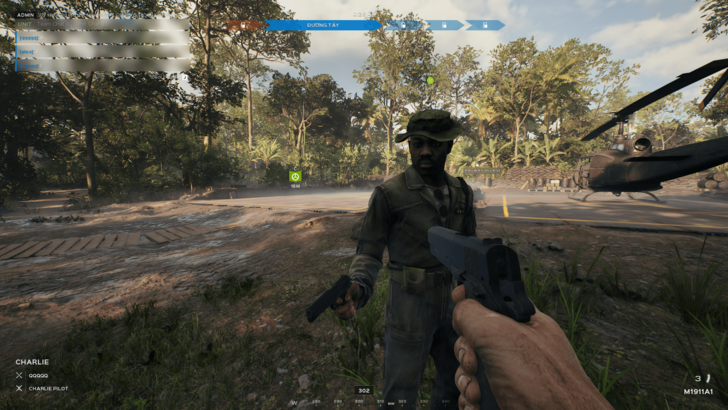
Some roles are much simpler to understand. Riflemen are primarily for straightforward infantry-based gunfights, while Engineers can construct Resource Nodes, Barricades, and Resupply Stations in friendly territory to provide resources to their team, reinforce specific areas, and repair friendly vehicles, respectively. This goes even further with Squad Leaders, as they can build Garrisons and Outposts to serve as temporary respawn points for their respective squads.
However, these roles pale in comparison to the team’s Commander.
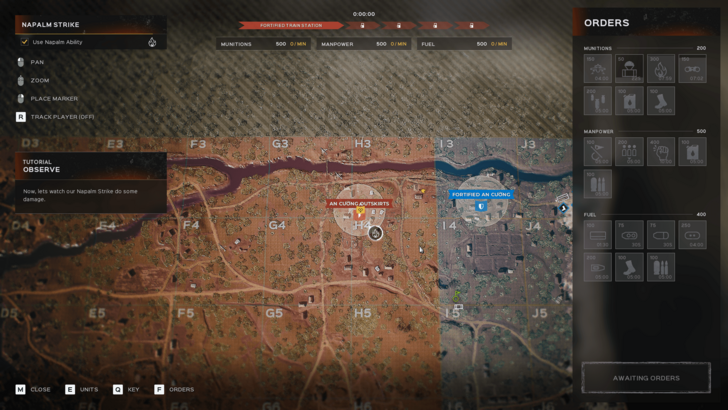
Serving as the team’s sole strategist, the Commander is responsible for directing the various squads to attack specific points with specific pings, and using what I like to call superpowers
by calling in recon planes for intel, ordering artillery runs to seize specific points, or reinforcing the team’s positions with supply drops for troops on the front lines. They are, without a doubt, the biggest influence on how each game goes, as they have the power to take over battlefields with the right calls and orders.
Of course, this also means that each team actually has to fulfill their roles. To make things clear, the game isn’t designed to be a one-man show. You (and maybe your squad) can go your own way and try to focus on kills, but if the numbers aren’t on your side, you’ll never be able to capture a point. Plus, given how it only takes 2-3 shots to kill someone, trying to play it like Call of Duty or even Battlefield is not advisable.
That being said, it’s often when you get immersed or get into character
that the game starts to be even more memorable. For context, some of the most memorable moments I had were playing as a Spotter on the two-man Recon squad, responsible for the busywork
of spotting enemies with their binoculars and creating mobile spawn points for their squad and team.
In one of these instances, the random Sniper I paired up with and I were entrenched on a hilltop overlooking a pivotal control point that our team needed to capture, or else we would lose the game. With clear communication on my end and amazing shooting from my partner, we successfully staved off a counter-attack from the enemy team, racking up about 9 confirmed kills from that one spot alone.
It even got to the point where the Sniper and I were out of ammo for us to continue our shooting spree, so we had to basically beg for ammunition and supplies from our Commander. Now, I don’t want to say we single-handedly won the game, but I’d like to think we made the game-winning play with all things considered.
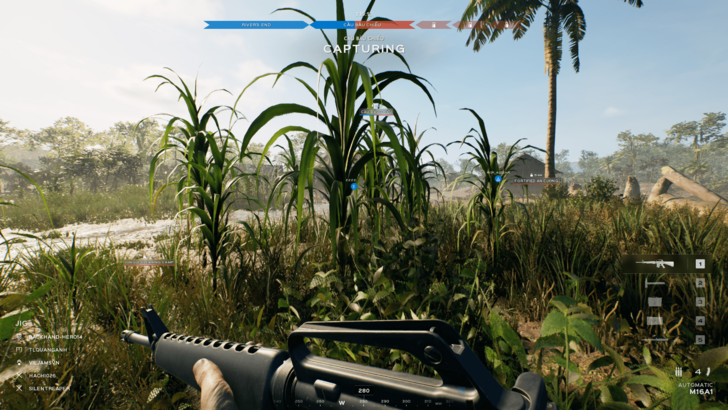
Personally, I found the gameplay loop quite fun, and the adjustment period of learning how to play your role and appreciating the game's slower pace is a novelty in itself. Additionally, the potential for role-playing is also amped up with this gameplay loop, as players have the freedom to really go in character. And that, quite frankly, is what makes the large-scale multiplayer experience potentially more memorable than any other multiplayer shooter.
However, there are issues in the game that are way too noticeable, and it can definitely affect the enjoyment of the game.
Gunplay, Progression, Match Flow, and Other Annoyances

One of the biggest requirements for a first-person shooter is to have satisfying gunplay, and unfortunately, that’s where the game falters. The starter guns (M16A1 for the US and Type 56 for the NVA) in the game for both teams are strong, actually too strong. For instance, the recoil for both of these guns is very easy to control, and since you only really need to hit 2-3 shots, this leads to firefights that don’t have much thought in them.
With the inherent design of Vietnam’s jungles pushing engagements into close-range firefights and guerrilla warfare, opponents would just camp in bushes and kill anyone on sight. Of course, it’s very easy to say that this is historically accurate to how the war played out, with both sides using natural cover in forests to win skirmishes.
The problem is that, in the context of a video game, it becomes quite hard to play against. The game doesn’t provide you with feedback on where you were shot from, so it becomes another issue of trying to find the enemy shooter to fight back against.
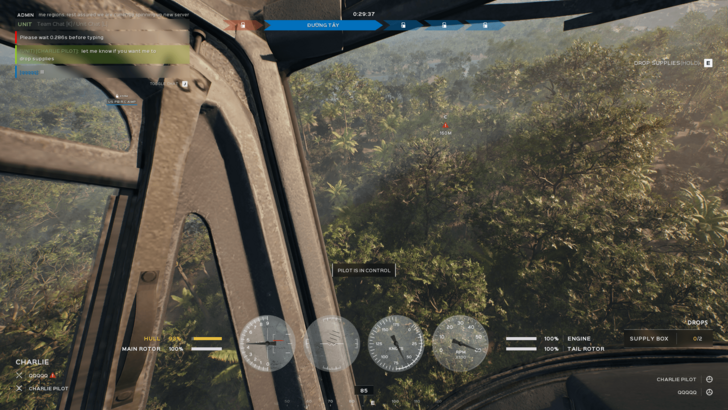
The easy way would be to relay the information to your Commander, and hopefully he orders an Armor team with a Tank or calls in Recon Planes or Artillery Strikes to flush out enemies in that particular area. However, the latter is readily available at the start of the game, as teams need to build up their resources and supplies before Commanders can actually use their superpowers.
But then there’s another problem: controller aim-assist. Ever since the introduction of cross-play and controller support, aim-assist in any PvP FPS game has consistently been one of the most polarizing topics in game design. In Hell Let Loose: Vietnam, the controller aim assist is noticeably potent, and, combined with guns that are easy to control, it makes it quite difficult to play against.
I know what you’re thinking: Why don’t you just turn off cross-play?
Well, I would if I had the option. All servers are forced to play with cross-play enabled, and while that’s great for matching up with the entire player base, console players have an inherent advantage because of how strong the aim assist is. Why don’t you just use a controller then?
Well, that’s not exactly a solution either. Not all PC players have a controller available, and that would just be fighting fire with fire.
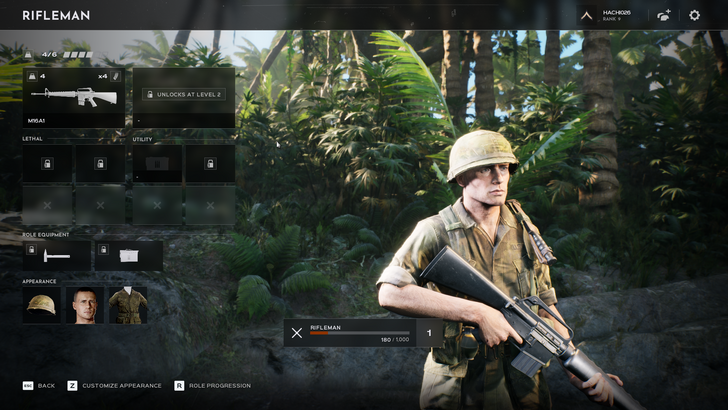
Which brings us to our next problem: the progression. It’s not wrong that it takes you quite a while to level up a class to gain new equipment, or in this case, new weapons. But, given how strong the starter weapons are for both teams, there’s not much reason to switch out of them.
There’s no nuance to using a submachine gun even if close-range firefights are the norm, since the starter rifles function just as well, if not better. This gimps the progression experience, as other than being able to access more equipment for some classes like grenades and other utility items for Riflemen, you don’t really have a reason to do so.

With all of these gunplay-related problems combined, matches can feel like a drag because of how matches usually go. Given that the respawn timers scale depending on how much activity there is in an area, players are forced to wait it out if they want to get into the action immediately. Conversely, players would instead spawn miles away from the point they’re supposed to be fighting for, even if it means they have to walk across the map just to get back.
It’s easy to blame this on a skill issue, as Commanders and Squad Leaders are responsible for creating spawn points, but it still feels bad to run all the way back or wait to respawn for a really long time just for it to happen again. And, trust me, no one likes doing that.
There are a couple of easy fixes to fix some of these problems, and I’m sure the developers are already hard at work looking for ways to balance them. Nonetheless, these are issues that affect the core experience and directly impact the game's design.
Optimization Could Be Better
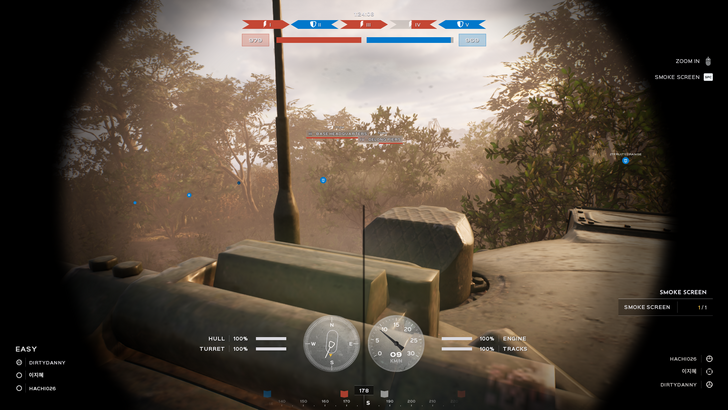
Large-scale multiplayer games tend to have varying levels of success in terms of game performance and server optimization. In Hell Let Loose: Vietnam, these could be much better.
It did take a bit of tuning, especially since there were a couple of frame drops and graphical anomalies at the start. With a mid-level rig using an RTX 3070, I was able to maintain a stable 60 fps at Medium to High settings with DLSS on. Sure, it’s not the optimal setting, as some might prefer to play it at higher graphical fidelity, but it seemed to reduce the frequency of stutters and artifacts.
But that doesn’t mean it’s excusable, as the game still tends to randomly crash on a whim. The more unfortunate problem is that these crashes aren’t problems that are easily solvable, as sometimes the error reports don’t exactly tell you why the game crashed. Hopefully, the developers can find a fix for it soon, as even if the crashes are fewer than in the game’s initial betas, they’re still frequent enough to be an annoyance.
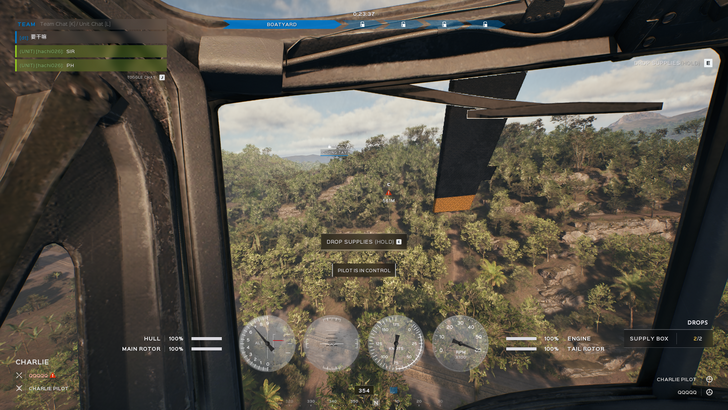
Another issue is the game’s Server Browser and the load times in general, as queuing to join a server can take a while and sometimes won't even allow you to join if you’re not a "VIP." For context, servers reserve a few slots for VIP players who are included in specific clans and other community servers.
This is more of a slight annoyance when compared to the performance issues, as you’ll most likely just be able to join a different server anyway. Thankfully, the developers have already stated that they’re investigating this particular issue, and it might not be a problem in the future.
With load times, though, this might be due to the game forcing cross-play, and I’ll give them credit where credit is due. Even servers with relatively high ping still feel playable and relatively smooth. If this is the price to pay for having a good connection, then the load times are definitely justifiable, at least for me.
Is Hell Let Loose Vietnam Worth It?
Wait For a Sale Or For More Content Updates

Hell Let Loose: Vietnam is fun at its core and, especially with friends, can offer some of the best experiences if you’re willing to immerse yourself. Given how quickly the developers have already been addressing some of the game's problems, it gives a bit of confidence that the game will get better over time. But right now, I can’t recommend buying it in its current state because it doesn’t feel much better than the previous game.
I’m sure those who enjoy large-scale FPS games will have a good time, regardless, but new players might not like the game’s design and deliberate slow pace. I will say, though, that the game is best enjoyed with a mic, so if you’re not the type of player to play these types of games, then you’ll probably not enjoy it as much as I did.
FAQ
Is There Single-Player Content in Hell Let Loose: Vietnam?
No. The game is primarily a multiplayer experience with a lengthy single-player tutorial to familiarize players with the game mechanics.
What are the System Requirements to Play Hell Let Loose Vietnam on Steam?
The System Requirements as listed on Steam are as follows:
| Specifications | Minimum | Recommended |
|---|---|---|
| OS | Windows 10 64-bit | Windows 11 64-bit |
| Processor | Intel Core i5-10600K / AMD Ryzen 5 3600X | Intel Core i5-12600K / AMD Ryzen 5 7600X |
| Memory | 16GB RAM | |
| Graphics | Nvidia RTX 2060 Super / AMD Radeon RX 6600 XT | Nvidia Geforce RTX 3060 Ti / AMD Radeon RX 6900 XT |
| Storage | 30GB | |
| Additional Specs | 1080p/60 fps TSR 71%/DLSS Ultra Performance | 1080p/60 fps TSR 100% High/DLSS Balanced |
Game8 Reviews














The price is wrong?